

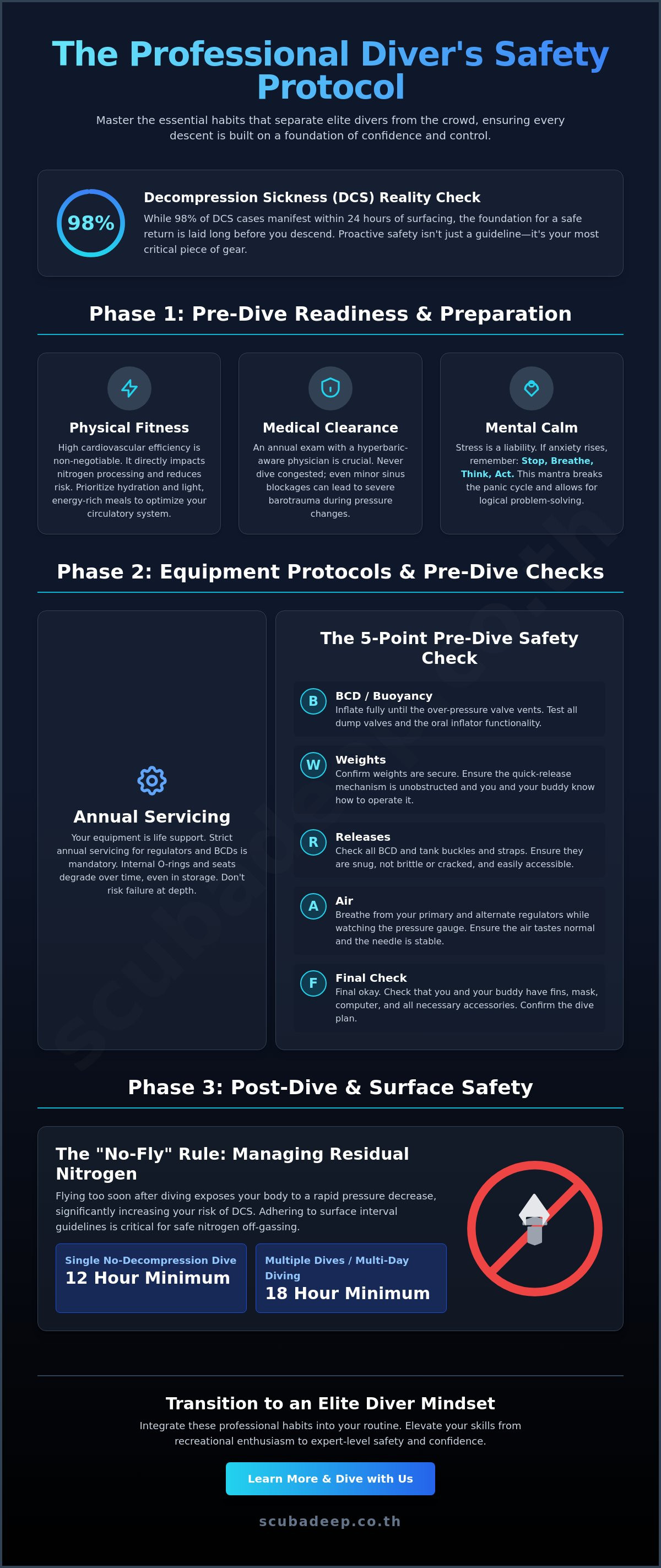
The difference between a breathtaking underwater adventure and a stressful emergency isn't just luck; it's the professional habits you build before your fins even touch the water. While 98% of decompression sickness cases manifest within 24 hours of surfacing, the foundation for a safe return is laid long before you descend. You likely already understand the fundamentals, yet the underlying fear of equipment failure or the persistent anxiety of monitoring your air supply can still cloud the excitement of a dive. Mastering a comprehensive set of scuba diving safety tips is the most effective way to replace that uncertainty with the calm confidence of an elite diver.
Continuing your education is the most effective way to sharpen your safety instincts. Professional training transforms you from a diver who simply follows instructions into one who can anticipate and mitigate risks. Whether you are learning to manage complex environments or refining your emergency response skills, each new certification adds a layer of redundant safety to your profile. If you are looking to advance your skills, you can find out more about Scuba Diving and PADI Certification Courses that focus on these essential safety protocols. This commitment to growth ensures that every descent is backed by the latest industry knowledge and technical proficiency.
We believe that safety is a sophisticated blend of technical expertise and a disciplined mindset. In this guide, you'll discover our ultimate professional checklist designed to mitigate risks and simplify complex decompression rules. From rigorous pre-dive inspections to the nuances of the buddy system, we'll provide the actionable protocols used by industry experts. You'll learn how to handle underwater situations with poise, ensuring your focus remains on the vibrant marine life and the hidden beauty of the deep. Let's explore the essential habits that will empower you to go further and dive deeper with total peace of mind.
Key Takeaways
- Learn why physical readiness and proactive risk management are the non-negotiable foundations of every professional dive plan.
- Discover the industry standards for maintaining your life-support equipment to ensure your regulator and BCD perform flawlessly at depth.
- Master essential scuba diving safety tips regarding buoyancy control and the buddy system to protect yourself and the delicate marine environment.
- Understand the physiological necessity of the "No-Fly" rule and how to safely manage nitrogen off-gassing long after you have surfaced.
- Transition from a recreational mindset to a safety-conscious professional by integrating continuous education and expert habits into your diving routine.
Essential Pre-Dive Preparation and Physical Readiness
Safety isn't just reacting to problems; it's the proactive management of your physiological state and the environment around you. Adhering to professional Diving safety standards ensures you aren't just prepared for the dive, but for any variables the ocean presents. These scuba diving safety tips start on land, long before you assemble your kit. True readiness requires a commitment to maintaining your body as carefully as you maintain your regulator.
High physical fitness is a prerequisite for safe underwater exploration. It isn't just about strength; it's about cardiovascular efficiency, which directly impacts how your body processes nitrogen. Proper nutrition and hydration play equally critical roles. Dehydration is a significant risk factor for decompression sickness because it reduces blood volume and slows gas exchange. Drink plenty of water and eat light, energy-rich meals to keep your circulatory system functioning optimally during your descent.
Professional divers often utilize a "Personal Minimums" checklist before every trip. This involves an honest assessment of your current fatigue levels, recent illnesses, and comfort with the predicted conditions. If you feel "off" or the environment exceeds your training, have the courage to call the dive. Integrating these scuba diving safety tips into your morning routine creates a safety-first culture that protects you and your buddy.
Assessing Your Medical and Physical Fitness
Diving places unique pressure on the body. Schedule an annual medical examination with a physician who understands hyperbaric medicine to ensure your heart and lungs are capable of the strain. Common contraindications like untreated asthma or cardiovascular concerns can become life-threatening in a high-pressure environment. Never dive while congested. Even minor sinus blockage can lead to serious barotrauma, causing painful ear or sinus injuries as pressure changes during your descent.
The Psychology of Safety: Mental Preparation
Stress is a dangerous element in the water. If you feel panic rising, use the professional mantra: Stop, Breathe, Think, Act. This simple sequence breaks the cycle of reactive panic and allows for logical problem-solving. Practice visualizing your skills, such as mask clearing or regulator recovery, while on the boat to build the muscle memory needed for high-stress moments. Maintaining a state of mental calm directly reduces your respiratory rate, which significantly extends your air consumption and bottom time.
Equipment Protocols: Managing Your Underwater Lifeline
Your equipment serves as your only lifeline in an alien, liquid environment. It isn't just luggage; it's life support. Professionals treat their gear with a level of respect that borders on the ritualistic because they know that even the most advanced technology requires human oversight. This means adhering to strict annual servicing for regulators and BCDs, regardless of how many dives you've logged. Over time, internal components like seats and O-rings can degrade, even when sitting in a gear bag. Regular maintenance ensures that when you need air at 30 meters, your regulator delivers it without hesitation.
Adopting a "Check, Double-Check" philosophy is one of the most vital scuba diving safety tips you can implement. Whether you own your kit or are using rental gear, you must verify every connection and seal personally. Never descend with a piece of equipment you don't fully understand. If you're unfamiliar with a specific integrated weight system or a new dive computer, ask for a professional briefing before you leave the boat. Following essential scuba diving rules regarding gear familiarity prevents confusion when you need to act quickly. If your equipment knowledge feels a bit dated, a professional Scuba Refresher Review is an excellent way to reacquaint yourself with modern standards.
The 5-Point Pre-Dive Safety Check
Consistency is the key to safety. Before every entry, run through this rigorous 5-point inspection with your buddy:
- BCD: Inflate the jacket until the over-pressure valve vents, then test all dump valves and the oral inflator.
- Weights: Confirm your weight belt or integrated pouches are secure and have a clear, unobstructed "quick release" path.
- Releases: Check all buckles and straps for proper tension and ensure they aren't brittle or cracked.
- Air: Breathe from both your primary and secondary regulators while watching your pressure gauge; the needle should remain steady.
- Final Inspection: Conduct a visual sweep for dangling hoses, tucked-in straps, and ensure your mask and fins are ready.
Maintenance and Inspection of Personal Gear
Salt is the primary enemy of dive longevity. Always rinse your gear in fresh water after every session, paying close attention to the regulator first stage and the internal bladder of your BCD. During your rinse, inspect your hoses for "bubbles" or cracks and check that your mouthpiece zip-ties are tight. Small details matter. Carrying a "Save-a-Dive" kit with spare O-rings, mask straps, and fin buckles can prevent a minor gear issue from ruining your entire day. These scuba diving safety tips ensure your equipment remains a reliable partner in your underwater explorations, much like how First Choice Plus Plumbing & Air ensures your home systems are serviced with precision to prevent unexpected failures.
In-Water Safety: Communication and Environment Management
Once you've crossed the threshold into the underwater world, safety transitions from preparation to active, real-time management. The buddy system serves as your most critical redundant safety layer. It isn't merely a rule; it's a professional partnership where each diver acts as the other's secondary life support. Expert scuba diving safety tips often focus on technical skills, but the ability to communicate effectively and maintain situational awareness is what truly separates an amateur from a professional. Stay close. Your buddy should never be more than a two-second swim away.
Professional air management requires more than just checking your gauge occasionally. You must calculate your "turn pressure" before the dive begins. To do this, subtract your desired surfacing reserve (typically 50 bar) from your starting pressure, then divide that number by two. If you start with 200 bar, your usable air is 150 bar, meaning you should turn back toward the exit point once you've consumed 75 bar. This disciplined approach ensures you always have enough gas for a slow, controlled ascent and a full safety stop.
Mastering Buoyancy and Ascent Rates
Buoyancy control is the primary skill for protecting both yourself and the delicate reef environment. It's a foundational concept taught during your entry-level scuba certification that requires constant refinement. Poor buoyancy often leads to rapid, uncontrolled ascents, which are the leading cause of lung overexpansion injuries. Use your dive computer to monitor your ascent speed religiously. Always perform a safety stop at 5 meters for 3 minutes. This pause is non-negotiable, as it allows your body to off-gas accumulated nitrogen safely before you reach the surface.
The Buddy System and Underwater Communication
Clear communication is vital when you can't speak. Review essential hand signals for air levels, "OK," and "Problem" with your partner before every entry to ensure there's no confusion at depth. If you happen to lose sight of your buddy, follow the standard professional protocol immediately. Search for one minute in a 360-degree circle. If you don't reunite within that sixty-second window, ascend safely and slowly to the surface to meet there. If you want to master these coordination skills in more challenging environments, our Advanced Open Water Course offers the perfect opportunity to level up your expertise. These scuba diving safety tips aren't just about preventing accidents; they're about creating a seamless, stress-free experience for every member of the team.
Post-Dive Safety and Continuous Education
Your dive doesn't end when you climb back onto the boat. While the underwater portion of your journey is complete, your body is still actively processing the nitrogen absorbed during your time at depth. The physiological "dive" continues for hours as your tissues gradually release residual gas. Integrating long-term scuba diving safety tips into your routine involves acknowledging this critical window for observation. For those looking to be prepared for any eventuality, completing a First Aid Course is a vital step for every serious diver.
Continuing your education is the most effective way to sharpen your safety instincts. Professional training transforms you from a diver who simply follows instructions into one who can anticipate and mitigate risks. Whether you are learning to manage complex environments or refining your emergency response skills, each new certification adds a layer of redundant safety to your profile. This commitment to growth ensures that every descent is backed by the latest industry knowledge and technical proficiency.
Surface Intervals and Recovery Protocols
Hydration remains your most effective tool for recovery. Drinking water after a dive is just as important as your pre-dive preparation because it assists your circulatory system in eliminating residual nitrogen. One of the most rigid safety protocols is the "No-Fly" rule. For multiple dives or consecutive days of diving, you must wait at least 18 to 24 hours before boarding a plane. The rapid drop in cabin pressure can cause nitrogen to expand into bubbles, leading to decompression sickness (DCS). Monitor yourself for symptoms like dull joint pain, unusual skin rashes, or extreme fatigue. If symptoms occur, the standard treatment is hyperbaric oxygen therapy, typically following the US Navy Treatment Table 6 protocol.
Advancing Your Safety Skills
Elite divers never stop learning. Transitioning from being self-aware to team-aware is a major milestone, and a Rescue Diver Course provides the skills to manage others in high-stress situations. You should also consider the safety advantages of using Enriched Air Nitrox. The higher oxygen content allows for more conservative dive profiles, reducing the amount of nitrogen your body absorbs. If you've been away from the water for six months or more, don't rely on memory alone. Engaging in regular scuba skills reviews ensures your reactions remain sharp and your safety knowledge is current. These habits protect you while enhancing the safety of the entire dive community.
Elevate Your Underwater Expertise
True mastery of the ocean begins with a commitment to the professional standards we've explored. From the discipline of pre-dive physical readiness to the technical precision of equipment maintenance, every habit you build serves to protect your journey. Remember that your lifeline extends beyond the surface interval; staying hydrated and respecting physiological limits are just as vital as your buoyancy control. By integrating these scuba diving safety tips into every excursion, you transform from a participant into a confident, safety-conscious explorer.
The path to becoming an elite diver is paved with continuous education and expert guidance. We provide comprehensive, safety-focused education through professional certification programs ranging from beginner to advanced levels. Whether you need a refresher review to sharpen your skills or want to join expert-led guided excursions to premier national dive sites, we act as your dedicated mentor. Join our professional training programs to master dive safety and ensure every descent is as secure as it is spectacular. The deep is waiting, and with the right training, you're ready to go further than ever before.
Frequently Asked Questions
How long should I wait to fly after a scuba dive?
You should wait a minimum of 18 to 24 hours after completing multiple dives before boarding an airplane. For a single no-decompression dive, the standard recommendation is at least 12 hours. These intervals allow your body to safely off-gas residual nitrogen, preventing the formation of bubbles that cause decompression sickness when exposed to the lower pressure of an aircraft cabin.
What should I do if my ears hurt while descending?
Stop your descent immediately if you experience any ear discomfort or pressure. Ascend a few feet until the pain subsides, then attempt to equalize your ears using the Valsalva maneuver or by gently swallowing. Never force a descent if you cannot equalize, as this can lead to a painful middle ear barotrauma. If the pressure doesn't clear, you must safely end the dive to protect your hearing.
Can I scuba dive if I am not a strong swimmer?
You must possess a basic level of swimming proficiency and comfort in the water to earn a certification. Most training agencies require you to swim 200 meters without assistance and tread water for 10 minutes. While you don't need to be a professional athlete, these requirements ensure you have the stamina to manage your equipment and navigate surface conditions safely. Confidence in the water is a core component of your safety profile.
What is the most common cause of scuba diving accidents?
Human error, often stemming from panic or poor judgment, is the primary cause of most diving incidents. While gear failure is statistically rare, accidents frequently happen when divers ignore their air supply, exceed depth limits, or fail to follow established scuba diving safety tips. Developing a disciplined mindset and maintaining situational awareness are your best defenses against preventable mistakes.
How often should I have my scuba equipment serviced?
You should have your regulator and BCD professionally serviced at least once every year, regardless of how many dives you've logged. Internal components like O-rings, filters, and valve seats can degrade or become brittle even when the gear is in storage. Regular maintenance is a non-negotiable professional habit that ensures your life-support system performs reliably when you are at depth.
What happens if I lose my buddy underwater?
Follow the standard "one-minute search" protocol if you become separated from your partner. Look around your immediate area for sixty seconds, checking for bubbles or light signals. If you don't reunite within that minute, begin a slow and controlled ascent to the surface. Your buddy will be doing the same, allowing you to reconnect safely at the surface rather than searching aimlessly underwater.