

The most iconic underwater landmark in the Andaman Sea might not actually be the best choice for your specific level of experience. With dozens of islands scattered across the coast, it's natural to feel overwhelmed by the sheer number of options or concerned about unpredictable currents at advanced locations. You want to ensure your time underwater is spent at a site that matches your current certification level while still offering the vibrant marine life you traveled to Thailand to see.
This comprehensive Phuket dive sites guide provides a curated shortlist of the premier destinations for the 2026 season, helping you choose with the confidence of a seasoned local expert. We'll explore everything from the historic King Cruiser Wreck to the colorful coral gardens of the Racha Islands, detailing the seasonal marine life and technical requirements for each. You will gain a clear understanding of where to find hidden gems and how to select a professional dive center that prioritizes your safety and personal progression. From the macro life at Koh Doc Mai to the majestic rays at Racha Noi, we've organized the best of the Andaman Sea to ensure your next descent is both safe and spectacular.
Key Takeaways
- Identify the unique marine ecosystems of the Racha Islands, Phi Phi, and local wreck circuits to better plan your underwater itinerary.
- Utilize this Phuket dive sites guide to align your specific certification level with sites that offer the best balance of safety, visibility, and biodiversity.
- Understand the technical nuances of site selection, where environmental factors like currents and seasonal visibility often outweigh depth as the primary challenge.
- Master the logistics of Phuket’s dual-season monsoon cycle and learn why essential gear like Surface Marker Buoys (SMB) are non-negotiable in Andaman waters.
- See how expert mentorship and professional consultation can transform your logbook entries through personalized site selection based on your long-term diving goals.
The Ultimate Phuket Dive Sites Guide: Gateway to the Andaman
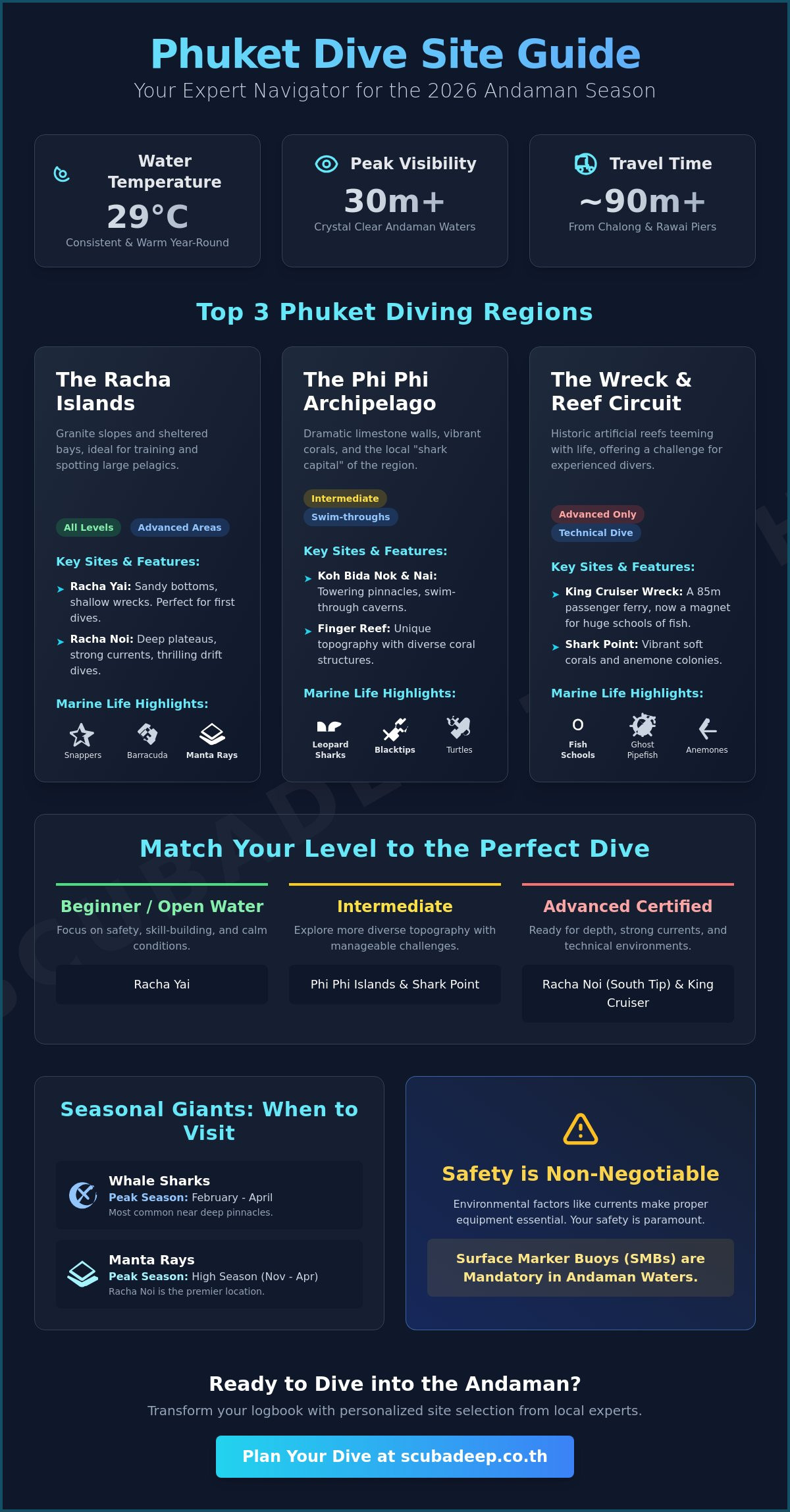
Phuket serves as the definitive springboard for exploring the Southern Andaman Sea's complex aquatic ecosystems. As Phuket, Thailand's largest island, it provides the logistical infrastructure necessary to reach some of the most remote and rewarding underwater environments in Southeast Asia. This Phuket dive sites guide is designed to help you navigate three primary sectors: the granite slopes of the Racha Islands, the dramatic limestone walls of Phi Phi, and the historic Local Wreck and Reef circuit.
The region is celebrated for its world-class conditions. You can expect water temperatures to hover around a consistent 29°C, while visibility often exceeds 30 meters during the peak season. However, as an elite mentor in this field, I must emphasize that site selection is just as critical as your regulator or computer. Matching your current skill level to the specific environment ensures you spend your bottom time observing life rather than managing stress. Professional guidance is about more than just finding fish; it's about understanding the technical demands of each unique location.
The Geography of Phuket Diving
Most excursions depart from Chalong or Rawai piers in the south. Boat travel times vary significantly. The Racha Islands are reachable within 90 minutes; meanwhile, the journey to Phi Phi or the King Cruiser Wreck can take up to three hours. The island's topography offers a distinct advantage. The eastern and southern sites remain largely protected from the heavy swells of the Southwest Monsoon, allowing for year-round access. Additionally, Phuket's proximity to the continental shelf drop-off facilitates the upwelling of nutrient-rich waters. This attracts large pelagic species that you won't find closer to the mainland.
Marine Life Highlights in 2026
The 2026 season has shown a remarkable resurgence in marine biodiversity. Divers frequently encounter leopard sharks resting on the sandy bottoms and hawksbill turtles patrolling the reefs. Macro enthusiasts will find ornate ghost pipefish hidden among the sea fans. Recent data from local conservation groups indicates a significant improvement in soft coral health due to stricter reef protection protocols.
- Seasonal Giants: Racha Noi remains the premier spot for Manta rays. Whale sharks are increasingly common near the deeper pinnacles from February through April.
- Reef Health: Look for thriving anemone colonies at Shark Point, which have benefited from the 2025-2026 ecosystem recovery initiatives.
Exploring the Top 3 Diving Regions Around Phuket
Phuket's underwater landscape is best understood when divided into three distinct geographical regions. Each offers a unique geological foundation and specific marine encounters. This structure helps you choose a trip that aligns with your technical comfort and aesthetic preferences. This Phuket dive sites guide categorizes these into the Racha Islands, the Phi Phi Archipelago, and the challenging King Cruiser circuit.
The Racha Islands: Racha Yai and Racha Noi
Racha Yai is the quintessential training ground for the region. It features sheltered bays with sandy bottoms and granite slopes, making it the premier choice for a Fun Dive Phuket or an initial Open Water certification. You'll find several shallow wooden shipwrecks here that have become artificial reefs for schooling snappers and batfish. In contrast, Racha Noi caters to those seeking a more intense experience. The "South Tip" is a deep plateau where stronger currents often bring in larger pelagics. It's a favorite for advanced divers who want to see manta rays or large schools of barracuda. For more detailed descriptions of these locations, you can consult this professional guide to Phuket's top dive sites.
Phi Phi Archipelago: Koh Bida Nok and Bida Nai
The Phi Phi Islands are famous for their dramatic limestone walls and thriving turtle populations. Koh Bida Nok and Koh Bida Nai are often called the "shark capital" of the local day-trip range. Blacktip reef sharks and leopard sharks are frequent sightings here. The topography includes the famous "Finger Reef" and several swim-throughs that reveal stunning underwater caverns. The mix of vibrant soft corals and massive hard coral structures defines the Phi Phi experience. By utilizing this Phuket dive sites guide, you can ensure your itinerary matches your specific goals.
For the experienced diver, the King Cruiser circuit offers a specialized trio. This includes the 85-meter long car ferry wreck, the anemone-covered Shark Point, and the limestone pinnacle of Koh Doc Mai. Each site requires precise buoyancy control and an understanding of local current patterns. If you're looking to push your limits, we recommend exploring our Advanced Open Water Course to prepare for these deeper environments. We act as consultants for your journey, ensuring you select the sites that provide the most rewarding progression for your logbook.
Site Selection: Matching Your Certification to the Right Reef
Choosing a location based solely on maximum depth is a common oversight. In reality, environmental factors like current strength and horizontal visibility are the true indicators of a site's difficulty. This Phuket dive sites guide emphasizes that matching your current technical proficiency to the environment is the most effective way to ensure safety. While a site might sit within your depth limits, unpredictable thermoclines or surge can quickly elevate the task load for an unprepared diver.
At Scubadeep, we act as your elite mentors to assess your readiness for more demanding environments. If you've been out of the water for a while, we often recommend a Scuba Refresher Review before heading to the deeper wrecks. This allows us to consult on your buoyancy and air management, ensuring you get the most out of your Fun Dive Phuket experience. For many, a day trip serves as the perfect bridge, allowing you to practice skills in a controlled setting before committing to an Advanced Open Water Course.
Best Sites for Beginners and Try Dives
For those just starting their journey or participating in a Try Dive, Racha Yai Bay 1 and 2 are unrivaled. These bays offer low-stress environments with consistent sandy bottoms and clear lines of sight. They provide a predictable platform to master basic skills without the distraction of heavy boat traffic or surge. Interestingly, Koh Dok Mai also offers a novice-friendly experience. While it's a massive limestone wall, the shallow sections are teeming with life and can be enjoyed safely by those in an Open Water Course. You can find more about these entry-level spots in this ultimate guide to scuba diving in Phuket.
Advanced Sites: Wrecks and Pinnacles
Once you've secured more experience, the local circuit offers technical challenges that reward precise control. The King Cruiser Wreck Dive Site features an 85m ferry resting at 32m depth. It's a massive structure that requires excellent buoyancy to navigate safely around its deteriorating metal frame. Nearby, Shark Point (Hin Musang) presents a multi-pinnacle challenge famous for its purple soft corals and often vigorous currents. Finally, the Anemone Reef Phuket Dive Site is a submerged mound that demands keen navigation. Because of the depth and potential for longer bottom times, these sites are often best explored after completing an Enriched Air Nitrox Course to maximize your safety margins.
Practical Planning: Seasons, Safety, and Equipment
Executing a successful underwater expedition requires more than just a map. It demands a professional understanding of local environmental cycles and safety standards. This Phuket dive sites guide provides the logistical framework needed to time your visit perfectly and prepare your gear for the specific demands of the Andaman Sea. Our approach is methodical; we ensure that every diver understands the "why" behind our safety protocols before they ever hit the water.
When to Book Your Phuket Diving Trip
Phuket operates on a dual-season weather system that dictates site accessibility and water conditions. The Northeast Monsoon, running from November to April, represents the peak season. During this window, you'll encounter flat seas and exceptional visibility that often exceeds 30 meters. It's the most reliable time for those seeking the quintessential crystal-clear experience across all major regions.
The Southwest Monsoon from May to October is known as the "Green Season." While rain is more frequent, this period offers unique advantages for the adventurous diver. You'll find fewer crowds at popular spots and an increased likelihood of "big animal" encounters. Whale sharks and manta rays are often drawn to the nutrient-rich waters during these months. When planning, don't just look at the rain forecast. Focus on wind direction instead, as the eastern sites often remain perfectly diveable even when the west coast sees swell.
Technical Considerations for Andaman Diving
Even in tropical waters averaging 29°C, technical preparation is vital. Divers frequently encounter thermoclines, which are sudden pockets of cooler water that can drop the temperature by several degrees at depth. We recommend a 3mm shorty or a full suit to maintain core warmth during multi-dive days. If your logbook shows a gap of six months or more, we strongly suggest a Scuba Refresher Review to re-familiarize yourself with your equipment and buoyancy control.
Safety in the Andaman Sea is anchored by specific protocols. Due to the strength of local currents, carrying a Surface Marker Buoy (SMB) is an essential requirement for every diver. We maintain a strict commitment to safety by utilizing oxygen-equipped vessels and maintaining small group ratios. For those participating in our three-dive day trips, we highly recommend an Enriched Air Nitrox Course. Using Nitrox reduces nitrogen absorption, allowing for longer bottom times and shorter surface intervals, which is the professional's choice for maximizing safety across multiple descents.
Elevate Your Experience with Scubadeep’s Elite Mentors
At Scubadeep, we act as more than just a service provider; we are the consultants for your long-term underwater journey. We don't believe in one-size-fits-all itineraries. Instead, our elite mentors work with you to select specific locations from this Phuket dive sites guide based on your logbook history and personal goals. This personalized approach ensures you're always diving in an environment that challenges your skills without compromising your safety. Whether you're looking to refine your buoyancy or explore historic maritime remains, we help you navigate the best of the Andaman Sea with professional authority.
If you're just beginning, we offer a seamless transition from your first Try Dive to becoming a fully certified diver. You can complete your Open Water Course in just three days, gaining the skills and confidence required to explore reefs around the globe. We take the sober responsibility of instruction seriously, ensuring that every student receives the high-tier training necessary to go further in their diving career.
Professional Certification Pathways
Phuket serves as the world’s premier classroom for advancing your technical proficiency. Once you've mastered the basics, our Advanced Open Water Course unlocks deeper and more complex sites. To truly excel, we recommend specialty training such as our Deep Dive Course or Wreck Diving Course, which are essential for safely navigating sites like the King Cruiser. For the serious adventurer, the Rescue Diver Course and First Aid Course represent the next logical step in your progression, shifting your focus toward teammate safety and emergency management.
Booking Your Next Adventure
Reserving your next Fun Dive Phuket or certification course is a methodical and transparent process. Our packages are all-inclusive, providing you with premium equipment, expert guidance from seasoned local experts, and high-end hospitality on our vessels. We handle every logistical detail so you can focus entirely on the discovery of Phuket's hidden underwater treasures. Our team is ready to help you plan an itinerary that reflects your unique ambitions and experience level.
Book your Phuket dive adventure with Scubadeep today and experience the difference that professional mentorship makes to your underwater journey.
Plan Your Next Descent into the Andaman
Navigating the diverse underwater terrain of Thailand requires more than just a boat; it demands a strategic approach to site selection and seasonal timing. This Phuket dive sites guide has highlighted how matching your technical comfort to the specific conditions of a reef or wreck ensures every minute of bottom time is both safe and rewarding. Whether you're targeting the vibrant corals of the Racha Islands or the advanced challenges of the King Cruiser, your progression depends on expert guidance.
At Scubadeep, our professionally certified instructors act as elite mentors to help you push your limits responsibly. We offer specialized wreck and deep diving training designed to elevate your technical proficiency while maintaining the highest safety standards in the region. Our team serves as consultants for your personal journey, ensuring you choose the right path for your specific goals. Don't leave your experience to chance. Explore Phuket’s Best Dive Sites with Scubadeep and begin your next chapter of discovery. The hidden secrets of the Andaman Sea are waiting for you.
Frequently Asked Questions
What is the best time of year to dive in Phuket?
The optimal window for diving in Phuket runs from November to April. During this peak season, you'll experience flat seas and horizontal visibility that often exceeds 30 meters. The "Green Season" from May to October is better for those seeking encounters with whale sharks and manta rays. While rain is more frequent then, many eastern sites remain sheltered and accessible.
Do I need a certification to dive the King Cruiser Wreck?
You must hold an Advanced Open Water certification to explore the King Cruiser Wreck. The ferry rests at a maximum depth of 32 meters, which is beyond the depth limits of a standard entry-level license. Because of the wreck's depth and the potential for strong currents, we also recommend that divers have recent experience and strong buoyancy control.
Are there sharks at Phuket dive sites, and are they dangerous?
Divers frequently encounter leopard sharks and blacktip reef sharks at sites like Phi Phi and Shark Point. These species are not dangerous and are generally quite shy around humans. Observing these majestic creatures in their natural habitat is a major highlight of any Phuket dive sites guide. They are a vital part of the local ecosystem and are protected by strict regulations.
How far are the dive sites from the main island?
Most sites are located between 90 minutes and 3 hours from Chalong or Rawai piers. The Racha Islands are the closest major destinations, reachable in about an hour and a half by boat. Phi Phi and the King Cruiser circuit are further offshore, requiring a longer transit. Most day trips utilize large, stable vessels that offer full hospitality during the journey.
Can I dive in Phuket if I haven’t dived in several years?
If you haven't dived in six months or more, you should complete a Scuba Refresher Review. This session allows you to re-familiarize yourself with equipment setup and practice essential skills in a controlled environment with a professional mentor. It's a responsible step that ensures you're confident and safe before heading to more challenging offshore locations.
What is the water temperature at Phuket dive sites?
The water temperature in the Andaman Sea remains a consistent 29°C throughout the year. You might encounter sudden thermoclines where the temperature drops by a few degrees at depth, but a 3mm shorty or full suit is usually sufficient for comfort. This warm, tropical climate makes Phuket one of the most inviting training environments in the world.
Is Nitrox available for day trips from Phuket?
Enriched Air Nitrox is available for most day trips and is the professional's choice for multi-dive itineraries. Using Nitrox reduces nitrogen absorption, which allows for longer bottom times and shorter surface intervals. If you're not yet certified to use it, you can easily complete an Enriched Air Nitrox Course during your scheduled fun dives.
What should I bring on a Phuket scuba diving day trip?
You should bring your certification card, logbook, swimwear, and reef-safe sun protection. While most professional centers provide high-quality rental equipment, you're encouraged to bring your own mask or computer if you prefer. Onboard hospitality generally includes meals and drinking water, so you only need a small dry bag for your personal items.