

Can online lessons alone earn you a scuba certification? No. For anyone researching scuba certification online elearning Thailand, online study can build your knowledge, but it does not replace the in-water practice and assessed diving skills required to complete the training pathway.
Studying at your own pace can help you make better use of work or travel time. Before enrolling, find out what happens after the lessons: training typically progresses from knowledge development to confined-water practice, then open-water dives where you demonstrate skills with an instructor.
This guide explains what e-learning can cover, what requires in-water training, and what to ask before you enrol. Check how practical sessions fit your schedule and what the course includes. Scubadeep offers an Open Water Course, but confirm its current learning format and requirements before booking. Understanding the path from online study to assessed skills helps you plan your training and progress with safety in mind.
Key Takeaways
- For scuba certification online elearning Thailand, check which course components are available online and which require supervised in-water training.
- Compare formats by checking instructor support, practical skill assessments, and how the training schedule works.
- Before enrolling, ask the provider to explain the course structure, certification requirements, and in-water training you’ll need to complete.
- Choose a clear progression from study to practical assessment, and consider Scubadeep’s Open Water Course as a possible next step.
Scuba certification online e-learning in Thailand: what the course pathway means
What can you complete online, and what still needs to happen in the water? For scuba certification online elearning Thailand, the key distinction is between studying course material and demonstrating that you can apply your skills underwater. E-learning usually covers knowledge development, not a complete certification by itself. Since course formats and requirements vary, check the full pathway before arranging your training around work or travel.
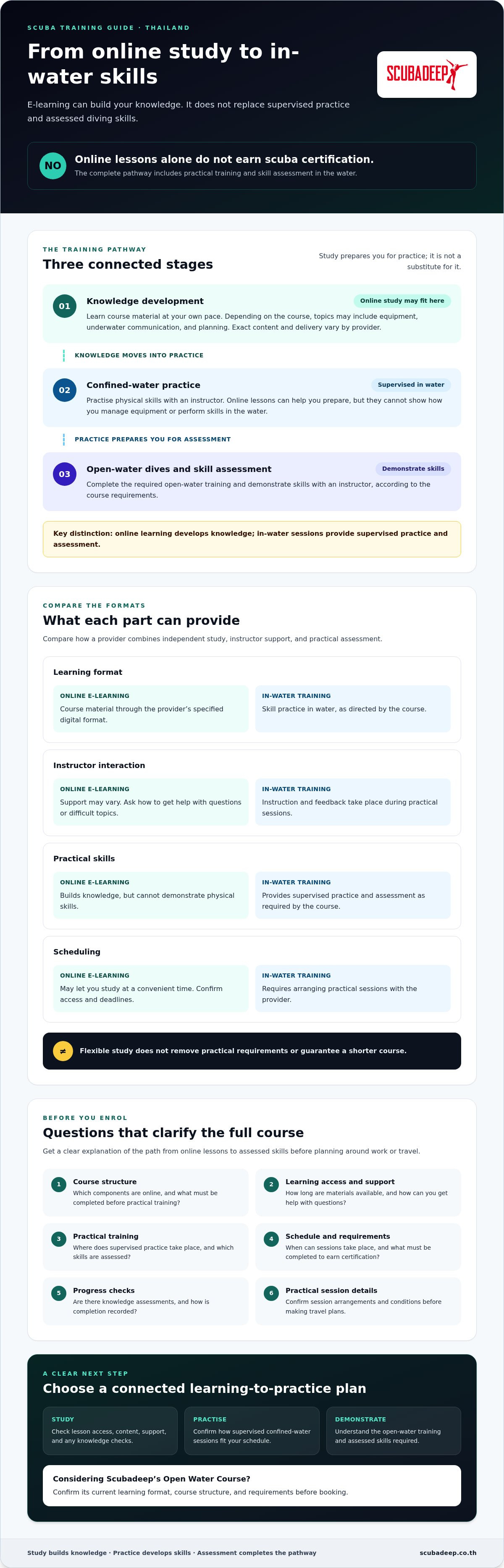
A typical entry-level pathway moves from knowledge study to supervised practice in confined water, then to open-water training and skill assessment. These stages connect what you learn to the decisions and actions involved in diving. For background on how training and qualifications differ, see this overview of diver certification levels.
What does online scuba e-learning usually cover?
Knowledge study helps you discuss diving concepts with your instructor and understand the reasoning behind safe practices. Depending on the course, topics may include equipment, underwater communication, and planning. These are examples, not a guaranteed syllabus: the provider determines the exact content and how it is delivered.
Before enrolling, ask how long you can access the materials, what learning support is available, and what you must finish before practical training begins. Check whether the online component includes progress checks or knowledge assessments, and how the provider records completion.
Does online study alone earn a scuba certification?
No. Completing online lessons is not the same as completing the full certification pathway. Reading material or answering knowledge questions can help you prepare, but it cannot show how you manage equipment, respond to an instructor, or perform required skills in the water. Practical training and assessment are generally part of entry-level diver training.
Ask the provider to confirm its current requirements, including where supervised practice takes place, which skills are assessed, and what you must complete to earn certification. Don’t assume every course follows the same format or timeline. A clear explanation helps you distinguish a convenient way to study from a complete training plan, and gives you a sound basis for planning your time in Thailand.
Compare online e-learning and in-water scuba training before enrolling
Online study offers flexibility, while practical training gives you a chance to develop and demonstrate skills under supervision. Neither format is better for everyone. For scuba certification online elearning Thailand, compare how each provider combines independent study, instructor support, and in-water assessment. Then consider which arrangement suits your learning preferences and schedule.
| Area | Online e-learning | In-water training |
|---|---|---|
| Learning format | Study course material through the provider’s specified digital format. | Practise skills in water as directed by the course. |
| Instructor interaction | Support may vary. Ask how to get help with questions or difficult topics. | Instruction and feedback take place during practical sessions. |
| Practical skills | Builds knowledge but cannot demonstrate physical skills. | Provides supervised practice and assessment, as required by the course. |
| Scheduling flexibility | May let you study at a time that suits you. Confirm access and deadlines. | Requires arranging practical sessions with the provider. |
Self-paced study may suit new divers who are comfortable learning independently and want to review material at their own speed. But flexibility does not remove the need to coordinate practical training. Before enrolling, ask when in-water sessions can take place, how to get help with questions during online study, and what you need to complete before moving to the next stage. Do not assume e-learning shortens the course or reduces practical requirements.
What should you expect from practical training?
Practical sessions allow you to practise skills under an instructor’s supervision and demonstrate them against the course’s assessment requirements. The setting, session count, and conditions depend on the provider and course, so confirm these details before making travel plans. For broader context, review Thailand's official diving regulations, and look for clear safety guidance as you prepare.
Choose a format based on the guidance you want and the time you have, not simply on which option sounds most convenient. To review a practical route to certification, explore Scubadeep's Open Water Course and confirm the current course structure and requirements directly.
Follow these steps to choose scuba certification e-learning in Thailand
A well-planned course connects study, instructor guidance, and practical assessment. Use these steps to compare options across Thailand and confirm the details before committing your time or arranging travel.
- 1. Define your goal. Decide whether you’re new to diving or building on previous training. This helps you identify a suitable course level and ask focused questions.
- 2. Map the course structure. Ask which components are online, which involve instructor-led participation, and how knowledge work leads into practical training. Confirm how skills are assessed and what you must complete to qualify for certification.
- 3. Verify the provider and pathway. Ask which training provider and certification pathway the course follows, and request its current requirements. Don’t assume programs use the same materials, assessment process, or completion conditions.
- 4. Check instructor support. Find out how to ask questions during online study and who can help if a topic or skill needs more explanation. Clear communication is useful, particularly when you’re new to diving.
- 5. Plan the practical sessions. Confirm dates and availability with the provider before building them into a travel itinerary. Ask about equipment arrangements, preparation, eligibility, and any personal information or documents you’ll need to provide.
Check the course structure before you start
For scuba certification online elearning Thailand, compare the complete pathway, not just the online materials. Ask how knowledge completion connects to supervised practice and assessment. Make sure you understand the certification requirements before you begin, including any steps that must happen in person.
Plan your practical training and next steps
Leave time in your schedule for practical training, and confirm availability with the provider rather than making assumptions. Review safety information as you prepare. The Divers Alert Network offers dive-safety resources, while your instructor’s course guidance should direct your practical preparation.
If you’re comparing courses, review Scubadeep’s Open Water Course and confirm its current format, requirements, and practical-training arrangements directly with the provider.
Choose a clear next step from online learning to Open Water training
A clear course pathway explains what you’ll study, how to access instructor support, and how practical skills are taught and assessed. When comparing scuba certification online elearning Thailand options, look beyond whether online learning is available. Check how it connects to the full Open Water training process and whether the practical requirements fit your plans.
Scubadeep offers an Open Water Course as a potential next step for new divers. Ask the team directly whether online or blended learning is currently available rather than assuming a particular format. Confirming the course structure can help you understand whether it suits your experience and what you’ll need to complete.
Questions to ask Scubadeep before enrolling
Use these questions to clarify the course before making a decision:
- Does the current Open Water Course include an online learning option, and what parts of the course does it cover?
- How does the course progress from knowledge learning to instructor guidance and practical training?
- Which skills are assessed, and what are the course’s certification requirements?
- What are the current schedule, prerequisites, and equipment arrangements?
Ask for details about the current course instead of relying on assumptions based on another provider’s program. If anything is unclear, request an explanation before enrolling. Knowing who will support your learning and how practical sessions are arranged makes planning easier.
Move from research to a course conversation
When you contact the team, share whether you’re new to diving or have previous experience, how you prefer to learn, and when you hope to train. Mention any scheduling limits so the provider can clarify what may fit. You do not need to commit before you understand the course structure and practical requirements.
For a starting point, explore Scubadeep’s Open Water Course, then ask about its current format and training pathway. Decide whether to proceed once you understand how study, instructor support, and assessed diving skills fit together.
Choose a Confident Path to Open Water
A suitable scuba certification online elearning Thailand pathway makes clear what you can study online, how instructors support you, and which practical skills you’ll need to demonstrate in the water. E-learning can help you prepare, but check the provider’s current requirements and schedule before you commit.
Scubadeep offers an Open Water Course and scuba education alongside guided diving experiences. Ask whether online or blended learning is currently available, how practical training and assessment work, and what you’ll need to complete. Clear answers help you plan around your experience, learning preferences, and available time.
Ready to explore your options? Explore Scubadeep’s Open Water Course and confirm the current course structure directly. With a clear understanding of the pathway from learning to assessed skills, you can plan your next step toward discovering the underwater world.
Frequently Asked Questions
Can you get scuba certified entirely online?
No, online learning should not be treated as the complete certification pathway. It can cover course knowledge and help you prepare, but practical skills and assessments are generally part of diver training. Requirements depend on the course and provider. Before enrolling, ask what must be completed in person, how skills are assessed, and how online study connects to the rest of the course.
Does online scuba e-learning include practical diving sessions?
Not necessarily. E-learning generally covers knowledge study, while practical training involves supervised skill development and assessment in the water. Course formats differ, so ask which sessions take place in water and how your skills will be evaluated. Also clarify how online study connects with instructor guidance, including how to get help with questions as you progress.
Can I complete scuba certification e-learning before travelling to Thailand?
Some providers may let learners complete the academic component before practical training, but this depends on the course and its current format. Before planning travel, confirm when online materials are available, how long you can access them, and what counts as completion. Ask how instructor support works and how practical sessions are arranged, so your study plan connects clearly to in-water training.
How do I choose an online scuba certification course in Thailand?
For scuba certification online elearning Thailand, compare the provider’s course pathway, instructor support, practical skills and assessments, prerequisites, and scheduling. Ask which parts can be completed online and what follows the study component. Request current details, including an explanation of the certification requirements. Course structures vary, so choose an option that suits your learning preferences and makes the practical training plan clear.
Is online scuba e-learning suitable for beginners?
It may suit beginners who are comfortable studying independently and managing coursework at their own pace. If you learn best through discussion, ask what direct instructor interaction is available before and during training. Online lessons are only one component when practical training is required. Find out how to raise questions, clarify challenging topics, and get guidance as you move from study into skill practice.
What should I ask a dive centre before booking an Open Water Course?
Ask whether online learning is currently available, what the course includes, and how practical skills are taught and assessed. Confirm any prerequisites, equipment arrangements, and scheduling options directly with the dive centre. Scubadeep offers an Open Water Course, but verify the current learning format and specific requirements with the team. Clear answers help you understand the pathway before making plans.