

Comparing dive courses can be confusing when course names don’t make clear whether you’re choosing a first underwater experience or training toward certification. The best option depends on what you want to do next, not simply which course sounds most advanced.
If you’re weighing a Try Dive against an Open Water Course, or wondering what to do after your first certification, start with your experience, comfort in the water and goals. At Scubadeep, you can progress from a Try Dive or beginner training to advanced and specialty courses, with safety and skill development central to the learning process.
This guide explains the differences between introductory dives, certification training and specialty courses. It also outlines when a refresher review, Rescue Diver Course or Enriched Air Nitrox Course may fit your goals. Consider what you want to learn or experience underwater, then choose the training that matches your current skills.
Key Takeaways
- Decide whether you want a first underwater experience, an initial certification or further training to build on existing skills.
- Compare dykkurser phuket by purpose and the experience each course is designed to support, rather than by course name alone.
- Treat scuba training as a set of options shaped by your goals and experience, not a ladder every diver must climb.
- Use your comfort in the water and the skills you want to develop to narrow down your choices.
- Scubadeep offers beginner, advanced and specialty training, with safety at the centre of skill development.
Compare Scuba Diving Courses in Thailand by Experience Level
Begin with the outcome you want: try scuba with an instructor, work toward your first certification, or develop skills you already have. Comparing what each option teaches and who it is for makes the course names easier to understand.
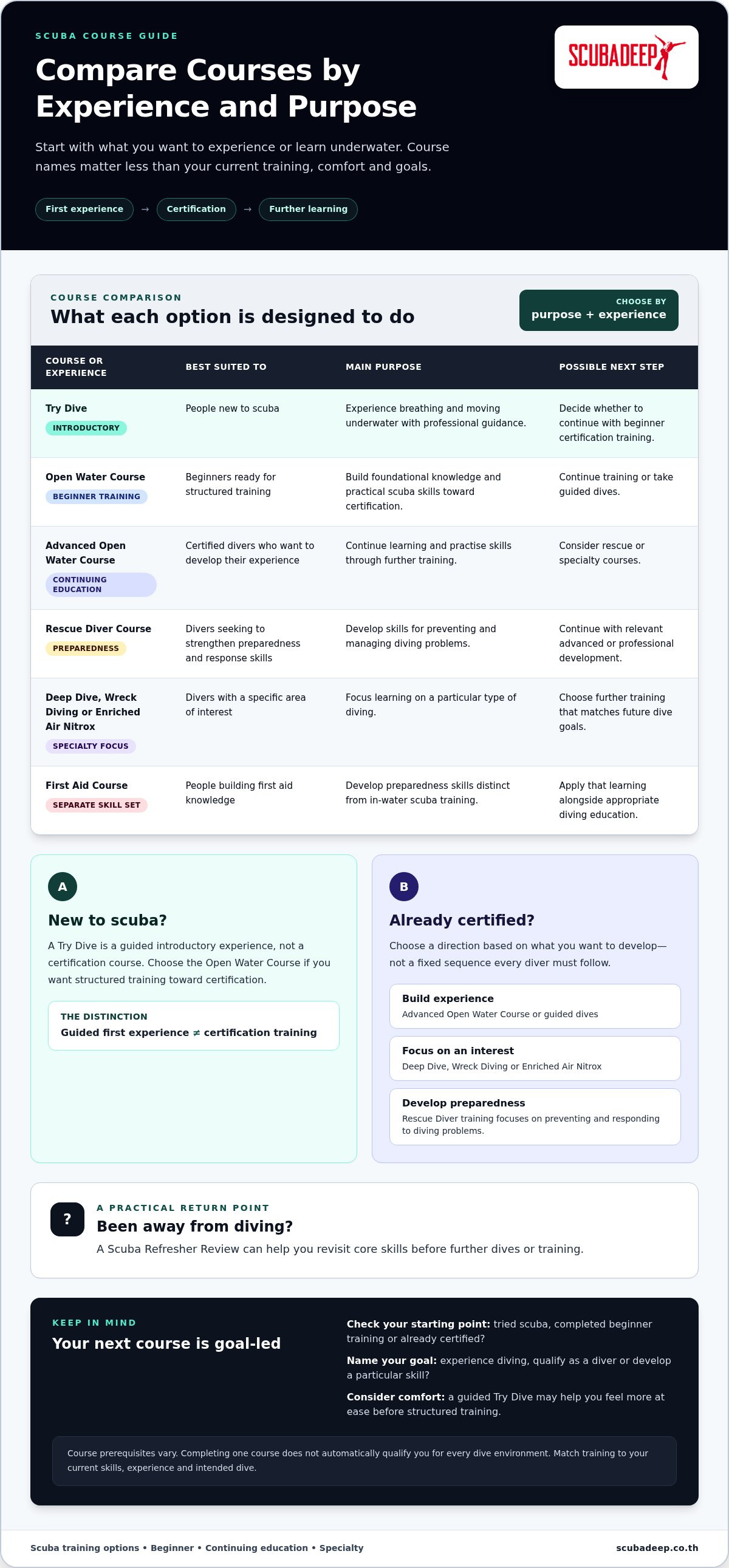
| Course or experience | Best suited to | Purpose | Possible next step |
|---|---|---|---|
| Try Dive | People new to scuba | Experience breathing and moving underwater with professional guidance | Decide whether to continue with beginner certification training |
| Open Water Course | Beginners ready for structured training | Build foundational knowledge and practical scuba skills toward certification | Continue training or take guided dives |
| Advanced Open Water Course | Certified divers who want to develop their experience | Continue learning and practise skills through further training | Consider rescue or specialty courses |
| Rescue Diver Course | Divers seeking to strengthen preparedness and response skills | Develop skills for preventing and managing diving problems | Continue with relevant advanced or professional development |
| Deep Dive, Wreck Diving or Enriched Air Nitrox | Divers with a specific area of interest | Focus learning on a particular type of diving | Choose further training that matches future dive goals |
| First Aid Course | People building first aid knowledge | Develop preparedness skills distinct from in-water scuba training | Apply that learning alongside appropriate diving education |
Start with an introductory dive or beginner certification
A Try Dive is an introductory experience, not a certification course. It gives you the chance to discover how scuba feels with professional guidance. If you want structured training toward certification, the Open Water Course is the beginner route. It involves learning and practising scuba skills, rather than simply completing a supervised introductory dive. For an overview of how certification and training standards are organised, see Diver certification standards.
Explore advanced, rescue and specialty training
If you’re already certified, an Advanced Open Water Course can support continued skill development, while Rescue Diver training focuses on preparedness and responding to problems. Specialty options provide a more focused direction: Deep Dive, Wreck Diving and Enriched Air Nitrox each centre on a distinct area of learning. First Aid is a separate course that develops first aid knowledge. Across dykkurser phuket, options range from a first underwater experience to continuing education. Choose according to your experience and goals, then explore the course details that are most relevant to you.
Understand the Scuba Course Progression from First Dive to Specialty Skills
Think of scuba training as a set of options shaped by your experience and interests, not a ladder every diver must climb from start to finish. You might begin with a Try Dive and then decide to work toward beginner certification. Or, if you’re already certified, you might want to focus on wrecks, deeper dives or another specialty. Course prerequisites vary, so base your next choice on your current training and the path you want to explore.
Certification training develops the knowledge and practical skills needed to qualify as a diver, while an introductory dive is a guided experience rather than a certification. This distinction helps make sense of dykkurser phuket: each course has a different purpose, and completing one course doesn’t automatically qualify you for every dive environment.
Follow a goal-led learning path
If you’re new to scuba, an introductory experience can help you decide whether you want to continue with Open Water training. After certification, you can build experience through guided dives or continue developing your skills with an Advanced Open Water Course. From there, let your interests guide you. Wreck Diving and Deep Dive courses offer focused learning paths, but the right preparation depends on the course and dive environment.
You don’t need to enrol in every course category. Match your next step to what you want to do, while keeping your training and experience in mind as your plans develop. For Thailand-specific context, the Tourism Authority of Thailand provides information on official diving regulations in Thailand.
Know when a refresher or safety course makes sense
If you’ve been away from diving and want to revisit core skills, a Scuba Refresher Review can be a practical return point before further dives or training. First Aid and Rescue Diver courses support preparedness in different ways: First Aid develops first aid knowledge, while Rescue Diver training focuses on preventing and responding to diving problems. Neither replaces careful planning or appropriate training for a particular dive.
Build your next step around confidence as well as ambition. Scubadeep’s scuba training options cover beginner courses, continuing education and specialty training to help you explore a path that fits your experience and goals.
Choose the Right Scuba Course for Your Experience and Goals
The right course should match your current experience, comfort in the water and the skills you want to gain. If you’re comparing dykkurser phuket, use this checklist to identify a sensible starting point:
- Experience: Have you tried scuba, completed beginner training or already earned a certification?
- Goal: Do you want to experience diving, qualify as a diver or develop a particular skill?
- Comfort: Would a guided Try Dive help you feel more at ease before you commit to structured training?
- Learning outcome: Are you looking for foundational skills, a refresher or focused continuing education?
A course can be a poor fit if it assumes skills you haven’t developed or repeats learning you’re ready to move beyond. Start with an honest assessment of your experience, then look at the course’s purpose and learning focus. Clear instruction and safety-focused learning matter at every stage. The International Diving Safety Standards offer another reference for readers interested in diving safety.
If you have never scuba dived
First decide whether you want to try scuba or pursue certification. A Try Dive gives you a guided introduction to the underwater experience; an Open Water Course is structured beginner training toward a recognized scuba certification. One introduces you to the experience, while the other provides a learning pathway. If you’re curious but unsure how you’ll feel underwater, begin with the introductory experience. If your goal is to develop the skills and knowledge associated with certification, explore beginner training.
If you are already certified
Think about what would make your next dive more comfortable or purposeful. If you want to revisit core skills before diving again, a Scuba Refresher Review may be a useful step. If you’re ready to keep learning, consider an Advanced Open Water Course or a specialty course that suits your interests and current experience. For a closer comparison of training beyond beginner level, look for an advanced scuba certification guide.
Choose training for the outcome you want, based on your background rather than the course title alone. Explore scuba courses with Scubadeep to find a suitable next step for your experience and goals.
Take Your Next Scuba Diving Step with Scubadeep
The best next step reflects your experience and what you want from diving. Scubadeep’s training covers first-time experiences, beginner certification, continued skill development and specialty learning. Focus on the path that fits your goals rather than assuming you need to complete every course.
Match Scubadeep training to your next goal
If you’re new to scuba and want to experience being underwater, a Try Dive offers an introductory step with professional guidance. If you’re ready to work toward a scuba certification, choose the Open Water Course instead. These options serve different purposes: one introduces the experience, while the other is structured beginner training.
For certified divers, the right course depends on what you want to revisit or learn. A Scuba Refresher Review gives you the option to revisit core skills. An Advanced Open Water Course supports further development, while Rescue Diver training focuses on preparedness and response. Specialty courses, including Deep Dive, Wreck Diving and Enriched Air Nitrox, let you focus on a particular area of interest. Choose the course that fits your current experience and goals.
Prepare for a confident course decision
Before choosing, consider what training you’ve completed, how comfortable you feel in the water and what you’d like to do next. Those details can help you identify an appropriate learning path. If beginner certification is your goal, start by exploring Open Water training with Scubadeep. If you’re comparing dykkurser phuket for continuing education, focus on the course that best matches your experience and interests.
Your next step doesn’t need to be the most advanced one. Start with the goal that matters to you, then build from there. Explore scuba courses with Scubadeep when you’re ready.
Choose Your Next Step Beneath the Surface
The right course isn’t necessarily the most advanced one. Start with your experience, comfort in the water and what you want to learn next. A Try Dive offers a guided first experience, while beginner certification training builds skills. Certified divers can choose a refresher, advanced course or specialty path to suit their goals. This is a practical way to compare dykkurser phuket and choose your next step thoughtfully.
Scubadeep provides training from beginner certification through advanced and specialty courses, alongside Try Dives, refresher reviews and safety education. Begin with the course that best matches your experience, then build your skills through training suited to your goals.
Ready to choose your next step? Explore scuba courses with Scubadeep.
Frequently Asked Questions
Which scuba diving course should a complete beginner choose?
If you want to experience scuba before committing to certification training, start with a Try Dive. If your goal is to develop beginner skills and work toward scuba certification, consider the Open Water Course. Think about your comfort in the water and what you want to achieve. When comparing dykkurser phuket, the key distinction is whether you want a guided introduction or structured training.
What is the difference between a Try Dive and an Open Water course?
A Try Dive is a guided introductory experience, while an Open Water Course is beginner training designed to develop scuba knowledge and practical skills toward certification. A Try Dive can help you discover how scuba feels, but it isn’t equivalent to completing certification training. Choose based on your aim: a first underwater experience or a learning path toward becoming a certified diver.
Do I need certification before taking an advanced scuba course?
Advanced scuba training is intended for divers who have already completed beginner certification training. It builds on existing knowledge and experience rather than serving as a starting point for someone new to diving. Prerequisites can vary by course, so consider your current certification and experience when choosing. If you’re a beginner, start with an Open Water Course and progress from there.
Can I take a scuba refresher course if I have not dived recently?
Yes. A Scuba Refresher Review can be a useful option if you want to revisit core skills after time away from diving. It gives you a chance to refresh your knowledge before returning to the water or continuing your training. Consider how confident you feel with your skills, and choose a refresher if reviewing the basics would help you feel better prepared for your next dive.
What can I learn in a scuba specialty course?
A specialty course focuses on a particular area of diving. Examples include Deep Dive, Wreck Diving and Enriched Air Nitrox training. Each has a different learning focus, so consider your interests and how a course fits your experience. Specialty training isn’t a substitute for the foundational skills or experience needed for a dive. Choose a course that aligns with your goals and the kind of diving you want to explore.
Is scuba diving training safe for first-time divers?
Scuba training places safety and careful instruction at the centre of learning, but no activity can be described as risk-free. First-time divers can begin with a professionally guided Try Dive or choose structured beginner training. Follow instructions, communicate how comfortable you feel and take the learning step that suits you. Scubadeep also provides safety education to help divers keep responsible habits in view as they gain experience.