

What if a wreck diving course is less about entering a ship and more about knowing when not to? It’s natural to wonder whether wreck training includes penetration, which skills you’ll practise, and whether you’re ready. Recreational wreck training builds judgment and control for responsible exploration. It does not grant permission to enter every wreck.
A wreck diving course develops skills such as buoyancy control, hazard awareness, navigation, and careful use of a guide line. These skills help you explore a wreck’s exterior with greater control and understand how structure, visibility, and conditions affect a dive. Penetration into an overhead environment requires a separate level of preparation.
Your readiness depends on your certification, experience, and comfort with core diving skills. Scubadeep’s Wreck Diving Course provides structured training for certified divers interested in wrecks. Guided wreck dives can give you a practical way to apply your skills within your training and the dive plan.
This guide explains what wreck training covers, how recreational and technical wreck diving differ, and how to prepare for a supervised dive. You’ll come away with a clearer sense of what to expect and how to progress thoughtfully.
Key Takeaways
- Wreck training develops planning, control, and site-assessment skills for responsible exploration.
- Exploring a wreck’s exterior is different from entering an overhead environment. Training does not authorize every entry.
- Buoyancy and trim help you stay in control and avoid disturbing the area around wreck structures.
- Prepare by reviewing the course requirements, clarifying your goals, completing the learning, and following your instructor’s guidance.
- A wreck diving course Phuket divers take can be a step toward guided wreck dives, with progression shaped by training and experience.
What Does a Wreck Diving Course Teach You?
A wreck diving course Phuket divers take is specialty training in planning, control, and site assessment. It helps certified divers approach wrecks thoughtfully: understand the dive plan, notice changing conditions, and make decisions within their training. The aim is not to turn every wreck into an entrance to explore. Recreational wreck diving often focuses on observing the exterior under supervision.
Definition: Wreck-diving training develops the skills and judgment to explore wreck sites within a diver’s training and dive plan. It does not grant unrestricted permission to enter wrecks.
Exploring a wreck from outside and penetrating inside it are different activities. An entry can place a diver beneath an overhead, where a direct ascent to the surface may not be possible. A wreck course focuses on its stated training scope, so don’t assume it includes penetration skills or covers every wreck. The overview of Wreck diving also describes the environments, procedures, and hazards involved.
Who Is Ready to Consider Wreck-Diving Training?
Prior certification provides a foundation for handling equipment and following dive procedures. Comfortable core skills leave more attention for the site. Readiness isn’t just a certification card. Look for calm buoyancy, awareness of your surroundings and buddy, and a willingness to follow the dive plan rather than improvise around an interesting opening.
Before training, consider how comfortable you are with buoyancy, buddy procedures, and basic dive planning. Share your certification and experience with your instructor so you can discuss your starting point and course expectations. If a skill feels rusty, refresh it before focusing on the additional demands of a wreck site.
What Makes Wreck Diving Different from a Reef Dive?
A wreck’s structure can create tight spaces, snagging hazards, and areas where visibility is limited or easily disturbed. These conditions can change how you position yourself, communicate with your buddy, and decide whether to continue. Careful observation from outside lets you appreciate the structure and marine life without crossing into an overhead environment.
Curiosity alone isn’t a reason to enter. Don’t go inside unless you have the specific training, equipment, supervision, and plan required for that type of dive. Respect your personal limits and your instructor’s guidance. A wreck course is a step toward more informed exploration, not a reason to stretch beyond those limits.
Which Skills Will You Develop During Wreck-Diving Training?
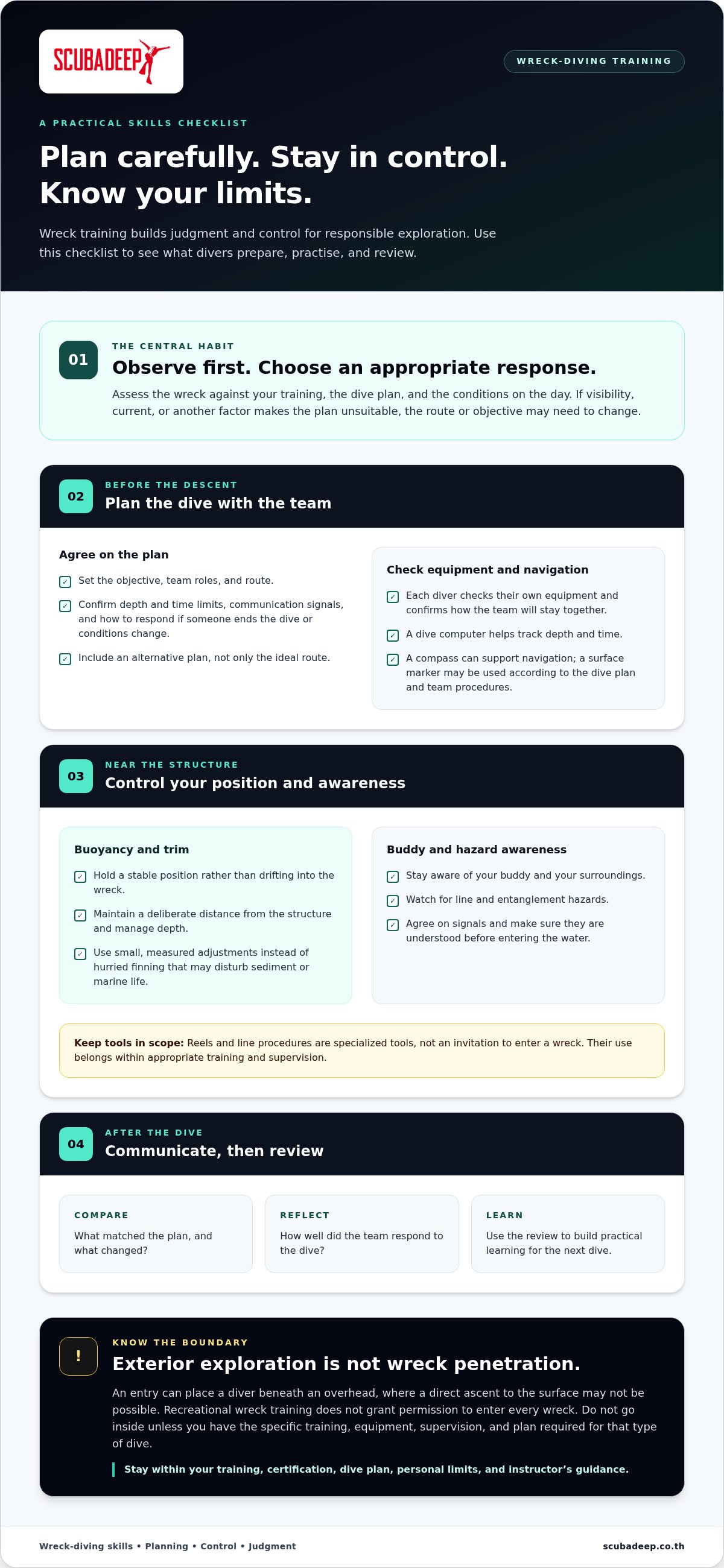
Wreck-diving training turns careful judgment into a repeatable process. You learn to prepare before descent, stay controlled near structures, communicate clearly with your buddy, and review decisions after the dive. Training activities depend on the course plan, but each skill supports one central habit: observe first, then choose an appropriate response.
Assess a wreck against your training, the dive plan, and the conditions on the day. A route or objective may need to change if visibility, current, or another factor makes the original plan unsuitable.
Plan the Dive Before Reaching the Wreck
Preparation starts with site information and conditions. The team agrees on the objective, roles, route, depth and time limits, communication signals, and what to do if anyone needs to end the dive or conditions change. Each diver checks their own equipment and confirms how the team will stay together. A dive computer helps track depth and time; a compass can support navigation, while a surface marker may be used according to the dive plan and team procedures.
Good planning includes an alternative, not just an ideal route. If visibility drops or the group loses orientation, divers should already know how to respond under the instructor’s direction. OSHA’s OSHA Commercial Diving Operations materials discuss hazards in underwater work. Their commercial context differs from recreational training, but they offer further background on underwater safety considerations.
Control Your Position and Awareness Underwater
Buoyancy and trim help you hold a stable position rather than drift into a wreck, brush against marine life, or stir up sediment. Good control also makes it easier to manage depth and maintain a deliberate distance from the structure. Small, measured adjustments are more useful than hurried finning close to fragile or confined areas.
Stay aware of your buddy, surroundings, and possible line or entanglement hazards. Agree on signals and make sure they’re understood before entering the water. Reels and line procedures are specialized tools, not an invitation to enter a wreck. Their use belongs within appropriate training and supervision.
Communicate, Then Review
After the dive, reflect on what matched the plan, what changed, and how well the team responded. This turns an experience into practical learning for the next dive. A wreck diving course can help you build these habits as part of a structured progression toward guided wreck-diving experience.
Does a Wreck Diving Course Mean You Can Enter a Wreck?
No. Completing a wreck diving course Phuket divers take doesn’t grant permission to enter every wreck. Training develops skills for wreck exploration within the course scope, your certification, and the dive plan. A guided dive around a wreck’s exterior is different from penetration, where the structure overhead can prevent a direct ascent to open water.
Understand the Boundary Between Exterior and Penetration Diving
Outside the wreck, you remain in open water and can ascend directly, subject to the dive plan and conditions. Inside, darkness, disturbed silt, entanglement hazards, and narrow or obstructed exits can make navigation and exiting more difficult. Even a visible opening may lead into a space where visibility can change quickly.
Penetration diving requires specific training, equipment, and procedures for overhead environments. A recreational wreck course shouldn’t be treated as a substitute for that preparation. Follow your certification limits, instructor guidance, and personal comfort level. If a planned dive is external, stay outside, even if an opening looks inviting.
Assess Conditions Without Letting Curiosity Set the Plan
Before the dive, consider visibility, current, depth, the wreck’s condition, and whether the team has the skills for the planned route. These factors work together. For example, reduced visibility can make it harder to keep the group together and monitor distance from the structure. Stronger current or an unexpected change in conditions may also make the original objective unsuitable.
Changing the plan, staying farther from the wreck, or ending the dive can be the prudent choice. Training helps divers recognize when conditions and capability don’t align, then respond without pressure to continue. Review Scubadeep’s scuba diving safety guidance as part of your preparation, and follow your instructor’s direction during training and guided dives.
Keep the distinction clear: wreck training supports informed exploration, while penetration calls for a separate level of preparation. To build your skills with structured training, explore the Wreck Diving Course.
How to Prepare for Your Wreck Diving Course and Continue Safely
A thoughtful preparation plan helps you get more from training and approach each wreck dive with clear expectations. For a wreck diving course Phuket divers can take, start by understanding the course requirements and your own experience. Training prerequisites depend on the programme, so discuss your certification and recent diving with your instructor rather than relying on assumptions or another diver’s experience.
Prepare for Training with Clear Goals
Before training, refresh the fundamentals you’ll rely on underwater: buoyancy, trim, buddy procedures, and dive planning. Think about what draws you to wrecks. You might be interested in maritime history, photographing the exterior, or observing marine life. Sharing your interests helps clarify your learning goals, while your instructor’s guidance keeps the dive objective appropriate to your experience and conditions.
Use a simple sequence:
- Review the course requirements and discuss any questions with your instructor.
- Identify the foundational skills you’d like to practise and the goals you want to pursue.
- Complete the course learning and preparation as directed.
- Follow your instructor’s plan and guidance during training.
Course format and learning components are covered as part of your training plan. Focus your preparation on the stated requirements and the skills you’ll use underwater, rather than assuming every wreck course follows the same format.
Choose Your Next Step After the Course
Training is a foundation, not a reason to rush toward more demanding dives. A guided wreck dive lets you apply your skills while a guide supports a plan suited to your certification, experience, and the conditions. Keep practising calm buoyancy, clear communication, and conservative decision-making. If conditions or comfort change, be ready to adjust the plan.
If your goals extend beyond recreational wreck exploration, continue your progression gradually. Scubadeep offers advanced specialty training, including Deep Diving, alongside its Wreck Diving Course.
Ready to build your skills with structured training? Explore Scubadeep’s Wreck Diving Course and take your next step toward guided wreck-diving experience.
Take Your Next Step Toward Wreck Exploration
Shipwrecks invite discovery, but confident exploration starts with preparation and sound judgment. A wreck diving course Phuket divers choose builds skills for assessing a site and staying in control. It doesn’t grant unrestricted permission to enter wrecks.
Remember the essentials: training develops planning, buoyancy, awareness, and communication; exploring a wreck’s exterior is different from penetrating an overhead environment; and readiness depends on your experience, course requirements, and the conditions. Follow your instructor’s guidance throughout training. Afterward, guided dives can help you apply what you’ve learned within your certification and personal limits.
Scubadeep offers a Wreck Diving Course alongside guided dives and a progression of scuba courses, supporting a considered step from structured learning to supervised experience. Explore Scubadeep’s Wreck Diving Course and begin building the skills to approach wrecks with care. Every dive is an opportunity to grow your confidence while keeping safety at the heart of exploration.
Frequently Asked Questions
What Is a Wreck Diving Course?
A wreck diving course is specialty training that helps divers plan and conduct wreck dives within their experience and training limits. Learning may cover site assessment, equipment awareness, buoyancy, depth control, and communication with a buddy. These skills help you make considered decisions around a wreck. Course topics depend on the training programme, so don’t assume it includes penetration skills.
Do I Need to Be Certified Before Taking a Wreck Diving Course?
Wreck training is intended for divers with prior scuba certification and experience, but exact prerequisites depend on the course. Scubadeep’s Wreck Diving Course is for certified divers interested in developing their wreck-diving skills. Discuss your certification, recent dives, and comfort with core skills with your instructor. Familiarity with buoyancy, buddy procedures, and basic dive planning gives you a stronger foundation, leaving more attention for assessing a wreck and applying new skills.
Does a Wreck Diving Course Teach You to Penetrate a Shipwreck?
Not necessarily. Exploring a wreck’s exterior in open water is different from entering it, where the structure overhead can prevent a direct ascent. Darkness, disturbed silt, entanglement, and restricted exits make penetration a distinct activity requiring appropriate training and procedures. A wreck specialty course shouldn’t be treated as universal permission to enter wrecks. Follow your certification, instructor guidance, and personal limits, and stay outside unless specifically trained for the planned dive.
What Skills Do You Learn in Wreck Diving Training?
Wreck-diving training develops planning, site assessment, buoyancy, awareness, equipment considerations, and team communication. For example, steady buoyancy helps you control your position near a structure, while clear signals help you stay coordinated with your buddy. The specific exercises depend on the course plan. Focus on how each skill supports controlled movement, communication, and decisions that stay within your training.
Is Wreck Diving Safe for Recreational Divers?
Risk depends on the wreck, conditions, preparation, and type of dive. A guided exterior dive is not the same as penetration into an overhead environment, which requires specific preparation. Training and professional supervision can support sound decisions, but they can’t remove every risk. Follow the dive plan, communicate with your buddy, and stay within your certification and comfort level. If conditions or your confidence change, adjust the plan or end the dive.
How Should I Prepare for a Wreck Diving Course?
Start by refreshing foundational scuba skills and discussing your experience with your instructor. Practise buoyancy, buddy communication, and dive planning, then consider what you hope to learn. You might be drawn to wreck history, photography, or marine life observation; sharing that interest can help focus your learning. Follow the instructor’s guidance throughout training and use the course requirements to guide your preparation.