

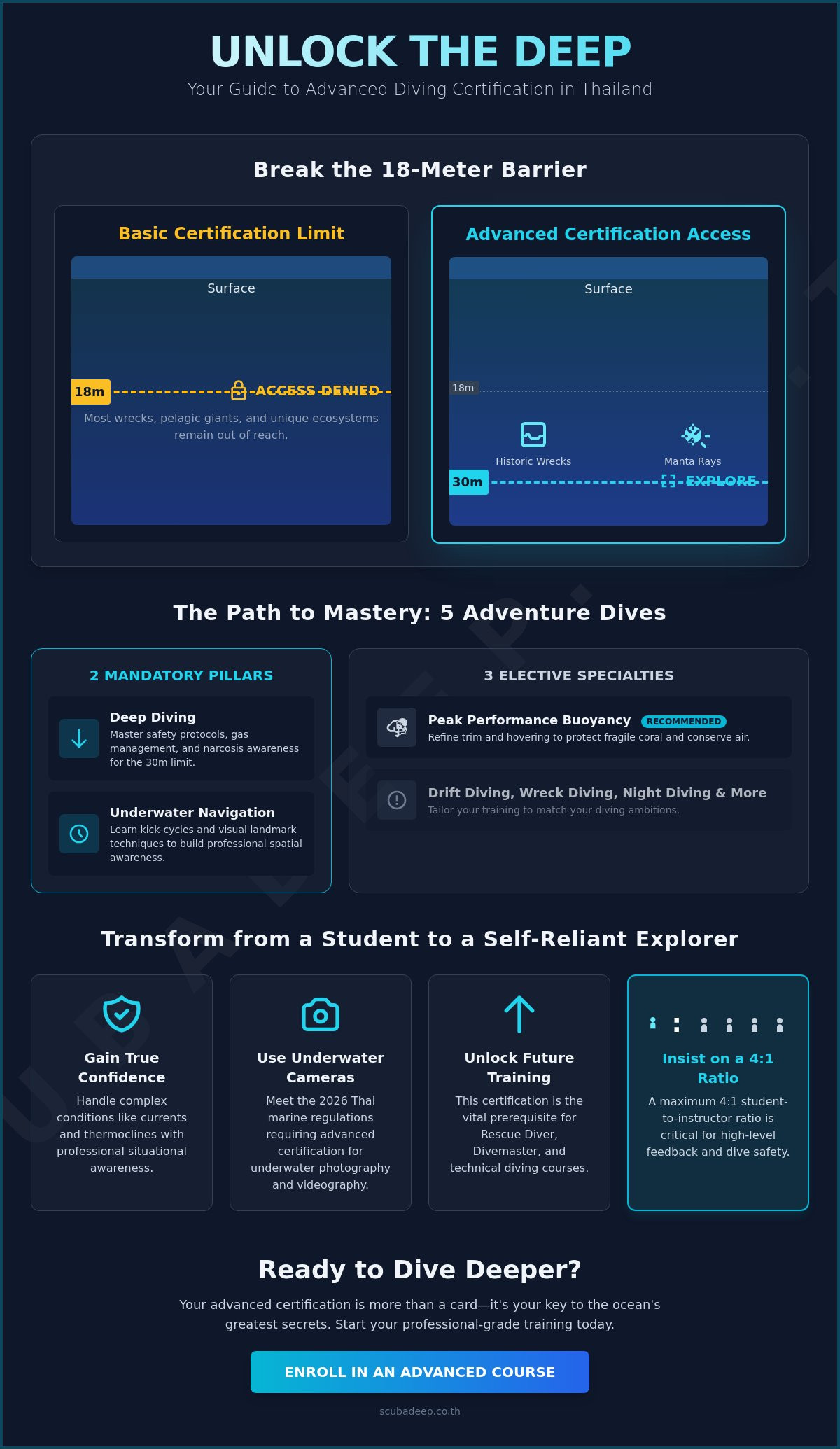
The 18-meter depth limit isn't just a safety guideline; it's a barrier that keeps you from Thailand's most legendary underwater secrets. If you've ever felt the frustration of staying shallow while others descend toward a historic wreck, you know that your initial training was only the first step. Enrolling in an advanced diving course Thailand is the definitive way to break through those restrictions and claim your place among the world's most capable explorers.
It's common to feel a bit of anxiety about managing air consumption or navigating tricky currents without a guide leading every move. You want to focus on the vibrant reefs, not struggle with your trim or worry about the 2026 regulations that now require advanced certification for using underwater cameras. This guide shows you how to refine your technical abilities so you can dive with genuine independence and professional-grade confidence.
We'll outline the exact path to mastering deeper descents and achieving the precise buoyancy needed to protect fragile ecosystems. You will learn which specialties provide the most value for your professional progression and how to unlock access to the deepest wrecks and most remote ecosystems in the region.
Key Takeaways
- Learn how to safely extend your depth limits to the 30-meter industry standard to access Thailand’s most exclusive underwater environments.
- Master essential navigation and deep-water techniques through five specialized adventure modules designed for professional skill progression.
- Understand why a maximum 4:1 student-to-instructor ratio is critical for ensuring safety and receiving high-level personalized feedback.
- Discover why completing an advanced diving course Thailand is the vital prerequisite for Rescue Diver certification and future technical diving opportunities.
- Gain the practical expertise needed to handle complex underwater conditions, from managing buoyancy in currents to navigating deep-sea wrecks.
Why an Advanced Diving Course in Thailand is Your Next Essential Step
Basic certification provides the foundation for your underwater journey, but it only grants you a glimpse of what the ocean truly offers. An advanced diving course Thailand serves as the professional bridge between entry-level skills and specialized expertise. It's designed to transform you from a supervised student into a self-reliant explorer who possesses the situational awareness to handle complex environments. You aren't just collecting another certification; you're building the confidence required to dive without an instructor leading every single step.
The most immediate change is the expansion of your operational limits. While basic training restricts you to 18 meters, obtaining an Advanced Open Water Diver certification officially extends your depth limit to 30 meters. This 12-meter difference is critical. In 2026, new Thai marine regulations also require this specific level of training for anyone wishing to use underwater cameras. This makes the advanced level the mandatory industry standard for anyone serious about documenting their discoveries or exploring the region's premier sites.
Breaking the 18-Meter Barrier
Many of Thailand's most iconic marine species, such as manta rays and whale sharks, are frequently encountered at depths between 20 and 30 meters. By staying shallow, you miss the chance to witness these pelagic giants in their natural habitat. Beyond the wildlife, this training introduces you to the physiological realities of nitrogen management and gas consumption at depth. You'll learn to monitor your dive computer with professional precision, ensuring that every minute spent on a deep reef is both safe and rewarding. This certification is the definitive standard for independent exploration in any professional dive circle.
Adapting to Thailand's Underwater Environments
Thailand's waters are beautiful but dynamic. The Andaman Sea often presents divers with strong drift currents that require specialized finning techniques and a calm mindset. Advanced training prepares you for these conditions, teaching you how to use the current to your advantage rather than fighting against it. You'll also learn to navigate thermoclines, those sudden layers of cold, low-visibility water that can disorient unprepared divers. Professional guidance during these dives is essential for mastering the subtle shifts in buoyancy and orientation. To prepare for these challenges, reviewing these scuba diving safety tips will help you establish the right mental framework before you even hit the water.
Core Skills and Adventure Dives: What You Will Master
The curriculum for an advanced diving course Thailand isn't just a list of tasks. It's a series of five specialized adventure dives that challenge your current abilities. While your initial training focused on survival and gear handling, this stage emphasizes refinement. You'll move away from following an instructor’s fins and start making critical underwater decisions yourself. This transition is vital for those wanting to move into professional tiers or simply dive with more autonomy.
The Mandatory Pillars: Deep and Navigation
Every advanced student must complete the Deep and Underwater Navigation modules. Deep diving introduces you to the safety protocols required for the 30-meter limit. You'll practice gas management and learn to recognize the subtle signs of nitrogen narcosis. These skills are essential for safely exploring the diverse Phuket dive sites guide, where many of the best features sit below 20 meters.
Navigation training focuses on precision. You'll master the 'kick-cycle' method to measure distance and use 'visual landmarks' like specific coral formations or rock clusters to find your way back to the boat. This builds the spatial awareness needed for professional advanced diver training protocols, ensuring you never feel lost in the blue.
Customizing Your Course with Electives
You choose three additional dives to tailor your training to your interests. In Thailand, three options stand out for their practical value. First, Peak Performance Buoyancy is critical for protecting the delicate coral reefs of the Racha Islands. You'll learn to hover effortlessly, which also significantly improves your air consumption. Second, Wreck Diving prepares you for iconic sites like the King Cruiser. You'll learn to navigate large structures while managing potential hazards.
Finally, Night Diving reveals the nocturnal biodiversity of the Andaman Sea, from hunting moray eels to bioluminescent plankton. Choosing these electives during your advanced diving course Thailand ensures you are prepared for the region's unique challenges. Selecting the right electives allows you to align your training with the specific topographies you plan to visit.
Refine your skills with a professional Advanced Open Water Course to see the ocean through a new lens.
Selecting the Right Professional Dive Center in Thailand
Selecting a training facility is the most influential decision you'll make for your professional progression. While many centers offer the advanced diving course Thailand, the quality of mentorship varies significantly. You shouldn't choose based on the lowest price alone. "Cheap" courses often cut corners by increasing group sizes or rushing through the mandatory modules. A "value" course prioritizes your mastery, offering more time to practice complex skills like advanced navigation or deep gas management.
The standard for excellence is a maximum 4:1 student-to-instructor ratio. This ensures you receive immediate, personalized feedback on your trim and situational awareness. Elite centers also pride themselves on their emergency readiness. Always verify that a facility maintains medical-grade oxygen and comprehensive first aid kits on board. Multi-lingual instructors are equally important. They ensure that technical concepts in the Advanced Open Water Diver course standards are clearly understood, regardless of your primary language. A center’s commitment to local conservation often mirrors their overall professional standards.
Safety Standards and Professional Certifications
Professional facilities act as consultants for your long-term goals. They don't just hand out certifications; they build competence. Look for centers that emphasize safety during every briefing and maintain their equipment to the highest industry standards. High-quality rental gear, including modern dive computers, is essential for managing your limits at 30 meters. When a center invests in its gear and its staff, it's a clear indicator of the quality of training you'll receive.
Logistics: Boats, Gear, and Timing
The vessel you dive from impacts your learning experience. Purpose-built dive boats provide stable platforms for gear preparation and professional briefings. This is a major advantage over shore-based operations or small speedboats. To truly optimize your experience, many professionals recommend including an enriched air nitrox course Phuket alongside your advanced diving course Thailand. This combination maximizes your bottom time on deep reefs and helps you stay more alert during multiple dives.
A typical itinerary spans two days, covering five to six dives. This pace allows for proper rest and thorough debriefings after each adventure dive. It's a methodical approach that ensures you don't just finish the course, but actually emerge as a more capable explorer. Secure your spot with a premier provider and book your Advanced Open Water Course today to start your professional progression.
Beyond the Certification: Your Future in Scuba Exploration
Completing an advanced diving course Thailand is a significant milestone, but it's really the launchpad for a lifelong pursuit of underwater mastery. This certification doesn't just grant you deeper access; it qualifies you for the next tiers of specialized training. Many divers find that once the 18-meter barrier is gone, their curiosity about safety and leadership grows. Adopting a mindset of continuous education ensures that every dive is safer and more rewarding than the last. By viewing this course as a foundation rather than a finish line, you prepare yourself for the challenges of more complex environments.
The advanced level is the mandatory prerequisite for the Rescue Diver and Master Scuba Diver tiers. These levels represent the pinnacle of recreational diving expertise. Beyond recreational limits, your new skills open the door to technical diving, where you can explore depths and overhead environments that remain off-limits to most. Scubadeep supports this long-term progression through a variety of specialties, ensuring you have the technical support and professional mentorship needed to reach your goals.
Specializing Your Skillset
The Rescue Diver course is the most logical next step for safety-conscious individuals. It shifts your focus from your own gear and buoyancy to the well-being of your team. You'll learn to anticipate problems before they occur and manage underwater emergencies with a calm, professional demeanor. This training is essential for anyone considering a transition into professional levels like Divemaster. If you aren't ready for another certification immediately, booking "Fun Diving" packages is an excellent way to cement your newly learned techniques. This allows you to practice navigation and deep gas management in a relaxed, non-training environment.
Joining the Elite Scuba Community
Being an advanced certified diver changes how you interact with the global diving community. You gain access to exclusive expeditions and networking opportunities with seasoned professionals who value high standards. Staying updated with the latest 2026 protocols and equipment is easier when you're part of a dedicated facility that prioritizes innovation. Scubadeep acts as your long-term consultant, providing the resources you need to stay current in an evolving industry. Whether you're aiming for a professional career or simply want to be the most capable diver on the boat, your journey continues with us.
For those looking to expand their career into the global diving industry, mastering professional communication with English Explorer can be the perfect complement to your technical expertise.
Explore our advanced training programs and start your journey with Scubadeep today.
Claim Your Place Among Thailand’s Elite Explorers
Transitioning from a beginner to a self-reliant diver requires more than just time underwater; it requires structured professional training. By enrolling in an advanced diving course Thailand, you bridge the gap between basic certification and specialized mastery. You've discovered how to navigate deep-sea wrecks and vibrant reefs with precision while breaking the 18-meter depth barrier. This progression isn't just about a new card; it's about gaining the situational awareness needed for a lifetime of safe exploration.
Choosing a mentor who prioritizes safety and mastery ensures you're prepared for the challenges of the open ocean. At Scubadeep, we provide expert multi-lingual instructors and maintain small student-to-instructor ratios to guarantee a premier learning environment. You'll gain exclusive access to Thailand's premier deep-sea dive sites while building the confidence to lead your own underwater adventures.
The ocean's most hidden secrets are waiting for those with the skills to find them. Elevate your diving skills with Scubadeep's professional advanced programs and start your journey toward professional excellence today. We look forward to seeing you in the water.
Frequently Asked Questions
What is the difference between Open Water and Advanced Open Water?
The primary difference lies in the level of independence and your operational depth limits. Open Water training focuses on fundamental safety and gear handling, while an advanced diving course Thailand emphasizes situational awareness and specialized environments. You move from basic survival skills to mastering specific activities like deep exploration or wreck navigation. This progression transforms you from a supervised student into a more self-reliant and capable underwater explorer.
Do I need a minimum number of logged dives to start the advanced course in Thailand?
You don't need a specific number of logged dives to begin your advanced training. Many divers choose to start immediately after their initial certification to keep their skills sharp and maintain momentum. This approach ensures that your basic habits are fresh while you learn more complex techniques. We simply recommend that you feel comfortable with your basic buoyancy before attempting the mandatory deep and navigation modules.
Can I complete the theory for my advanced course online before arriving in Thailand?
You can absolutely finish your theoretical studies online through digital learning platforms before your arrival. Completing the knowledge reviews at your own pace from home is a professional way to maximize your time in the water. This ensures that once you reach the boat, our instructors can focus entirely on your practical skill development and adventure dives. It's the most efficient way to manage your holiday schedule.
Is the advanced diving course difficult or physically demanding?
The course is designed to be engaging and focused on skill refinement rather than extreme physical exertion. While you'll complete five dives over a two-day period, the emphasis is on mental awareness and buoyancy control. Most students find an advanced diving course Thailand more relaxing than their initial training because they've already mastered the basics. It's about gaining experience in new environments under the guidance of a professional mentor.
How deep can I dive after completing the advanced course?
You'll be certified to dive to a maximum depth of 30 meters upon successful completion of the course. This is a significant expansion from the 18-meter limit of entry-level training. This 30-meter limit is the professional industry standard for recreational diving. It grants you access to Thailand's premier deep-sea pinnacles and historic wrecks. It also ensures you meet the 2026 regulatory requirements for using underwater cameras at these depths.
What happens if I haven't dived in a long time before starting the course?
We recommend a Scuba Refresher Review if it's been more than six months since your last underwater experience. This session ensures your fundamental safety protocols and buoyancy skills are current before you begin advanced training. It's a responsible way to build confidence and ensures you get the most value out of your new adventure dives. Starting with a solid foundation makes your progression toward the 30-meter limit much safer.