

Most travelers view the ocean as a scenic backdrop, yet for a select few, it's a professional playground where boundaries disappear. Deciding to enroll in a scuba license course Thailand is the definitive first step toward joining this global community of underwater explorers. It's natural to feel overwhelmed by technical jargon, safety requirements, or the variety of certification levels available. You want the freedom of the deep but might feel hesitant about the time commitment or finding an instructor who truly prioritizes your safety.
We understand that your journey beneath the waves should be as secure as it is exhilarating. This guide provides a professional, step-by-step roadmap to mastering the certification process and securing a license recognized at every dive site on the planet. We'll break down the essential course phases, clarify the current medical clearances required in Thailand, and show you how to select a premier dive center. By the end of this article, you'll have the confidence to move from the surface to the depths with absolute precision and expert guidance.
Key Takeaways
- Understand how an internationally recognized scuba license course Thailand serves as your permanent passport to explore the world's oceans independently.
- Learn why continuous education through advanced courses is vital for enhancing your safety and expanding your technical diving capabilities.
- Master the essential phases of training, moving from digital knowledge development to hands-on skill mastery in confined water environments.
- Identify the critical criteria for selecting a premier dive center, focusing on small group ratios and rigorous equipment maintenance standards.
- Gain total clarity on current medical clearance requirements and international standards to ensure a seamless certification journey.
Understanding the Scuba License Course in Thailand
Obtaining a scuba license course Thailand represents a significant transition from being a spectator to becoming an active explorer of the marine world. This isn't merely a recreational permit; it's a formal educational program that grants you the technical capability to dive independently with a buddy. Every certification issued here adheres to strict global protocols, ensuring that your credentials are recognized at dive centers across every continent. You aren't just learning to breathe underwater; you're gaining a lifetime qualification that opens the door to 70% of the planet.
International training agencies play a vital role in maintaining the integrity of these programs. By following established Open Water Diver certification standards, instructors ensure that every student masters essential physics, physiology, and safety procedures. These agencies conduct regular audits to uphold high-tier instruction. Thailand has emerged as a global hub for this education because it successfully balances these rigorous safety requirements with a welcoming, professional hospitality that puts beginners at ease. It's a place where expertise meets adventure in a highly structured environment.
The Entry-Level Certification: Open Water
The Open Water Course serves as the foundational license for the vast majority of divers. Upon successful completion, you gain the privilege to plan and execute dives to a maximum depth of 18 meters. This certification never expires, though we always recommend a refresher if you've been away from the water for an extended period. Prerequisites are straightforward but essential. You must be at least 10 years old, demonstrate basic swimming proficiency, and complete a standard medical questionnaire to ensure you're fit for the physical demands of the underwater environment.
Why Get Certified in Thailand?
Enrolling in a course within this region provides access to a diverse range of marine environments that act as the perfect classroom. From calm, clear bays to more challenging offshore sites, the variety of conditions helps build a more versatile skill set. You'll benefit from a high concentration of experienced, multi-lingual instructors who view themselves as mentors in your diving journey. Additionally, the cost-effectiveness of training here is a major draw. You can access premium instruction and modern equipment at a lower price point than in many Western countries, allowing you to invest more in your future diving adventures.
Progression Paths: Selecting Your Certification Level
Successfully finishing your initial scuba license course Thailand is a milestone, but the ocean's true depth requires ongoing skill refinement. Moving beyond the basics isn't just about exploring further; it's about building the technical resilience needed for diverse environments. Every new certification level introduces specific tools and mental frameworks that transform a novice into a self-reliant diver. This educational journey ensures that your muscle memory remains sharp while you encounter new variables like increased depth, stronger currents, or overhead environments.
Advanced and Specialty Training
Once you've secured your foundation, the next logical step is to expand your operational limits. The Advanced Diving Course Thailand focuses on practical application through five specialized dives. You'll learn to manage the physiological effects of depth and master the precision required for underwater navigation. Specialty training allows you to customize your journey further. For example, Enriched Air Nitrox is a popular choice for those wanting to extend their bottom times by using gas mixes with higher oxygen content. Other specialties like Wreck Diving and Deep Diving provide the technical framework necessary to explore historical sites or reach depths of 40 meters safely.
Rescue and Safety Leadership
Safety is the cornerstone of every elite diver's mindset. While early courses focus on individual skills, the Rescue Diver level shifts your perspective to the well-being of the entire dive team. This training is widely considered the most transformative experience for recreational divers. It teaches you to anticipate problems before they occur and manage equipment malfunctions or diver stress with professional composure. This level is often paired with first aid and emergency oxygen provider training to ensure a comprehensive safety toolkit. You can review our Scuba Diving Safety Tips to understand the rigorous standards we maintain throughout these leadership programs. If you're ready to advance, explore our professional certification tracks to find the right path for your goals.
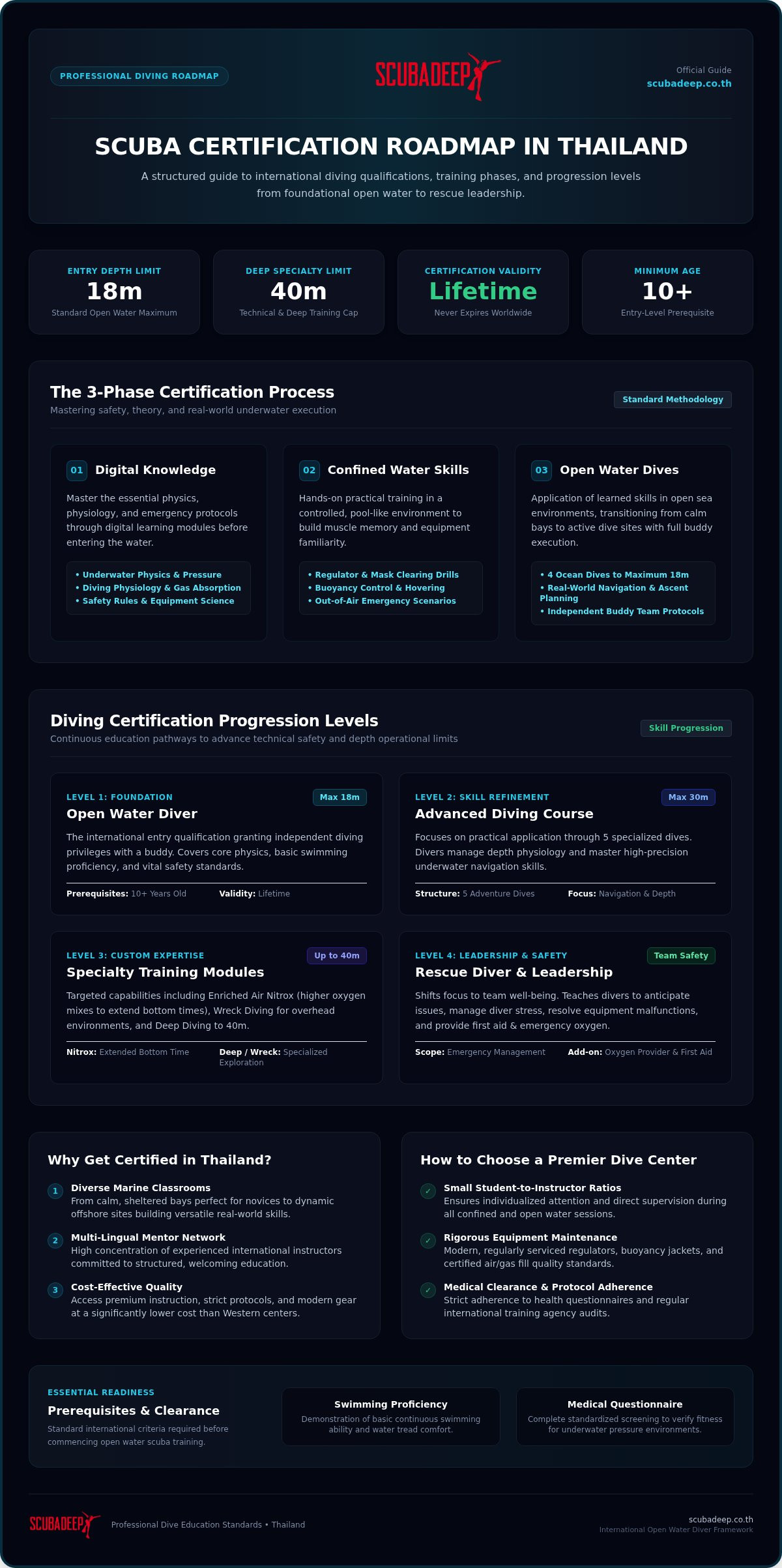
The 3-Phase Journey to Your Scuba License
Obtaining your certification is a methodical process designed to transform curiosity into competence. A scuba license course Thailand follows a logical progression that prioritizes your safety and psychological comfort at every stage. We adopt an "Elite Mentor" approach, maintaining low student-to-instructor ratios to ensure you receive personalized attention. This structure allows you to master complex technical skills without feeling rushed or overlooked in a large group. The journey is divided into three distinct phases: theoretical knowledge, confined water training, and open water application.
Mastering the Theory of Diving
The first phase focuses on the science that makes underwater exploration possible. Most students now opt for modern e-learning platforms, which allow you to complete the academic portion at your own pace before arriving. You'll study the physics of pressure, the mechanics of buoyancy, and the vital importance of dive planning. Understanding these principles ensures you can make informed decisions while submerged, effectively managing your air supply and decompression limits. This theoretical foundation is the cornerstone of underwater safety, providing the technical "why" behind every physical skill you'll later perform.
From the Pool to the Ocean
Once the theory is mastered, you'll transition to confined water training. This typically takes place in a swimming pool or a shallow, protected bay where conditions are entirely controlled. You'll build confidence by practicing essential skills such as mask clearing, regulator recovery, and air sharing with a buddy. These sessions are designed to make your reactions instinctive. After you've demonstrated proficiency in this safe environment, you'll move to the final phase: four open water check-out dives. During these dives, you'll apply everything you've learned in the ocean while being closely monitored by your instructor. Successfully completing these dives proves you have the mastery required to dive independently.
Completing a scuba license course Thailand is the most efficient way to gain a globally recognized credential while enjoying professional-grade instruction. If you're ready to begin your underwater education, you can book your Open Water Course today and start your journey with expert guidance.
How to Choose a Premier Dive Center in Thailand
Choosing where to enroll in a scuba license course Thailand is a vital safety decision. A premier center doesn't just provide a certification card; it ensures you become a safe, competent diver capable of managing your own underwater profile. Start by evaluating the center's commitment to equipment maintenance. Regulators and buoyancy control devices should be serviced according to strict manufacturer schedules, usually annually. High-quality centers invest in modern, well-maintained equipment to minimize technical risks and maximize your comfort during training.
Group size is a non-negotiable factor. While international standards allow for larger groups, an elite mentor approach limits ratios to four students per instructor. This ensures you receive immediate feedback and constant supervision. Beyond technical skills, diving offers deep personal rewards. You can explore the Benefits of Scuba Diving to see how this sport enhances mental and physical health. Always verify that the center holds current credentials with recognized international training agencies, as this guarantees the validity of your license.
The Instructor Factor
Your instructor acts as your gateway to the underwater world. Look for professionals who possess extensive local environmental knowledge and a proven track record of teaching. A professional mentor remains patient, inclusive, and highly attentive to student anxiety. Language support is also vital. In a global hub like Thailand, premier centers offer multi-lingual instruction to ensure there's no ambiguity during safety briefings or technical dive planning. Clear communication is the foundation of a successful learning experience.
Facilities and Logistics
Examine the logistics of the operation before committing. A professional center maintains its own dive boats equipped with essential emergency tools, including medical oxygen, first-aid kits, and marine radio systems. When reviewing the price, clarify exactly what's included. A transparent quote should cover your digital materials, certification fees, and equipment rental. Planning your schedule is equally important. Allow for at least three to four days for a stress-free certification. Rushing through the curriculum can lead to fatigue and reduced skill retention. A methodical approach ensures you leave the course feeling empowered and ready for the ocean.
Begin Your Underwater Legacy
Transitioning from a casual observer to a certified diver requires a structured path that prioritizes both technical skill and personal safety. You now understand that a scuba license course Thailand is more than a simple holiday activity; it's a professional certification program that grants you access to the world's most exclusive marine environments. By focusing on elite instructor-to-student ratios and our nationwide expertise in dive safety, you ensure your training meets the highest international standards. This rigorous foundation allows you to progress confidently into advanced specialties like Deep or Wreck diving while maintaining total control beneath the surface.
We're committed to acting as your elite mentor as you explore the depths and push your personal boundaries. We believe that every diver deserves a training experience that is as safe as it is exhilarating. Begin your journey with a professional scuba license course today and discover the profound transformation that awaits beneath the waves. The ocean is ready for those who value quality and expertise; let's explore it together.
Frequently Asked Questions
How long does it take to get a scuba license in Thailand?
A standard scuba license course Thailand typically requires three to four consecutive days to complete. This timeframe allows for a methodical progression through theoretical knowledge, confined water skill sessions, and the final four open water qualifying dives. We recommend scheduling a five-day window to allow for adequate rest and to ensure you don't feel rushed. This pace supports better skill retention and ensures you meet all safety standards with professional composure.
Do I need to be a strong swimmer to take a scuba license course?
You don't need to be a competitive athlete, but basic swimming proficiency is a mandatory safety requirement. Students must demonstrate the ability to swim 200 meters without aids or 300 meters using a mask, snorkel, and fins. Additionally, a ten-minute survival float or tread-water exercise is required. These prerequisites ensure you're comfortable in the water and capable of managing yourself on the surface before beginning your underwater training.
Is the scuba license earned in Thailand valid in other countries?
Yes, the certification you earn is internationally recognized and valid at dive centers across the globe. Thailand adheres to rigorous international training standards that ensure your credentials meet global requirements for independent diving. Whether you plan to explore the reefs of the Red Sea or the kelp forests of California, your license serves as a permanent passport to the underwater world. It's a lifetime qualification that requires no renewal.
What is the minimum age to start a scuba license course?
The minimum age to enroll in an entry-level certification program is ten years old. Divers between the ages of ten and fourteen earn a Junior Open Water certification, which comes with specific depth limits and requires supervision by a certified adult or professional. Once the diver reaches fifteen, the certification can be upgraded to a standard adult license. This structured approach ensures that younger explorers develop their skills within a safe and age-appropriate framework.
Can I start my scuba training online before arriving in Thailand?
Most modern students choose to complete their theoretical knowledge development via digital e-learning platforms before their arrival. This approach allows you to study the physics and physiology of diving at your own pace from home. By finishing the academic portion early, you maximize your time in the water once you reach the dive center. It's an efficient way to streamline your scuba license course Thailand and focus entirely on practical skill mastery during your visit.
What happens if I cannot complete all the course requirements?
If you're unable to finish all phases of the training, your instructor can issue an official referral form. This document details the specific segments you've successfully mastered and is valid for up to twelve months. You can take this referral to any authorized dive center worldwide to complete the remaining requirements without starting over. This flexibility ensures that your progress is documented and respected, allowing you to resume your education when you're ready.