

At 40 meters beneath the surface, ambient pressure reaches five atmospheres absolute, draining your breathing gas roughly five times faster than at sea level. Stepping into an accredited deep diver specialty course Thailand provides turns this demanding physiological environment into a disciplined, exhilarating adventure. You already appreciate the magnetic appeal of descending onto deep oceanic pinnacles and historic wrecks, but uncertainties surrounding nitrogen narcosis, emergency decompression stops, and gas redundancy can make even seasoned divers pause.
That hesitation is entirely natural, because moving beyond entry-level depth limits requires sharp technical awareness rather than casual guesswork. In this guide, you'll discover how dedicated deep training and premier safety protocols safely unlock Thailand's 40-meter underwater realm with total composure. We'll examine international certification requirements, gas consumption calculations, ascent line mechanics, and equipment configurations so you can explore deeper waters with absolute peace of mind.
Key Takeaways
- Enrolling in an accredited deep diver specialty course Thailand offers qualifies you to explore down to the universal recreational limit of 40 meters worldwide.
- Master mission-critical gas management calculations, narcosis recognition, and descent line control across four structured open water dives.
- Discover the specialized equipment configurations necessary for extreme recreational profiles, including redundant gas drop tanks and high-output dive torches.
- Learn how to evaluate elite training providers by inspecting low student-to-instructor ratios and comprehensive emergency oxygen setups.
- Understand how professional mentorship and physiological readiness assessments build the self-reliance required for Thailand's deepest underwater environments.
Understanding the Deep Diver Specialty Course in Thailand
Enrolling in a deep diver specialty course Thailand offers transforms recreational divers into disciplined, self-reliant explorers. While introductory certifications cover foundational competencies, this specialty establishes mastery at the absolute 40-meter (130-foot) recreational threshold. Operating across Thailand's warm, clear tropical waters provides ideal conditions to focus on task loading without battling extreme thermoclines or poor visibility. Gaining this certification safely unlocks deep offshore pinnacles and pelagic marine habitats that remain strictly inaccessible on shallower profiles.
The 40-Meter Benchmark vs. 30-Meter Advanced Limits
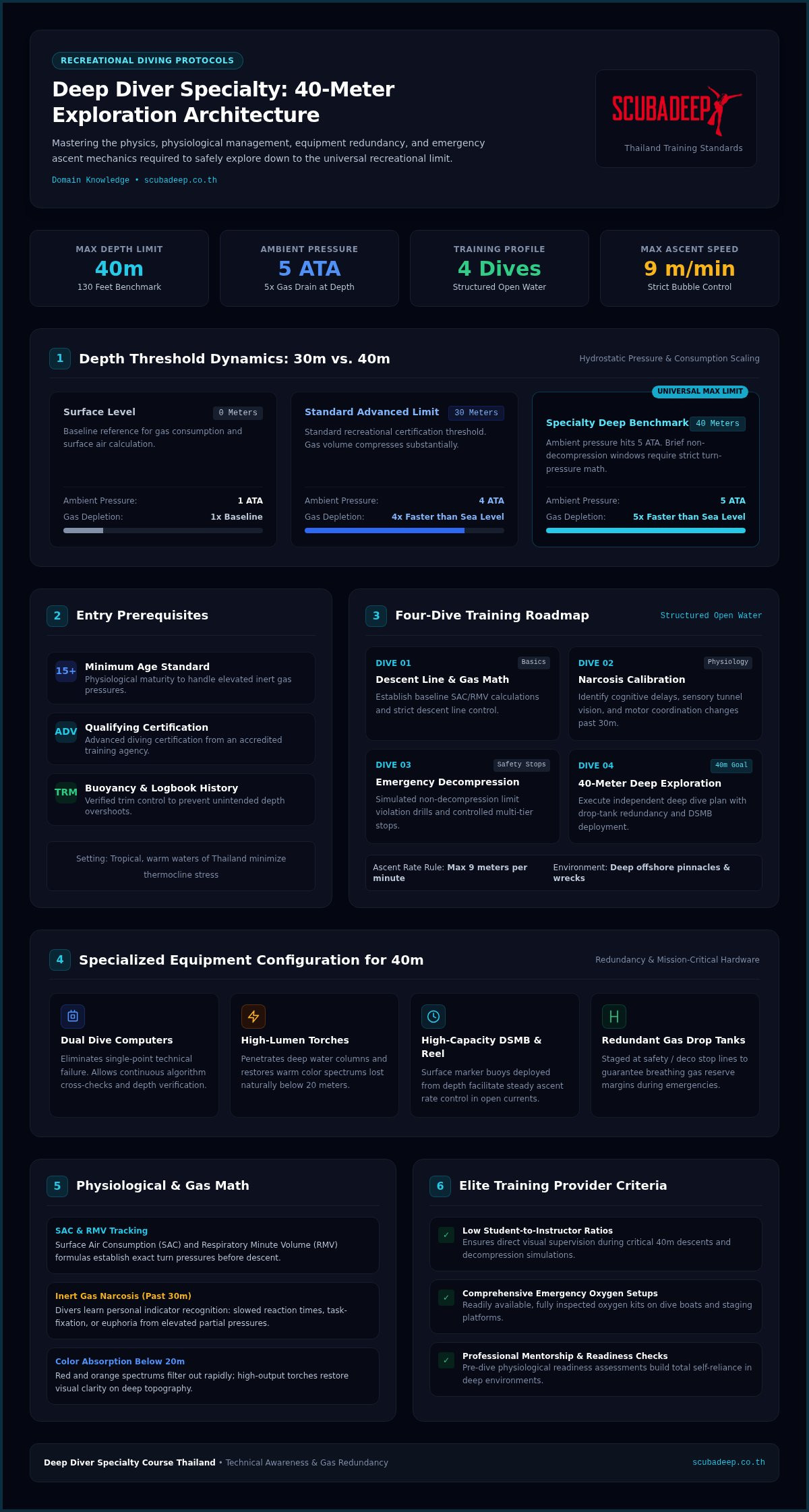
Standard advanced certifications typically cap exploration at 30 meters under general recreational parameters. Stepping down to 40 meters isn't merely adding depth; it fundamentally alters dive physics. At this depth, ambient pressure reaches five atmospheres absolute (ATA), compressing gas volume, accelerating cylinder consumption, and slashing non-decompression limits (NDLs) to brief windows. According to established recreational deep diving standards, divers must replace casual bottom monitoring with rigid turn-pressure schedules, descent line management, and multi-tier ascent rates. Specialty training systematically bridges this gap, ensuring candidates maintain complete composure while avoiding accidental decompression obligations.
Prerequisites and Entry Standards for Candidates
Diving to the edge of recreational limits demands established baseline proficiency. Before undertaking a deep diver specialty course Thailand programs require, candidates must hold an advanced diving course Thailand credential or an equivalent qualifying certification from an internationally recognized training agency. Candidates must be at least 15 years of age, ensuring the physiological maturity needed to handle elevated inert gas pressures. Training providers also inspect documented logbook history to confirm stable neutral buoyancy. Precise trim and buoyancy control are non-negotiable when suspended above deep seabeds where unintended descents can quickly compromise safety margins.
Core Curriculum: Skills, Physiology, and Specialized Equipment
Across four structured training dives, the deep diver specialty course Thailand presents elevates diver competence from observational diving to active gas planning and situational control. Building genuine underwater self-reliance requires understanding how elevated hydrostatic forces affect human physiology and equipment mechanics simultaneously.
Physiological Factors: Narcosis and Gas Management
Inert gas narcosis routinely manifests past 30 meters, slowing cognitive processing and dulling motor coordination. Students practice identifying early personal indicators like delayed response times, sensory tunnel vision, or uncharacteristic euphoria. Training pairs this mental calibration with strict gas management math. Divers calculate Surface Air Consumption (SAC) and Respiratory Minute Volume (RMV) to project exact turn pressures. Establishing non-negotiable turnaround thresholds ensures you always ascend with sufficient breathing gas reserves for both yourself and your team.
Critical Equipment Configuration for Deep Descents
Reaching deeper boundaries requires redundant hardware configurations to manage risks smoothly:
- Dual dive computers: Continuous depth monitoring and algorithm cross-checks prevent single-point technical failures.
- High-lumen primary torches: High-powered dive lights illuminate the dramatic loss of warm color spectrums below 20 meters.
- High-capacity DSMBs and reels: Surface marker buoys deployed from depth facilitate controlled ascents in open currents.
Integrating these configurations with practical scuba diving safety tips creates seamless operational readiness. If you want to refine your personal gear setup under direct professional supervision, exploring specialized mentorship through Scubadeep's training team offers an ideal next step.
Ascent Protocols and Emergency Decompression Safety
Deep ascents demand unwavering discipline. Divers must maintain a strict ascent rate capped at nine meters per minute, preventing rapid bubble formation in body tissues. Course drills incorporate simulated emergency decompression stops, training divers to manage inadvertent non-decompression limit violations calmly. Aligning your dive plans with medical guidance on decompression illness and dive safety protocols ensures conservative multi-day margins, including mandatory three-to-five-minute safety stops at five meters.
How to Choose the Right Deep Diver Training Program
Selecting the right dive center for your deep diver specialty course Thailand journey determines whether you merely collect a certification card or genuinely develop technical composure. While standard recreational operations often prioritize swift student turnover, mastering extreme recreational depths requires strict operational safety margins, small-group attention, and premium vessel support.
Instructor Ratios and Safety Support Systems
Direct oversight is vital at 40 meters. Top-tier dive centers maintain a tight ratio of no more than two to three students per instructor on deep training dives. This allows continuous monitoring of breathing cadence, situational awareness, and buddy cohesion. Reputable operations also run purpose-built support systems from their vessels:
- Weighted descent lines: Provide stable physical references to manage descent rates and avoid spatial disorientation.
- Dedicated stage tanks: Hang an auxiliary breathing gas cylinder with regulators at five meters to guarantee redundant gas for safety stops.
- Onboard medical readiness: Keep active oxygen demand valves, high-capacity pure oxygen units, and first-aid kits ready for immediate deployment.
Site Selection: Deep Offshore Pinnacles vs. Coastal Reefs
Training locations dictate the quality of your learning experience. Shallow coastal reefs lack the topography needed for true depth management. Elite centers select submerged offshore pinnacles that rise out of deep water. These sheer vertical drop-offs allow candidates to calibrate buoyancy in open blue water while using the pinnacle wall as a visual reference point. Sheltered deep sites also help you practice controlled ascents without unpredictable surge or heavy boat traffic compromising safety.
Synergies with Enriched Air Nitrox Specialty
Pairing deep training with an enriched air program represents the gold standard in recreational skill progression. Blending elevated oxygen percentages (typically 28% to 30%) extends non-decompression limits during repetitive profiles, drastically reducing post-dive fatigue. Candidates learn to calculate maximum operating depths to prevent central nervous system oxygen toxicity while optimizing bottom time. Divers who expand their education in this way experience the broader physical and mental benefits of scuba diving with supreme confidence. If you're ready to advance under elite supervision, enroll with Scubadeep today to secure personalized specialty instruction.
Booking Your Deep Dive Course with Scubadeep
Committing to a deep diver specialty course Thailand offers is an investment in personal competence, requiring a training partner that treats depth with absolute technical rigor. Scubadeep delivers world-class specialty instruction focused on precision, situational discipline, and true diver self-reliance. Rather than treating this qualification as a rapid tick-box exercise, elite mentors guide you through comprehensive theory reviews before you ever step onto the dive deck, ensuring your transition into open water is steady, controlled, and deeply rewarding.
The Scubadeep Training Methodology
Every phase of your training incorporates thorough operational preparation to ensure maximum comfort at depth:
- Detailed pre-dive briefings: Instructors pre-assess equipment configurations and analyze environmental conditions, descent line procedures, and conservative gas turnaround limits.
- Cognitive and communication drills: Underwater exercises test motor skills and buddy interaction under the actual physiological effects of depth, training you to manage nitrogen narcosis proactively.
- Profile debriefs: Instructors analyze your personal dive computer logs, critiquing your multi-level ascent rate profiles, safety stop depth control, and individual gas consumption trends.
Preparing for Your Course: Logistics and Certification Steps
Seamless execution begins long before boardings commence. Getting ready for your Deep Dive Course requires just a few straightforward preparation steps:
First, complete your digital learning modules ahead of arrival. Gaining command over depth physics, nitrogen absorption models, and gas volume calculations ensures you board the boat focused entirely on in-water execution. Second, verify that your standard Diver Medical Participant Questionnaire is fully up to date, securing physician clearance if any conditional flags arise. Finally, contact your instructors directly prior to day one. Pre-course scheduling coordination guarantees that your high-specification rental gear, computer setup, and custom dive plans align perfectly with your training itinerary in Thailand.
Take Command of Your Deep Diving Progression
Stepping beyond 30 meters marks a defining transition in your diving journey. Reaching the recreational limit of 40 meters demands deliberate gas planning, mental calibration, and disciplined equipment redundancy. When you enroll in a premier deep diver specialty course Thailand provides, you replace uncertainty with technical self-reliance, giving you the skills to explore vertical walls and submerged habitats with complete control.
Scubadeep pairs you with elite instructors who prioritize conservative safety margins above all else. With a modern fleet supporting offshore training, comprehensive emergency protocols, and redundant gas systems deployed on every descent, you receive the highest standard of specialty education. Your journey into deep water should be inspiring, structured, and executed with absolute precision. Advance your skills and certify to 40 meters with Scubadeep and begin exploring Thailand's magnificent underwater world with unwavering confidence.
Frequently Asked Questions
How deep can I dive after completing the Deep Diver Specialty Course?
You can dive to a maximum depth of 40 meters (130 feet) after earning your certification. This threshold represents the absolute boundary for recreational no-decompression diving recognized across international training agencies. Completing your deep diver specialty course Thailand training qualifies you to plan and execute dives to this depth globally without professional supervision, provided you stay within non-decompression limits and dive with a certified buddy.
Is the Deep Diver Specialty Course significantly more challenging than Advanced training?
The course demands greater mental discipline and precision gas planning rather than superior athletic endurance. While advanced courses introduce basic deep diving concepts down to 30 meters, specialty training focuses intensely on gas management calculations, narcosis recognition, and ascent speed regulation. You don't need elite physical strength, but you do need rock-solid buoyancy control and situational focus to handle faster gas consumption rates and reduced bottom times safely.
Can I combine my Deep Diver Specialty Course with an Enriched Air Nitrox certification?
Yes, combining these programs is a highly recommended progression path that maximizes your underwater efficiency. Enrolling in both your deep diver specialty course Thailand program and an Enriched Air Nitrox Course allows you to utilize oxygen-enriched gas mixes down to their maximum operating depths. This dual approach substantially extends your allowable non-decompression limits on repetitive deep profiles while teaching you how to manage oxygen exposure thresholds with expert precision.
What happens if I experience nitrogen narcosis during a training dive?
If you experience symptoms of inert gas narcosis, you and your instructor or dive buddy will immediately ascend several meters until the symptoms subside. Nitrogen narcosis produces sensations ranging from slowed thinking to mild disorientation, but it leaves no lingering physiological effects once ambient pressure drops. Course drills teach you to recognize your personal warning signs early, communicate clearly with your partner, and ascend together to restore sharp mental acuity instantly.
What equipment is required for deep specialty diving in Thailand?
Deep specialty diving requires standard recreational gear supplemented with specialized safety, signaling, and tracking equipment. You need a personal dive computer to monitor non-decompression limits and ascent rates accurately, alongside a secondary timing device or backup computer. You'll also use a high-powered primary dive torch to restore color spectrums absorbed by depth, an underwater slate for gas tracking, and a high-capacity surface marker buoy with a spool for open-water ascents.
How long does it take to complete the full deep certification program?
The certification takes two days to complete, comprising comprehensive theory and four structured open water training dives. Candidates review digital theory modules before completing in-water skills across consecutive boat days. If you've previously logged an accredited deep adventure dive during your advanced certification, your instructor can credit that dive toward Dive #1. This credit streamlines your schedule to three training dives while ensuring you achieve total mastery of all deep competencies.