

What if the difference between freezing during an unexpected crisis and saving a life isn't memorizing medical textbooks, but building raw muscle memory? Enrolling in an emergency first response course Thailand adventurers, divers, and professionals choose shouldn't mean sitting through hours of passive, dry lectures. It's completely natural to worry whether your training will satisfy international workplace prerequisites, or to feel confused by the technical distinctions between primary care, secondary care, and CPR modules.
You're certainly not alone in wanting training that moves beyond textbook theory and equips you for real emergency situations. In this comprehensive 2026 guide, you'll discover how to choose the premier emergency first response certification course in Thailand to build genuine, calm capability. We'll break down the core curriculum step by step, show you how realistic scenario training satisfies prerequisites for advanced rescue diver programs, and explain how to earn an internationally validated credential valid for two full years.
Key Takeaways
- Master the distinct practical boundaries between primary life-saving CPR techniques and secondary injury management.
- Identify quality benchmarks when selecting an emergency first response course Thailand training center, focusing on realistic scenario simulations over passive lectures.
- Complete the mandatory international prerequisite required to transition seamlessly into the advanced Rescue Diver Course.
- Earn an internationally recognized medical response credential valid for two years within a flexible, one-day practical training schedule.
Essential Curriculum of an Emergency First Response Course in Thailand
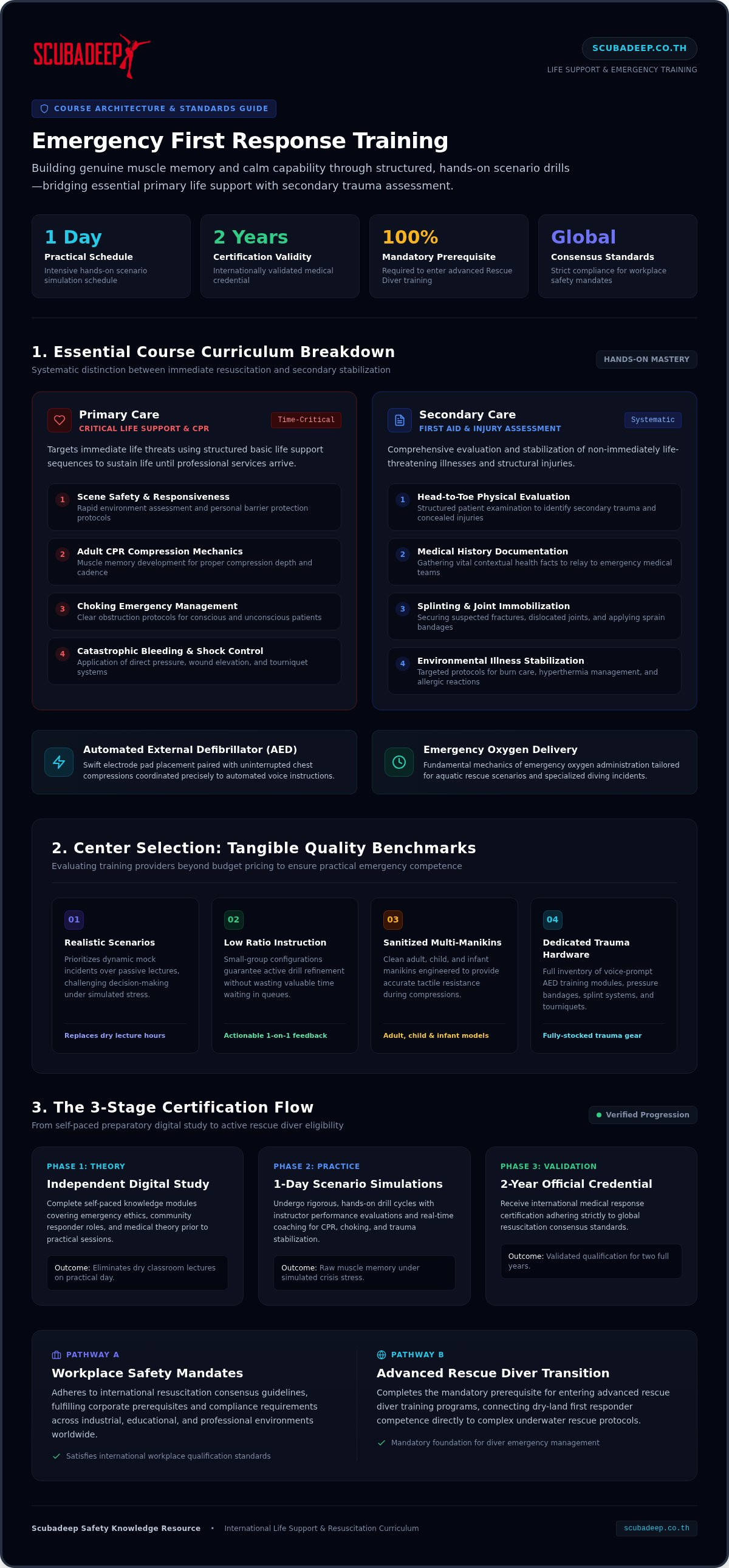
Emergency first response is an internationally recognized life-support curriculum designed to build immediate, practical capability during medical crises. Rather than treating emergency care as a passive theoretical lecture, an emergency first response course Thailand candidates undertake delivers structured, hands-on mastery of essential life-support protocols. Participants learn the civic and ethical role of acting as a prepared community first responder, mastering personal barrier protection, rapid patient assessments, and shock management techniques that sustain life until professional medical services take over.
Primary Care: Critical Life Support and CPR Protocols
Primary care instruction targets immediate, time-critical emergencies using structured basic life support sequences. Students rehearse scene safety assessments, responsiveness checks, and adult CPR mechanics using realistic compression depth and cadence. Hands-on drills establish total confidence in managing choking emergencies for conscious and unconscious patients, as well as controlling catastrophic bleeding through direct pressure, elevation, and tourniquet application.
Secondary Care: First Aid and Injury Assessment
Secondary care teaches responders how to evaluate and manage non-immediately life-threatening injuries through systematic patient evaluation. Trainees practice conducting comprehensive head-to-toe physical assessments and gathering relevant medical histories. Practical exercises focus on splinting suspected fractures, immobilizing dislocated joints, and stabilizing sprains with supportive bandages, alongside targeted protocols for burns, hyperthermia, and allergic reactions.
Automated External Defibrillator (AED) and Oxygen Administration
Modern emergency first response course Thailand curricula fully integrate automated external defibrillators into cardiac arrest practice. Responders practice swift pad placement while coordinating uninterrupted chest compressions according to automated voice prompts. In addition, students explore the fundamental mechanics of emergency oxygen delivery systems, developing critical competence for managing aquatic rescue scenarios and specialized diving incidents.
How to Choose the Best Emergency First Response Course in Thailand
Selecting the right training center requires looking past budget rates and evaluating tangible educational standards. The premier emergency first response course Thailand providers offer combines convenient independent digital study with focused, small-group practical drills. Low student-to-instructor ratios ensure you don't spend valuable training hours waiting in line; instead, you actively refine critical hands-on techniques. Before committing to a center, review these 15 essential scuba diving safety tips to understand the high baseline standards reputable safety professionals maintain.
Instructor Credentials and Practical Scenario Training
Practical competence depends entirely on instructors who take realistic simulations seriously. High-caliber facilities rely on experienced emergency care instructors who evaluate your performance directly, offering actionable feedback after every mock incident. Rather than sitting through repetitive lectures, you should spend the majority of your time reacting to dynamic scenarios that challenge your decision-making and build calm muscle memory under stress.
Facility Standards and Medical Training Equipment
Training quality is reflected in the equipment you handle during class. Reputable facilities provide clean, sanitized adult, child, and infant manikins that give accurate tactile resistance during compressions. You should also ensure the facility supplies dedicated AED training units with responsive voice prompts, alongside fully stocked trauma kits containing pressure bandages, splints, and tourniquets.
Certification Recognition and Workplace Compliance
Your certification should adhere strictly to international resuscitation consensus standards. This global alignment ensures your two-year qualification satisfies demanding corporate workplace safety mandates and fulfills mandatory prerequisites for advanced rescue diver training. When you're ready to master these vital life skills under dedicated mentorship, partnering with Scubadeep connects you directly with professional instructors focused on real-world responder competence.
Connecting First Response Skills to Advanced Rescue Diver Training
Solid medical response protocols bridge the critical gap between recreational exploration and rescue readiness. While foundational training begins on dry land, an emergency first response course Thailand divers complete instills the sharp situational awareness needed to spot subtle distress cues and defuse complications before they escalate. Pairing these fundamental life-support capabilities with an advanced diving course Thailand pathway transforms you from a dependent diver into a self-reliant, highly capable dive buddy.
The Essential Bridge to Rescue Diver Certification
International diver training agencies require current CPR and first aid credentials, completed within the previous twenty-four months, before granting rescue certifications. Mastering land-based stabilization exercises builds the mental resilience required for complex open-water emergencies. Candidates learn to translate stationary CPR techniques to shifting boat decks and rocky shorelines, establishing smooth coordination between in-water rescue teams and surface first aid managers.
Managing Diving-Specific Emergencies and Barotrauma
Advanced rescue scenarios require prompt identification of marine-specific trauma, such as pulmonary barotrauma, severe marine life stings, hypothermia, and near-drowning events. Responders practice delivering uninterrupted emergency oxygen to individuals showing suspected signs of decompression sickness while initiating local emergency medical dispatch. Cultivating this level of safety awareness also reveals the profound benefits of scuba diving, as physical stamina and calm mental focus directly reinforce underwater safety.
Take the next step in your diver education journey. You can enroll in the Rescue Diver Course with Scubadeep to turn basic medical skills into proactive diver safety leadership.
Booking Your First Aid Course in Thailand: Schedule, Fees, and Next Steps
Organizing your medical qualification in Thailand offers a clear, streamlined schedule designed for busy travelers and local professionals alike. An emergency first response course Thailand training center delivers generally wraps up within a single, highly productive day. Because reputable centers utilize digital home study, you absorb theoretical concepts beforehand at your own speed, leaving classroom hours completely free for tactile practice. Ready to get started? Take decisive action and reserve your training program with dedicated safety instructors.
Course Structure, Duration, and Preparation
Modern training blends flexible self-study with structured in-person skill mastery. Before arriving at the facility, you complete digital eLearning modules covering critical basic life support principles, injury surveys, and emergency prioritization. The in-person session spans roughly seven to eight hours of practical demonstrations, peer-to-peer bandaging exercises, and simulated crisis scenarios, concluding with an objective written exam confirming your knowledge retention.
Prerequisites, Inclusions, and Re-Certification Requirements
Getting certified doesn't require any medical background, swimming experience, or previous diving credentials. Open to both divers and non-divers, standard packages provide comprehensive resources to ensure complete readiness:
- Digital study manuals, emergency flowcharts, and quick-reference guides
- Hands-on practice materials, including sterile gauze, slings, splints, and pocket masks
- Official certification processing that awards an internationally recognized credential
Your certification remains valid for twenty-four months. Completing a brief refresher every two years updates your muscle memory against evolving international resuscitation protocols and keeps your workplace or dive safety qualifications active worldwide.
Step Forward with Proven Emergency Response Confidence
True readiness in an unexpected medical crisis isn't about memorizing rules; it's about building decisive, automatic capability. Completing an emergency first response course Thailand provides equips you with internationally validated CPR and first aid competencies that remain recognized worldwide for two full years. Whether you're satisfying prerequisites for advanced rescue training or stepping up to protect colleagues and loved ones, practical scenario rehearsal turns uncertainty into calm action.
Scubadeep delivers premier diver safety education meeting the highest international emergency standards. Through dedicated professional instructors and small-group scenario simulations, you experience a clear progression from foundational first aid skills through advanced rescue diver qualifications. Don't wait for an emergency to test your instincts. Master Life-Saving Skills with Scubadeep and gain the practical confidence to protect yourself and others wherever your adventures lead.
Frequently Asked Questions
Do I need scuba diving certification to take an emergency first response course in Thailand?
No, you do not need any scuba diving certification or previous medical training to enroll. An emergency first response course Thailand safety providers deliver is a comprehensive layperson program open to everyone. Non-divers, parents, teachers, and corporate staff regularly attend these sessions alongside divers. The skills focus on universal primary and secondary care principles applicable across everyday domestic emergencies, professional workplace environments, and outdoor recreational settings.
How long is an emergency first response certification valid after course completion?
Your emergency first response certification remains officially valid for twenty-four months from your completion date. International resuscitation protocols mandate this two-year cycle to guarantee that practical basic life support capabilities remain sharp. Once this period concludes, candidates simply attend an updated practical refresher workshop to review evolving CPR techniques, refresh scenario muscle memory, and renew their active responder credentials without retaking the entire foundational course.
Can I use this first response certification for workplace health and safety compliance?
Yes, this credential satisfies workplace health and safety compliance requirements across a wide range of corporate industries. Because the curriculum adheres to established international consensus guidelines from recognized resuscitation councils, multinational corporations, educational facilities, and travel organizations accept the credential. Employers recognize that students have proven hands-on capability in CPR execution, serious bleeding containment, and systematic shock management rather than just reviewing theoretical concepts online.
How much time does it take to complete the emergency first response course in Thailand?
Completing the full program typically requires one intensive day of hands-on classroom drills, supported by preparatory digital home study. Candidates study theoretical principles online beforehand at their own pace, which takes approximately two to four hours. The subsequent in-person workshop spans seven to eight hours. This practical time focuses purely on hands-on bandaging, CPR manikin cycles, and dynamic scenario testing under the direct supervision of qualified instructors.
What is the minimum age required to enroll in emergency first response training?
Standard international guidelines set no universal minimum age limit to enroll in first response training. The curriculum is entirely performance-based, requiring only that students demonstrate the physical strength and cognitive maturity to execute life-saving skills effectively. While some specialized training facilities establish a recommended baseline of twelve years old, motivated younger participants who can correctly perform chest compressions and follow AED prompts are welcome to earn their certification.
Does the course include automated external defibrillator AED training?
Yes, automated external defibrillator (AED) training is fully integrated into the primary care curriculum of modern courses. During your practical training, you'll work directly with dedicated AED training devices that feature simulated audio and visual prompts. You practice correct pad placement on adult and pediatric manikins while coordinating uninterrupted chest compressions. This hands-on integration ensures you possess complete confidence when utilizing public access defibrillators during a sudden cardiac crisis.