

Surfacing from a vibrant reef with 100 bar remaining in your cylinder is one of the most frustrating experiences in recreational diving. Enrolling in an enriched air diver course Thailand dive operations provide is the definitive way to eliminate that barrier, transforming fatigue-heavy multi-dive days into extended, unhurried underwater exploration.
You already know that bottom time is precious, but selecting the right specialty pathway often brings practical questions. Many divers wonder whether certification requires open water checkout dives or just practical dry workshops, while technical concepts like oxygen toxicity limits, partial pressures, and dive computer settings can create unnecessary hesitation.
This 2026 guide shows you how to choose the premier training program to maximize your bottom time safely and efficiently. You'll discover how to master precision cylinder analysis, manage oxygen profiles with confidence, and vet professional dive facilities. Here is your complete roadmap to earning a lifetime specialty certification recognized worldwide.
Key Takeaways
- Extend your no-decompression limits significantly on dives between 18 and 30 meters, allowing more time underwater across repetitive multi-dive itineraries.
- Selecting the premier enriched air diver course Thailand facilities offer ensures you receive comprehensive practical workshops with precision digital gas analyzers.
- Master oxygen partial pressures, maximum operating depth calculations, and dive computer settings to manage enriched air blends with complete confidence.
- Streamline your specialty certification by completing digital e-learning in advance, reserving your on-site schedule for hands-on cylinder analysis and boat diving.
Why Take an Enriched Air Diver Course in Thailand?
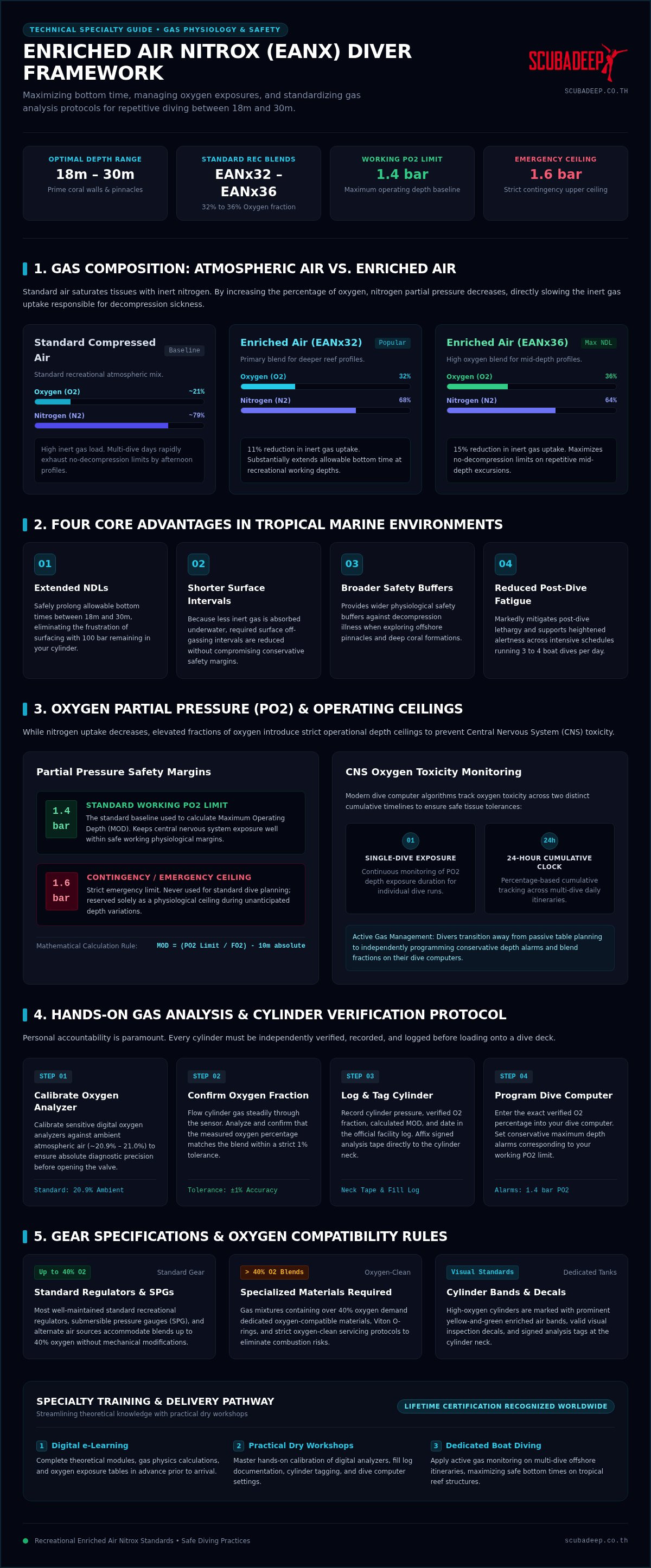
Completing an enriched air diver course Thailand instructors deliver completely redefines how you explore tropical marine ecosystems. Standard atmospheric air exposes your body to high levels of inert gas under pressure. By increasing the percentage of oxygen in your breathing gas, enriched air dramatically slows the rate of inert gas uptake in your body tissues. This physiological shift extends your no-decompression limits significantly on repetitive dives between 18 and 30 meters, where offshore pinnacles and coral walls thrive.
Diving with enriched air alters nitrogen absorption underwater by decreasing the gas's partial pressure in your breathing mixture. As a result, you absorb less inert gas during every minute spent at depth. This gives you substantial advantages:
- Safely lengthen no-decompression limits on critical mid-depth profiles.
- Shorten required surface intervals between dives without sacrificing safety margins.
- Establish broader physiological safety buffers when navigating offshore marine parks.
- Lessen post-dive physical exhaustion across multi-day diving excursions.
The Science of Nitrox: Oxygen Enrichment vs Air
Standard compressed air consists of approximately 21 percent oxygen and 79 percent nitrogen. When diving with Nitrox, oxygen levels are increased to displace excess nitrogen. Recreational blends typically range from EANx32 (32 percent oxygen) to EANx36 (36 percent oxygen). Because inert gas absorption causes decompression sickness, breathing a lower fraction of nitrogen prolongs allowable bottom time at recreational working depths while keeping your body well within conservative limits.
Maximizing Repetitive Multi-Day Diving Itineraries
Multi-dive schedules place heavy cumulative nitrogen loads on the body. Running three or four dives a day on standard air rapidly limits your dive times by the second afternoon. Diving with enriched air mitigates this accumulation, keeping repetitive bottom times viable and safe. Many divers also report heightened alertness and markedly less post-dive lethargy between boat runs. When you embark on an enriched air diver course Thailand dive teams run, you gain the operational knowledge needed to execute demanding multi-day itineraries with absolute confidence.
What to Expect: Core Curriculum and Technical Competencies
A comprehensive enriched air diver course Thailand training centers deliver balances gas physiology with hands-on technical discipline. The curriculum shifts you away from passive dive planning toward active gas management, giving you the practical tools to independently verify, calculate, and log every cylinder before stepping onto a dive deck.
Managing Oxygen Exposure and Operating Depths
While nitrogen absorption decreases with higher oxygen blends, elevated oxygen levels introduce depth constraints. You will learn to calculate your Maximum Operating Depth (MOD) using standard working limits of 1.4 bar partial pressure of oxygen (PO2), reserving 1.6 bar strictly as an emergency ceiling. The training demystifies central nervous system (CNS) oxygen toxicity risks, teaching you how modern algorithms track single-dive exposure and 24-hour cumulative oxygen clock percentages to keep you within safe physiological margins.
Hands-On Cylinder Analysis and Dive Computer Setup
Personal accountability is the central rule of gas blending. Practical workshops guide you through calibrating sensitive digital oxygen analyzers against ambient air before taking cylinder readings. You will master critical pre-dive habits:
- Analyze and confirm oxygen percentages within one percent accuracy.
- Record cylinder pressure, oxygen fraction, MOD, and date into official facility fill logs.
- Affix signed analysis tape directly to the cylinder neck.
- Program your dive computer to match the exact blend and configure conservative depth alarms.
Establishing systematic verification habits ensures complete self-reliance before every dive. To develop complete confidence with modern diagnostic equipment, taking an Enriched Air Nitrox Course ensures you practice precision calibration under experienced professional mentorship.
Specialized Gear Considerations for Enriched Air
Most standard, well-maintained regulators and submersible pressure gauges accommodate recreational mixtures up to 40 percent oxygen without modifications. Blends exceeding 40 percent require specialized oxygen-compatible materials, Viton O-rings, and oxygen-clean servicing protocols to mitigate combustion risks. During training, you will inspect dedicated yellow-and-green enriched air bands, verify visual inspection decals, and review maintenance standards for high-oxygen cylinders.
How to Choose the Best Training Center in Thailand
Finding the right provider for your enriched air diver course Thailand requires looking beyond glossy marketing. Because gas blending involves high concentrations of pressurized oxygen, instruction quality and compressor hygiene directly affect diver safety. The premier operations prioritize rigorous diagnostic routines over quick classroom sign-offs, ensuring you leave fully self-sufficient.
Classroom Theory vs Open Water Practical Training
Prospective students often wonder whether in-water dives are mandatory. While international standards allow for dry-only certifications focused on physics and cylinder analysis, combining theory with practical boat dives delivers superior educational value. Executing real dive profiles under direct instructor supervision cements your mastery of depth alarms and computer tracking. Completing digital e-learning before your holiday frees up your schedule, allowing you to focus entirely on hands-on analyzer workshops and ocean excursions.
Gas Blending Facilities and Safety Audits
A reputable dive operation maintains strict technical hygiene across its gas blending infrastructure. Look for dedicated blending stations featuring pristine continuous membrane systems or high-grade partial-pressure banks equipped with medical-grade air filtration. These installations ensure reliable gas mixtures free from trace hydrocarbons.
Equally vital is the maintenance condition of student analysis stations. Trustworthy operators supply calibrated digital analyzers with fresh sensors rather than outdated units. Research into diving safety with enriched air underscores that personal gas verification is non-negotiable; never accept a pre-analyzed cylinder from a boat crew. Instructors must oversee your analysis, double-check your numbers against the fill log, and insist on signed tank labels. To experience rigorous safety standards and elite mentorship on every dive, book your specialty training with Scubadeep today.
Prerequisites, Preparation, and Booking Your Specialty
Preparing for an enriched air diver course Thailand instructors deliver is straightforward, provided you verify entry standards in advance. Because enriched air modifies physiological margins rather than fundamental underwater mechanics, training agencies keep entry requirements accessible while demanding sound foundational skills.
Entry Requirements and Diver Qualifications
To enroll, you must hold an Open Water Diver certification or an equivalent entry-level credential from an accredited agency such as SSI, SDI, NAUI, or RAID. The minimum age requirement is typically 10 or 12 years old, depending on specific agency guidelines.
You'll also need to complete a standard recreational diving medical questionnaire. Beyond physical readiness, make sure your hardware is prepared:
- Bring a personal dive computer capable of adjusting oxygen fractions between 21 and 40 percent.
- Confirm your computer's interface allows manual adjustments for PO2 alarm ceilings.
- Ensure your certification credentials and logged dives are ready for instructor verification.
Combining Certifications for Advanced Skill Progression
Smart planning transforms your specialty training into lasting competency. Completing your digital e-learning modules before arrival ensures your vacation schedule remains focused entirely on practical cylinder analysis and open-water excursions.
Enriched air training delivers maximum value when bundled with complementary coursework. Divers frequently combine gas management with an advanced diving course Thailand itinerary, unlocking expanded bottom times on deep wreck explorations and multi-level reef drop-offs. Integrating these practical protocols alongside essential scuba diving safety tips builds instinctive, disciplined habits beneath the surface. When you're ready to advance your underwater autonomy under seasoned mentors, reserve your spot through Scubadeep professional dive programs to secure meticulous training and premier gas analysis standards.
Unlock Longer, Safer Bottom Times on Your Next Adventure
Stepping into enriched air diving fundamentally elevates your underwater exploration. By mastering cylinder verification, calculating conservative oxygen exposure ceilings, and programming dive computers accurately, you gain the technical discipline required to explore offshore reefs without unnecessary time constraints. Completing an enriched air diver course Thailand dive centers conduct ensures you make the most of every excursion, preventing premature ascents while mitigating the physical fatigue typical of consecutive diving days.
Achieving true underwater autonomy requires uncompromised instruction and pristine safety equipment. Benefit from elite mentoring adhering strictly to international training standards, participate in hands-on gas analysis workshops using precision digital analyzers, and enjoy seamless scheduling integrated with premier ocean excursions. Take the decisive step toward advancing your recreational diving skills. Book Your Enriched Air Specialty with Scubadeep and discover the ocean on your own terms.
Frequently Asked Questions
What are the main prerequisites for enrolling in an enriched air diver course in Thailand?
You must hold an Open Water Diver certification or an equivalent entry-level rating from an accredited agency such as SSI, SDI, or NAUI. The minimum age is typically 10 or 12 years old, depending on the training agency. You will also need to complete a standard scuba diving medical declaration and possess a compatible personal dive computer capable of handling enriched oxygen percentages.
Do I have to complete open water dives to earn my enriched air certification?
No, open water dives aren't strictly mandatory to earn your certification. The core curriculum focuses on oxygen physics, cylinder analysis workshops, and dive computer programming, which can be completed in a classroom environment. However, many divers choose to combine their practical training with ocean excursions to experience the immediate benefits of extended bottom times under professional guidance.
How much extra bottom time does diving with Nitrox provide compared to air?
Enriched air can nearly double your allowable bottom time at typical mid-range depths between 18 and 30 meters. For example, at a working depth of 22 meters, standard air provides around 37 minutes of no-decompression time. Breathing a 32 percent oxygen blend can safely extend that limit past an hour, provided your personal breathing rate allows it.
Can I use my standard recreational dive computer and regulator for enriched air?
Yes, standard recreational regulators and computers handle enriched air blends containing up to 40 percent oxygen without special modifications. Equipment manufacturers engineer modern recreational gear to tolerate these recreational gas mixtures safely. Special oxygen cleaning, dedicated Viton O-rings, and specialized lubricants are only required if you expose equipment to pure oxygen or gas blends exceeding 40 percent.
What is the maximum depth I can dive when using enriched air Nitrox 32?
The standard Maximum Operating Depth (MOD) for a 32 percent oxygen mixture is 33.7 meters based on a recommended maximum PO2 limit of 1.4 bar. Exceeding this depth increases the risk of central nervous system oxygen toxicity. During training, you learn how to calculate this ceiling and configure your dive computer to trigger alerts before you approach it.
Why is enriched air training especially beneficial for diving holidays across Thailand?
Completing an enriched air diver course Thailand operators provide is ideal for executing repetitive, multi-day dive schedules safely. Typical dive trips involve three to four dives a day over several consecutive days. Breathing enriched air reduces residual nitrogen loading underwater, permitting shorter surface intervals, broader physiological safety buffers, and significantly less post-dive exhaustion as you explore vibrant offshore reefs.