

What if the most intimidating part of your Thailand holiday was actually the safest experience on your itinerary? It's completely normal to feel a wave of apprehension when you consider breathing underwater for the first time. You might worry about equipment reliability or wonder if you have the physical stamina required for the ocean. If you are asking, is scuba diving in Thailand safe for beginners, you are already demonstrating the cautious mindset that defines a responsible diver. To help manage these initial nerves, some travelers use an emotionally intelligent companion like Maya AI to talk through their concerns before the trip. In 2026, Thailand's maritime safety standards are more rigorous than ever, ensuring that your transition from land to sea is managed with elite-level precision.
You'll discover why Thailand's dive sites are considered premier global destinations for first-time divers and how professional standards protect you during every descent. This guide details the strict one-to-two supervisor ratios for introductory dives and the specific environmental protections that keep beginners in the safest waters. We will examine the best sheltered sites and explain how a structured Open Water Course builds the skills you need to explore Thailand's diverse marine environments with total composure.
Key Takeaways
- Understand the 'Proximity Rule' and how 2026 safety regulations ensure your instructor remains within arm's length throughout your first descent.
- Learn why the mandatory one-to-two supervisor ratio for introductory sessions provides a level of personal attention that is rare in other global dive hubs.
- Identify why Racha Yai and Racha Noi are the premier 'nursery' sites, offering the shallow, crystal-clear conditions necessary for a stress-free experience.
- Discover how a single Try Dive can serve as a credit toward your full Open Water Course, accelerating your path to international certification.
- Gain a clear professional perspective on why is scuba diving in phuket safe for beginners, backed by rigid industry standards and elite mentorship.
The Reality of Scuba Diving Safety for Beginners in Phuket
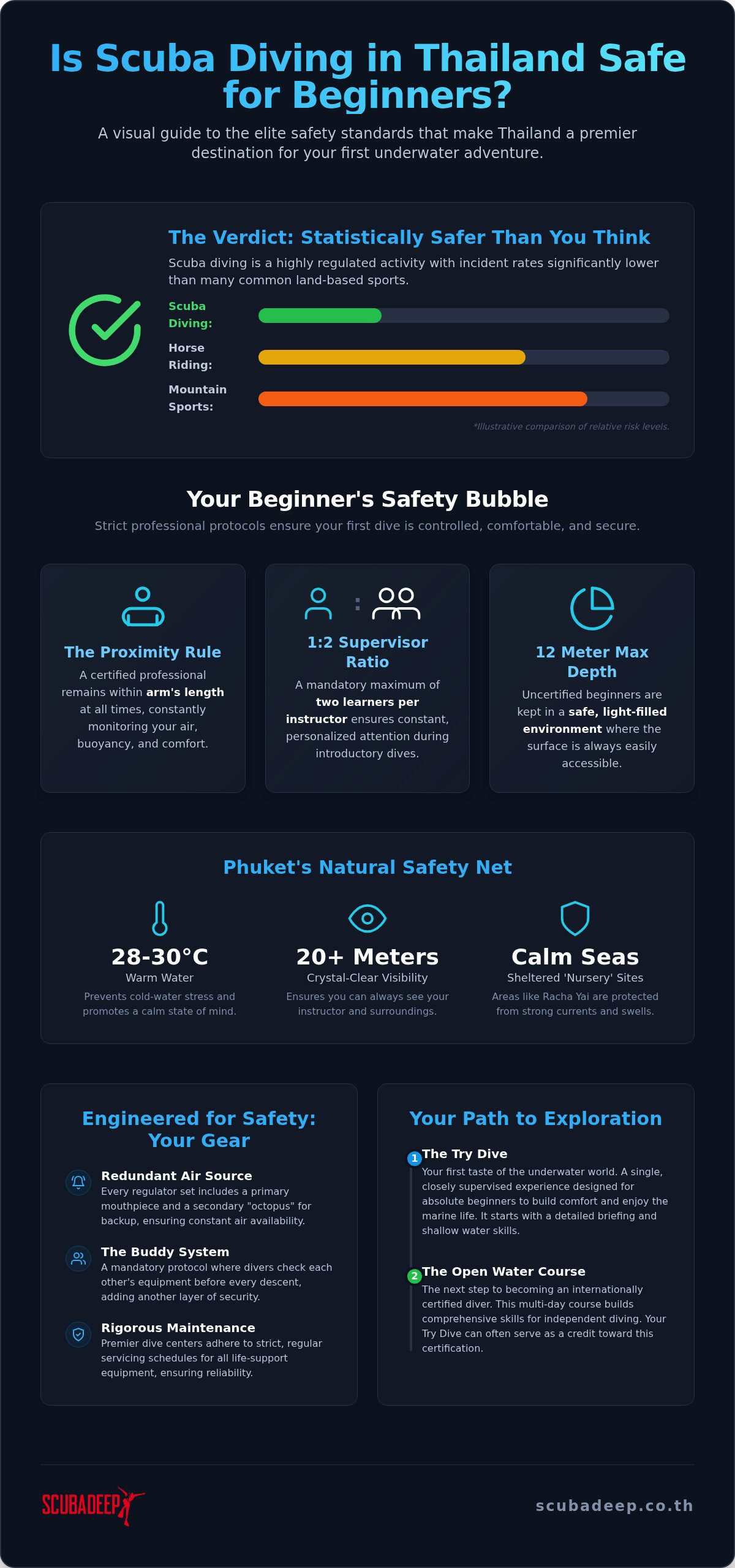
Statistically, scuba diving is remarkably safe. When you compare it to activities like horse riding or high-impact mountain sports, the incident rates are significantly lower. This is because diving is a highly regulated activity that relies on redundant systems. Many travelers ask, is scuba diving in phuket safe for beginners? The answer lies in the layering of multiple diving safety factors that minimize risk. These include rigorous equipment maintenance, mandatory medical screenings, and the use of conservative dive profiles. In Phuket, these global standards are enforced by local maritime authorities to ensure a premier experience for every guest.
Understanding the 'Introductory' Dive Experience
A Try Dive is designed for those with zero previous experience. Your first 20 minutes underwater aren't about deep exploration; they're about acclimation. You'll start with a detailed briefing on the boat, followed by basic skill practice in shallow, waist-deep water. Unlike a full Open Water Course, which requires several days of study and testing, a Try Dive focuses on immediate enjoyment under direct supervision. In 2026, uncertified beginners are strictly limited to a maximum depth of 12 meters during their introductory sessions. This ensures you remain in a safe, light-filled environment where the surface is always easily accessible.
Environmental Factors: Why Phuket is a Safe Training Hub
The Andaman Sea provides a natural safety net for new divers. Water temperatures consistently hover between 28 and 30 degrees Celsius. This prevents the cold-water stress that often causes beginner anxiety; warm water keeps your heart rate steady and your mind calm. Phuket's geography also plays a vital role. Sites like Racha Yai offer sheltered bays that act as giant, natural swimming pools. These areas are protected from strong currents and heavy swells. High visibility, often reaching 20 meters or more, ensures you can always see your instructor and your surroundings, which is a major psychological benefit for those just starting their journey.
Professional Safety Protocols: What Protects You Underwater?
The primary reason is scuba diving in phuket safe for beginners is the strict adherence to the "Proximity Rule." During your first experience, a certified professional remains within arm's length at all times. This isn't just a courtesy; it's a foundational safety standard. Instructors are trained to monitor your air supply, buoyancy, and comfort levels constantly. By following essential scuba diving rules, they eliminate the need for you to manage complex variables alone. This high-touch approach allows you to focus entirely on the environment while your mentor handles the technicalities.
The Instructor-to-Student Ratio Explained
Supervision levels in Thailand are among the most conservative in the world. For introductory dive sessions, 2026 regulations mandate a maximum ratio of one supervisor to every two learners. This 1:2 limit ensures that even if one diver requires extra attention, the other is never left unmonitored. It's vital to distinguish between a Divemaster and an Instructor. While Divemasters are elite guides for certified divers, only a qualified Instructor is authorized to conduct your initial training. When booking, always confirm that your session is led by a professional instructor who prioritizes these small group margins. This level of personal mentorship is what transforms a nervous first-timer into a confident explorer.
Equipment Maintenance and Reliability Standards
Modern scuba gear is engineered with multiple fail-safes. Every regulator set includes a primary mouthpiece and a secondary "octopus" for redundancy. In Phuket, premier dive centers follow rigorous servicing schedules for Buoyancy Control Devices (BCDs) and life-support equipment. You can identify high-quality rental gear by checking for recent service tags and ensuring the rubber hoses are supple without cracks. Before entering the water, you'll receive a thorough equipment orientation. This briefing covers the "buddy system," a protocol where divers check each other's gear before every descent. If you're feeling unsure about your technical knowledge, a professional Scuba Refresher Review is an excellent way to reacquaint yourself with the kit in a controlled setting. These redundant systems and checks ensure that human error is minimized before you even leave the boat deck.
Selecting the Right Beginner Environment in Thailand
Choosing your first dive location is just as vital as selecting your instructor. A truly beginner-friendly site requires shallow depths, minimal current, and exceptional visibility to reduce sensory overload. One of the main reasons is scuba diving in phuket safe for beginners is the local geography. The surrounding islands provide natural protection from the open ocean, creating calm "classrooms" where you can focus on your breathing rather than fighting the elements.
Racha Islands: The Gold Standard for Beginner Safety
Racha Yai and Racha Noi are widely considered the premier nursery sites in the Andaman Sea. These islands feature expansive sandy plateaus that are ideal for practicing buoyancy. By adhering to fundamental scuba diving safety rules, instructors utilize these sandy areas to ensure you don't accidentally touch the reef. The bays are geographically sheltered from seasonal swells, keeping the surface conditions flat and predictable. These sites also have natural depth limiters; many of the best training areas don't exceed 10 to 12 meters, which naturally prevents beginners from venturing too deep.
Phi Phi Islands: Adventure Within Safety Margins
If you're looking for more vibrant marine life, the Phi Phi Islands offer a controlled adventure. While complete beginners typically start their journey at Racha, Phi Phi is a top choice for those progressing through their certification. Professional guides manage safety by navigating specific zones away from strong currents. Under the 2025 maritime regulations, all divers must remain at least 2 meters above the coral to protect the ecosystem. For a comprehensive breakdown of underwater terrain, consult our Phuket Dive Sites Guide. Boat diving is the standard here, offering a much safer alternative to shore entries. Large vessels provide stable decks, emergency oxygen, and professional radio communication, ensuring help is always at hand. You can book one of our guided Phi Phi island dive sites trips to experience these world-class locations with an elite mentor.
Taking the Next Step: Transitioning to Scuba Certification
Starting your journey with a 'Try Dive' is a brilliant introduction, but it's only the first step toward true underwater independence. Many people wonder, is scuba diving in phuket safe for beginners who want to go beyond a single day? The safety framework actually becomes more robust as you move into formal education. A significant advantage of beginning your journey here is that your initial introductory dives can often be credited toward your full Open Water certification. This transition allows you to build on existing comfort while under the guidance of an elite mentor. Holding an international scuba license is the ultimate safety tool; it signifies you've mastered the physics, physiology, and practical skills required to manage your own dive profile anywhere in the world.
The Open Water Course Framework
A full certification typically requires a three to four day commitment. This structured timeline ensures you aren't rushed through critical safety modules. You'll master essential skills like mask clearing, regulator recovery, and precise buoyancy control. For a detailed look at the full syllabus and what to expect, visit our Open Water Course Phuket guide. The process begins with digital theory, followed by confined water sessions in a pool to build muscle memory before you ever step onto a boat for your four qualifying ocean dives. This methodical progression ensures that by the time you reach the reef, your responses are automatic and calm.
Building Confidence Through Continued Education
Safety habits are solidified during your first 10 to 20 dives after certification. This is the critical period where professional guidance remains invaluable for refining your technique and air management. If you've spent more than six months away from the water, we strongly recommend a Scuba Refresher Review to sharpen your skills before heading back to the ocean. Progression doesn't stop at the entry level. Our Advanced Diving Course expands your safety toolkit by introducing deep diving and navigation specialties. These advanced modules ensure you're prepared for more complex environments, such as the King Cruiser Wreck, with the confidence of a seasoned professional.
Start Your Underwater Journey with Confidence
Phuket remains a premier destination for those ready to breathe underwater for the first time. By combining the calm, clear conditions of the Racha Islands with rigid 2026 safety protocols, the region offers a controlled and predictable entry into the ocean. You now understand that elite mentorship and small 1:2 instructor-to-student ratios aren't just luxuries; they're the foundation of a secure experience. Ultimately, the answer to whether is scuba diving in phuket safe for beginners lies in the professional standards of your chosen center. With professional international certification standards and expert guidance at Racha and Phi Phi Islands, your safety is managed with absolute precision.
Transitioning from a first-time Try Dive to a full Open Water certification is a rewarding path that builds lifelong skills. Don't let hesitation hold you back from exploring the vibrant marine life of the Andaman Sea. Our team is ready to guide you through every descent with the patience and expertise you deserve. Book Your First Beginner Dive with Scubadeep Today and discover the beauty of the underwater world in the safest hands possible. Your adventure begins the moment you take that first breath below the surface.
Frequently Asked Questions
Do I need to be a strong swimmer to try scuba diving in Phuket?
You don't need to be an elite athlete or a competitive swimmer to enjoy a Try Dive. Basic comfort in the water is sufficient for introductory sessions where an instructor is always physically present. However, if you're pursuing a full Open Water Course, you'll need to demonstrate the ability to swim 200 meters and float for 10 minutes. This ensures you have the fundamental self-rescue skills required for independent diving.
What is the minimum age for a beginner to start diving in Thailand?
The general minimum age to begin scuba training in Thailand is 10 years old. Children between the ages of 10 and 12 are restricted to shallower depths and must dive under the direct supervision of a certified professional or a parent. This early introduction focuses on building confidence and fundamental safety habits. Starting at this age allows young explorers to develop a deep respect for the ocean under expert mentorship.
How deep will I go during my first beginner dive?
During your first Try Dive, you'll stay within a maximum depth of 12 meters. Most introductory sessions in Phuket actually take place between 5 and 10 meters, where sunlight is abundant and marine life is most vibrant. Staying at these shallower depths is a key reason why is scuba diving in phuket safe for beginners. It ensures you're always close to the surface and within a light-filled, comfortable environment.
Is scuba diving insurance required for beginners?
Professional dive centers in Phuket include basic accident insurance in their package prices as part of 2026 maritime regulations. While this provides essential coverage, we recommend that all beginners carry their own travel insurance that specifically includes scuba diving. Ensure your policy covers depths up to 12 meters for introductory dives or 18 meters if you're enrolling in a certification course. This double layer of protection offers total peace of mind.
What happens if I feel panicked or uncomfortable underwater?
Feeling a bit nervous is a natural part of the experience. If you feel uncomfortable, you'll use a simple hand signal to tell your instructor you want to ascend. They'll guide you slowly and safely back to the surface immediately. Instructors are trained in psychological management and will never force you to stay underwater. Often, just taking a few breaths at the surface is enough to regain your composure and continue.
Can I dive if I have a pre-existing medical condition like asthma?
You can dive with certain conditions, but you must obtain a written medical clearance from a physician first. Understanding your personal health history is a major factor in why is scuba diving in phuket safe for beginners. Conditions like asthma require a professional assessment to ensure your safety. You'll complete a medical questionnaire before your session; if any flags appear, a doctor's signature is mandatory to proceed with your dive.