

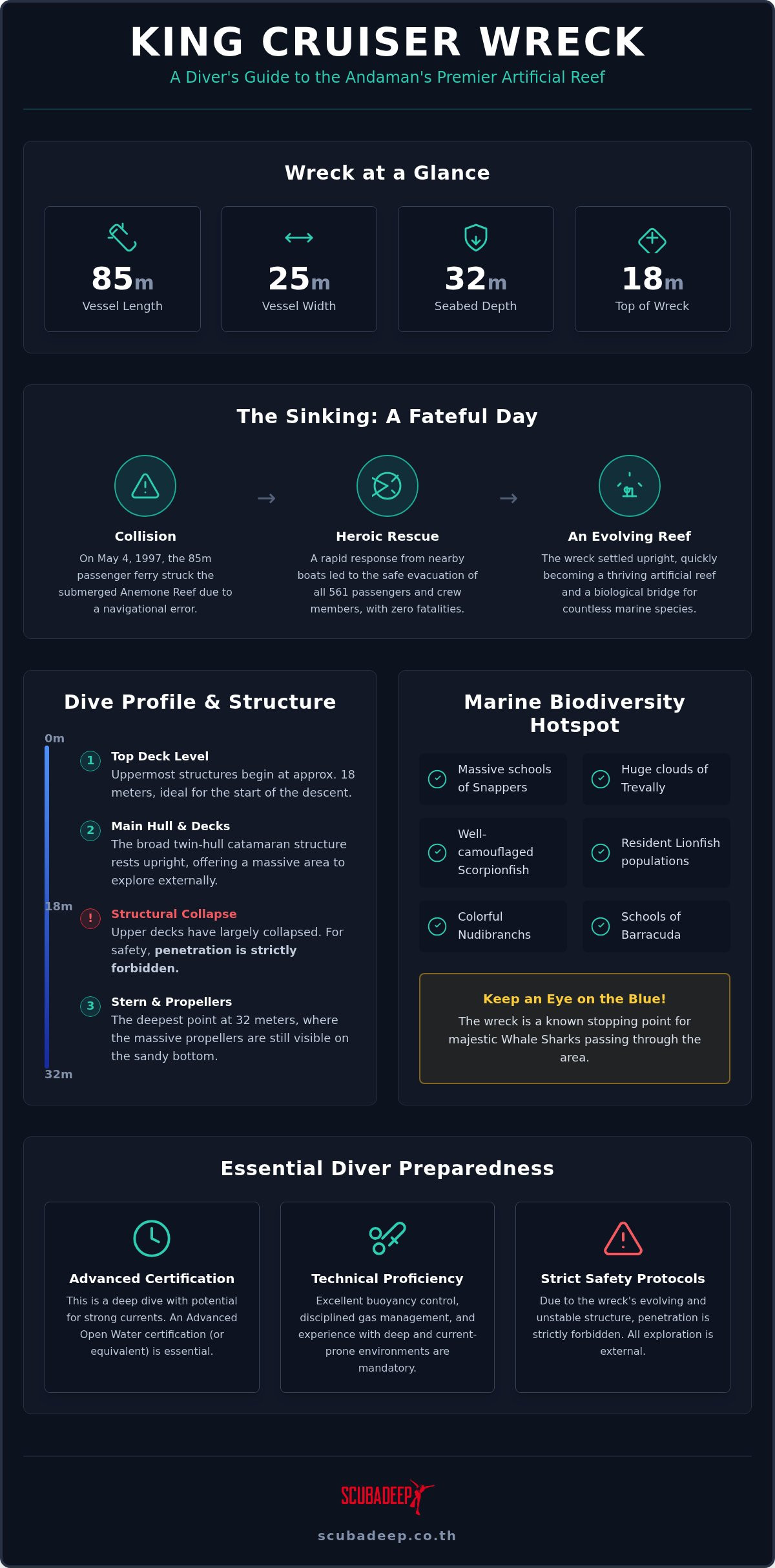
On May 4, 1997, a navigational error transformed an 85-meter passenger ferry into the most formidable artificial reef in the Andaman Sea. The King Cruiser is no longer just a ship; it's a thriving, high-energy ecosystem that demands respect and advanced situational awareness. You likely recognize it as a premier underwater landmark, yet it's common to feel a sense of uncertainty regarding its current stability or the strong currents often reported at these depths. Preparing for a King Cruiser Wreck dive requires more than just curiosity; it requires a clear understanding of whether your experience aligns with the site's technical demands.
This guide from Scubadeep provides the professional clarity you need to approach this iconic site with absolute confidence. We'll explore the ship's history and the incredible marine biodiversity that has claimed the 32-meter seabed. You'll also find a clear breakdown of the certification requirements and safety protocols necessary for this environment. From the top of the wreck at 18 meters down to the debris field, we'll preview the layout and preparation steps that ensure your journey is both adventurous and secure. By the end, you'll know exactly how to manage the conditions and what to expect during your descent.
Key Takeaways
- Trace the history of the 85-meter catamaran ferry and the events of May 1997 that established this legendary underwater landmark.
- Identify the essential certification levels and safety protocols required to navigate a King Cruiser Wreck dive Phuket successfully.
- Examine the wreck's depth profile and layout to better manage your bottom time and situational awareness at 32 meters.
- Gain insights into the "evolving reef" ecosystem and the diverse marine life that now populates the decaying steel structure.
- Learn how to leverage professional mentorship to progress from a recreational visitor to a specialized wreck explorer.
The History and Sinking of the King Cruiser Wreck
The King Cruiser wasn't originally destined for the seabed. It began its operational life as a Japanese car ferry before being repurposed for passenger transport between the mainland and the islands. On May 4, 1997, this routine service ended in a dramatic maritime event. The 85-meter vessel struck a submerged pinnacle, fundamentally altering the local underwater landscape. Today, a King Cruiser Wreck dive Phuket provides a window into this history while showcasing nature's ability to reclaim man-made structures.
Technical Specifications of the Vessel
The ship's engineering is a primary reason it remains such a compelling site. Measuring 85 meters in length and 25 meters in width, it featured a robust twin-hull catamaran design. This structure supported multiple deck levels, which allowed for significant passenger capacity. A look at the History of the King Cruiser explains how its broad footprint influenced its final descent. Because of the catamaran’s stability, the ship settled onto the sandy bottom in an almost perfectly upright position, which makes the remaining decks ideal for systematic exploration by advanced divers.
The 1997 Incident: A Timeline
The collision occurred when the ferry veered off its standard course and struck the jagged peaks of Anemone Reef. This site is known for its shallow, hidden pinnacles that sit just below the surface. The impact caused a massive breach in the hull, and the vessel began to take on water immediately. Despite the speed of the sinking, the event is celebrated for its successful rescue operation. Nearby fishing boats and other vessels responded to the distress call, ensuring that all 561 passengers and crew members were safely evacuated without any loss of life.
In the years following the sinking, the wreck’s position between major reef systems facilitated its transformation. It was officially designated as a recreational dive site, serving as a biological bridge for local species. The steel hull provided a massive surface area for coral growth, turning a transport vessel into Thailand’s most iconic artificial reef.
Diving the "Thaitanic": Site Layout and Marine Biodiversity
The physical scale of the vessel creates a unique underwater topography. It rests on a sandy bottom at 32 meters, with the uppermost structures reaching a depth of approximately 18 meters. Reviewing the King Cruiser Wreck specifications reveals the sheer volume of steel that has become part of the seabed. This vertical profile requires disciplined gas management and buoyancy control. Undertaking a King Cruiser Wreck dive Phuket is a journey through a massive, three-dimensional maze that rewards those with advanced skills.
The ship is no longer a static object. It's an "evolving reef" where soft and hard corals have completely encrusted the hull. This transformation highlights the benefits of scuba diving in fostering a deep appreciation for marine conservation. As you descend, you'll likely encounter massive clouds of yellow snappers and bigeye trevally. These schools are often so dense they momentarily block out the sun, creating a shimmering silver and gold canopy over the wreck.
Ecosystem of the Wreck
Life on the wreck is stratified by level and visibility. Lionfish and well-camouflaged scorpionfish are common across the remaining deck structures. Divers with a keen eye for macro life can find various nudibranchs and small crustaceans tucked into the twisted metal. While the wreck itself is the draw, the surrounding blue water often holds surprises. Whale sharks and large schools of barracuda frequently pass through the area, drawn by the high concentration of baitfish. For those ready to explore this landmark, booking a Fun Dive with a professional guide ensures you see the best sections of the site while maintaining safety.
Structural Evolution and Navigation
The passage of time has significantly altered the ship's integrity. The upper decks have largely collapsed into the main hull, which is why penetration is now strictly forbidden for safety reasons. Navigation focuses on the external perimeter and the remaining recognizable features. The stern remains a highlight, where the massive propellers are still visible at the deepest point of the site. During periods of strong Andaman Sea currents, the wreck acts as a vital sanctuary for marine life, providing a low-energy zone where fish can congregate in the lee of the steel walls.
Essential Skills and Safety Protocols for Wreck Exploration
Mastering a King Cruiser Wreck dive Phuket involves more than just curiosity; it requires a level of proficiency that matches the site's complexity. Because the wreck sits in open water and reaches depths of 32 meters, an Advanced certification is the minimum requirement for participation. This environment often experiences moderate to strong currents that can shift during the dive, making it essential for divers to be comfortable with deep water entries and line descents. You'll find that having a solid foundation in deep diving protocols is the difference between a stressful outing and a successful exploration.
To maximize your time on the ship, using Nitrox (Enriched Air) is highly recommended. At depths between 25 and 30 meters, the increased oxygen percentage significantly extends your no-decompression limits, allowing for a more thorough investigation of the hull. Before heading out, reviewing these scuba diving safety tips will help you align your personal checklist with professional standards. Safety isn't just about gear; it's about the mental preparation required for deep, current-prone sites.
Buoyancy and Environmental Awareness
The wreck is a decaying structure with sharp, rusted surfaces and fragile coral growth. Maintaining perfect buoyancy isn't just about protecting the reef; it's a vital safety requirement to avoid injury from jagged metal. You must also practice proper finning techniques to avoid "silting." Kicking up sediment in the larger passages can rapidly reduce visibility for the entire group. When currents are present, follow this professional descent protocol:
- Firmly grasp the buoy line before leaving the surface to avoid being swept off-site.
- Execute a hand-over-hand descent while maintaining eye contact with your buddy.
- Equalize your ears every meter to stay ahead of the pressure changes.
- Pause at the 18-meter mark on the wreck's top structure to regroup with your guide.
Gas Management and Decompression Safety
Deep diving naturally results in higher air consumption and shorter bottom times. A dive computer is non-negotiable for this site to monitor your NDLs in real-time. Professional guides play a critical role here, acting as mentors who monitor the group's air consumption and ensure everyone begins their ascent with a generous reserve. If you're ready to transition from a recreational visitor to a skilled explorer, consider enrolling in an Advanced Open Water Course to refine these technical skills under expert supervision.
Always plan for a conservative safety stop. Due to the depth of the King Cruiser Wreck dive Phuket, many professionals recommend an additional deep safety stop at 15 meters for one minute before the standard three-minute stop at five meters. This methodical approach to decompression ensures you return to the surface feeling refreshed and ready for your next adventure.
Elevating Your Experience with Professional Wreck Training
The King Cruiser is more than a destination; it serves as the ultimate classroom for those pursuing a Wreck Diving Course. Transitioning from a recreational visitor to a specialized explorer requires a shift in mindset and technical proficiency. By engaging with this site under professional guidance, you learn to manage the unique variables of wreck environments, from complex navigation to advanced gas planning. This site is the perfect venue to apply the skills acquired in an advanced diving course Thailand, moving beyond basic certification toward elite-level mastery.
The Scubadeep Mentorship Advantage
Success at this depth depends on the quality of your instruction. We prioritize small group ratios to ensure that every diver receives personalized attention and expert safety monitoring. Our instructors act as elite mentors, sharing deep knowledge of the national waters of Thailand and the specific behavior of local marine life. This high-tier approach doesn't just make you a better diver; it produces responsible explorers who respect the integrity of underwater heritage sites. You'll gain the confidence to navigate the perimeter of the vessel while maintaining the situational awareness required for deep environments during a King Cruiser Wreck dive Phuket.
Planning Your National Dive Adventure
Visibility at the site varies throughout the year, typically peaking between November and May when the Andaman Sea is at its calmest. A King Cruiser Wreck dive Phuket is most rewarding when combined with neighboring landmarks like Shark Point and Anemone Reef. These sites are often bundled into a single day-trip itinerary, providing a comprehensive look at the region's biodiversity. To ensure the best experience, we recommend using a dive computer and considering an Enriched Air Nitrox Course to extend your time on the wreck structures. Join an elite community of divers who value quality, safety, and professional progression by booking your next Wreck Diving Course with seasoned experts.
Master the Depths of Thailand's Premier Shipwreck
The King Cruiser is a testament to nature's resilience, transforming from a 1997 maritime incident into a complex, vertical ecosystem. You've seen how the 32-meter depth and potential currents demand disciplined buoyancy and advanced technical preparation. Whether you're navigating the stern's massive propellers or observing the silver clouds of snappers, every moment underwater reinforces the need for professional mentorship. This site isn't just a dive; it's a milestone in your progression. Mastering the King Cruiser Wreck dive Phuket requires a commitment to safety and a passion for discovery.
Scubadeep maintains a national reputation for scuba excellence in Thailand, offering specialized wreck and deep diving mentorship for those who value quality. Our small group sizes ensure your safety remains the top priority while you explore the intricacies of the hull. Book your King Cruiser wreck adventure with the elite mentors at Scubadeep today. We're ready to help you push your limits and discover the hidden secrets of the Andaman Sea with confidence. Your next great underwater story starts here.
Frequently Asked Questions
Is the King Cruiser wreck suitable for beginner divers?
No, the site is not recommended for beginner or Open Water divers. Due to its depth and the potential for strong currents in these national waters, participants must hold an Advanced Open Water certification at minimum. Beginners often find the conditions challenging as the depth exceeds their initial training limits. We recommend gaining experience at shallower reefs before attempting a King Cruiser Wreck dive Phuket to ensure you have the necessary buoyancy skills.
How deep is the King Cruiser wreck dive site?
The wreck rests on a sandy seabed at a maximum depth of 32 meters. The uppermost structures of the vessel, including the remaining deck levels, sit at approximately 18 meters below the surface. This depth profile makes it a classic deep dive. Divers must monitor their no-decompression limits closely. Using Enriched Air Nitrox is a common strategy here to extend your allowable bottom time while exploring the massive 85-meter hull.
Can I still swim inside the King Cruiser wreck?
Swimming inside or penetrating the wreck is no longer permitted for safety reasons. Over the decades, the steel structure has significantly deteriorated, leading to the collapse of the upper decks. These internal spaces are now unstable and pose a high risk of entanglement or injury from jagged metal. Exploration is restricted to the exterior of the hull, which still offers incredible views of the ship's massive propellers and thriving coral ecosystems.
What is the best time of year to dive the wreck in Thailand?
The optimal window for visiting this landmark is between November and May. During these months, the sea conditions are generally calm and visibility can reach up to 25 meters. Outside of this peak season, the southwest monsoon can bring larger swells and reduced visibility, making the boat journey more difficult. Planning your trip during the dry season ensures the best chance of encountering the massive schools of fish that congregate around the wreck.
Do I need a special certification to dive the King Cruiser?
You must hold an Advanced Open Water certification to participate in a King Cruiser Wreck dive Phuket. Because the site qualifies as a deep dive, standard entry-level certifications aren't sufficient for the depth requirements. Many divers choose to combine this experience with a Deep Diver or Wreck Specialty course. These advanced programs provide the technical mentorship needed to manage nitrogen levels and navigate the perimeter of large sunken vessels with professional precision.
What kind of marine life is most common on the wreck?
The site is famous for its high density of marine life. You'll regularly see massive schools of yellow snappers and bigeye trevally that cloud the upper decks. Scorpionfish and lionfish are frequently spotted camouflaged against the rusted steel. In the surrounding blue water, it's common to see large barracuda and, occasionally, whale sharks passing through. The wreck acts as a massive artificial reef, supporting a much higher biomass than the surrounding sandy seabed.