

What if your first breath beneath the surface wasn't a moment of anxiety, but the start of a lifelong obsession with the deep? For many, the decision to learn to scuba dive in Thailand is the highlight of their journey, yet it's often clouded by questions about safety and time. You might feel overwhelmed by the different training agencies or worry that a certification course will consume your entire holiday. It's a common concern, but the reality is that modern training is more streamlined and accessible than ever before.
We believe that choosing the right mentor is the most critical step in your underwater progression. This guide provides the essential steps, medical requirements, and expert tips you need to earn your certification in Thailand’s world-class 28°C to 30°C waters. We'll walk you through the logical progression from your first pool session to diving at depths of 18 meters. You will discover how to manage your TDAC entry requirements, understand the latest 2026 marine park regulations, and find a training schedule that respects your vacation time. Let's begin your journey into the blue with confidence and professional clarity.
Key Takeaways
- Identify why Thailand's tropical environment is the premier choice for your first descent, offering consistent 28°C temperatures and vibrant marine biodiversity.
- Learn how to streamline your schedule by completing the academic portion of your training via digital eLearning before your holiday begins.
- Master the essential steps to learn to scuba dive in Thailand, including the transition from confined water skill sessions to your first ocean dives.
- Review the mandatory medical and physical requirements to ensure you're fully prepared for the 18-meter depth qualification.
- Understand the logical progression from beginner certifications to advanced specialties, opening doors to a global community of ocean explorers.
The Appeal of Thailand: Why Start Your Diving Journey Here?
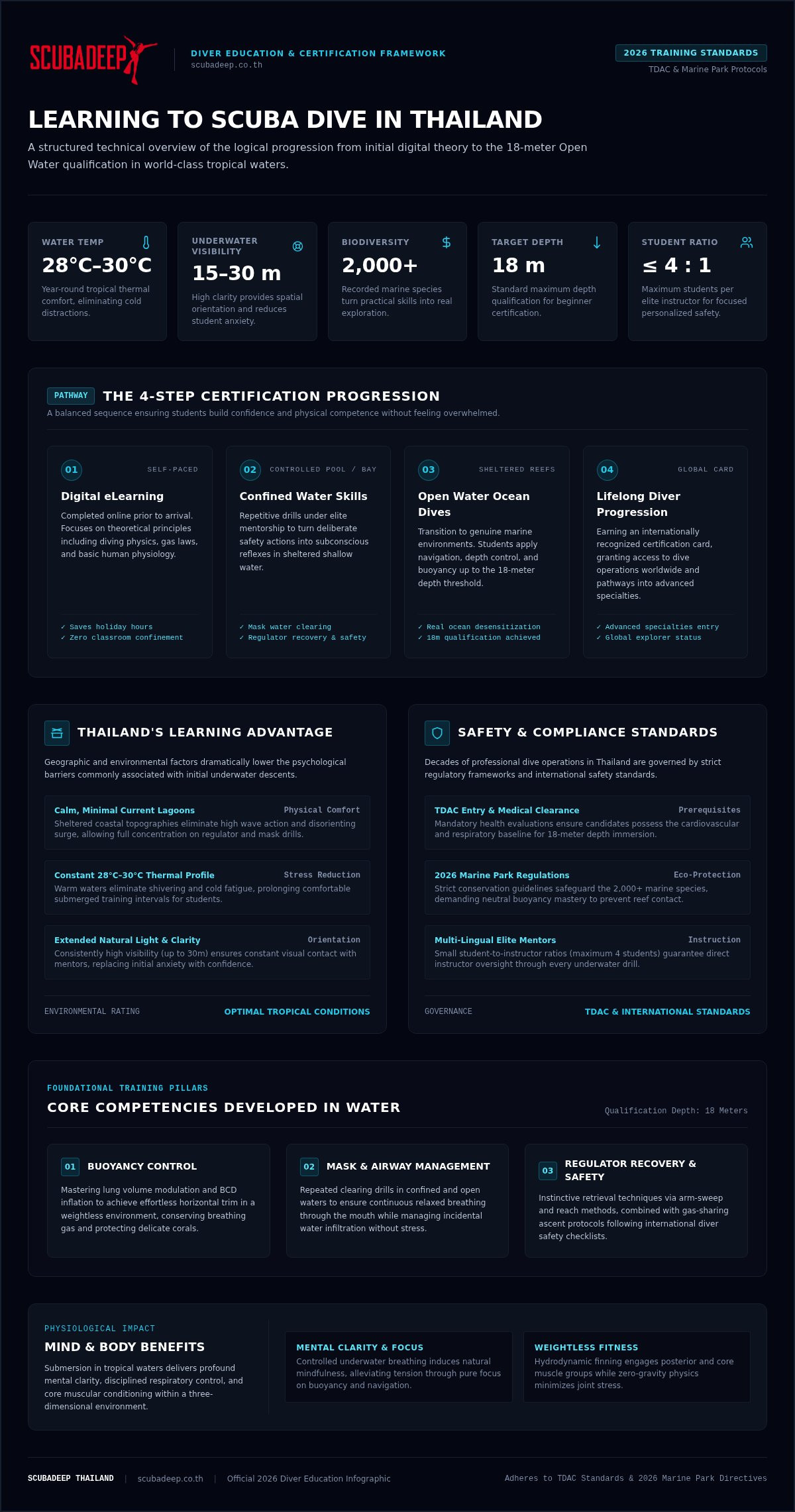
Thailand stands as a premier global destination for those ready to begin their underwater journey. Choosing to learn to scuba dive in Thailand offers more than just a certification card; it provides an immersive entry into a world of vibrant marine life and professional excellence. The region is characterized by exceptionally warm water temperatures, typically ranging between 28°C and 30°C throughout the year. This warmth allows students to focus entirely on their skills without the distraction of cold, ensuring a comfortable and productive learning environment. Visibility is equally impressive, often reaching 15 to 30 meters, which provides the clarity needed for beginners to feel secure and oriented during their first descents.
Staggering biological diversity defines these tropical waters. With over 2,000 recorded marine species, every training session becomes a genuine exploration rather than a simple rehearsal. This richness transforms routine skill practice into an engaging adventure. Engaging with this environment also offers significant benefits of scuba diving, such as improved mental clarity and physical fitness, as you learn to master your buoyancy and breathing in a weightless world.
Ideal Conditions for Beginners
Safety and comfort are the pillars of successful diver training. Thailand’s coastline offers numerous sheltered areas where the water remains calm and currents are minimal. These conditions are perfect for mastering the Open Water Diver certification standards, which include essential knowledge development and confined water practice. Learning in a tropical setting reduces the psychological barriers often associated with the sport. When you are surrounded by clear, shallow lagoons and colorful reefs, the initial anxiety of breathing underwater quickly fades, replaced by curiosity and confidence.
A Hub of Professional Expertise
Professional infrastructure supporting the Thai diving industry is built on decades of experience and strict adherence to international safety protocols. You'll find a high concentration of elite mentors and multi-lingual instructors who are dedicated to personalized instruction. Reputable centers prioritize small student-to-instructor ratios, often capping groups at four students or fewer. This ensures you receive the focused attention necessary to progress safely. When you choose to learn to scuba dive in Thailand, you are entering a system designed for your success. From your initial Open Water Course to pursuing advanced specialties, the logical progression available in 2026 allows you to build a solid foundation under the guidance of seasoned experts who know these waters intimately.
The Path to Certification: Understanding the Training Process
The journey to becoming a certified diver is a structured, four-step process designed to build your confidence and competence methodically. In 2026, the standard for entry-level training focuses on a logical progression that ensures you're never overwhelmed. By choosing to learn to scuba dive in Thailand, you are engaging with a training system that balances the excitement of discovery with a sober responsibility for safety.
Theory and eLearning: Saving Your Holiday Time
Modern digital platforms have revolutionized the academic portion of your training. By opting to complete your knowledge development via eLearning, you can study at your own pace before arriving at your destination. This proactive approach allows you to absorb complex concepts regarding gas laws and physiology in a relaxed setting. Understanding these principles is the cornerstone of scuba diving safety tips, ensuring you arrive with a solid theoretical foundation. Completing this stage at home means you won't spend your precious holiday hours in a classroom; instead, you'll be ready to head straight to the water.
Mastering Skills in Confined Water
The next phase takes place in a controlled environment, such as a swimming pool or a shallow, sheltered bay. Under the guidance of an elite mentor, you'll practice essential skills like clearing your mask of water and recovering a regulator. These sessions prioritize repetitive practice to turn conscious actions into natural responses. A significant focus is placed on buoyancy control, which is vital for protecting both the diver and the delicate marine ecosystems. Before entering the water, all students must review the DAN diving health and safety guidelines to ensure they meet the physical requirements for the sport. This stage is about building a steady, safety-conscious persona beneath the surface.
Open Water Dives and Final Certification
The final steps involve four open-water ocean dives, typically conducted over two to four days. During these dives, you'll apply the skills you mastered in confined water while exploring real reef environments. You'll stay within a maximum qualifying depth of 18 meters, accompanied by your instructor who provides constant supervision. Upon successful completion of these dives, you'll receive an internationally recognized license that never expires. This certification is your passport to global exploration. If you're ready to take the first step toward this milestone, consider starting your Open Water Course with a team that values professional standards and personalized instruction.
Essential Preparation: Requirements and What to Expect
Preparing to learn to scuba dive in Thailand involves understanding the foundational requirements that ensure a safe and productive experience. For the 2026 season, most entry-level programs remain accessible to anyone aged 10 or older who possesses a basic level of physical health. You don't need to be a competitive athlete to participate; instead, instructors look for basic water comfort. This is typically verified by a 200-meter swim without aids and the ability to float or tread water for 10 minutes. These benchmarks are standard across the industry and help confirm you possess the necessary stamina for ocean training.
Professional centers provide all the technical equipment required for your course. This includes a buoyancy control device (BCD), a regulator set with a depth and pressure gauge, and thermal protection such as a 3mm shorty wetsuit. You can expect to spend three to four days of active training to earn your certification. This time is split between the skill development and open water dives discussed in previous sections. It's a focused commitment designed to fit seamlessly into a standard holiday itinerary while maintaining the highest levels of instruction.
Health and Fitness for Diving
A common myth is that you must be in peak physical condition to dive. In reality, the focus is primarily on your respiratory and cardiovascular health. You'll complete a standardized medical self-assessment form before getting started. If you have pre-existing conditions like chronic asthma or heart issues, a physician's sign-off is required to ensure your safety. During your training days, prioritize hydration and rest. The tropical climate and the physical exertion of diving can be taxing, so staying well-rested is a key part of your safety protocol and overall enjoyment.
Choosing the Right Training Center
Your choice of facility determines the quality of your mentorship. Look for centers that demonstrate a commitment to rigorous equipment maintenance and strict safety protocols. A premier center won't just teach you the basics; it will offer a clear roadmap for your future, such as a transition into an advanced diving course Thailand. Prioritize centers where you feel a strong rapport with the instructors, as their expertise and patience are more valuable than a discounted price.
When you decide to learn to scuba dive in Thailand, ensure you're following the most professional path by discovering How to Obtain a Scuba Diving Certification from a trusted regional expert. Ready to begin? Explore our professional training options at scubadeep.co.th.
Beyond Your First Breath: Life as a Certified Diver
Becoming a certified diver is more than a holiday achievement; it's an entry into a global community of ocean advocates. Once you learn to scuba dive in Thailand, you gain the freedom to explore the 70% of our planet covered by water. This license acts as your passport to deeper reefs, historic wrecks, and ecosystems that remain hidden from the surface. It's a lifelong credential that empowers you to join a network of explorers dedicated to marine conservation and discovery. You're no longer a spectator; you're an active participant in the underwater world.
Continuing Your Education
Progression doesn't stop at the surface. Advanced training paths, such as the Deep Dive Course or Wreck Diving Course, allow you to refine your technical skills and expand your limits. These specialties significantly improve your air consumption and underwater confidence by teaching you to manage specific environments with precision. Reaching the Rescue Diver level is a major milestone in your development. It transforms you from a student into a truly self-reliant buddy, capable of managing safety protocols for yourself and others. This level of training builds the steady, safety-conscious persona that defines an elite diver.
Your Next Steps in Thailand
If you haven't yet committed to a full course, you can book a try scuba diving session to experience the weightless sensation firsthand. For those already certified, the immediate next step is to join guided "Fun Dives." These excursions allow you to gain experience and log dives under the supervision of local experts who know the best-kept secrets of the region. Every dive you log builds the muscle memory and comfort required for more advanced exploration.
Safety remains a sober responsibility even after you've earned your card. If you've been out of the water for more than six months, a Scuba Refresher Review is essential. It ensures your skills remain sharp and your confidence is restored before you head back into the blue. Diving is a skill that rewards consistency. Regular practice keeps your buoyancy precise and your air consumption efficient, allowing for longer and more relaxed encounters with marine life.
Start your journey with an elite mentor who values your long-term growth and safety. Whether you're taking your first breath or advancing your expertise, professional guidance is the key to a successful underwater life. Explore our range of professional courses at scubadeep.co.th and begin your transformation today.
Master Your Skills in Thailand’s World-Class Waters
Choosing to learn to scuba dive in Thailand is the first step toward a transformative relationship with the ocean. You've seen how the region's consistent 28°C to 30°C waters and professional training infrastructure create the perfect environment for beginners. By embracing modern eLearning and following a logical progression from confined skills to open-water exploration, you can earn an internationally recognized certification in just three to four days. This qualification isn't just a license to dive to 18 meters; it's an invitation to join a global community of explorers.
Scubadeep stands as your Elite Mentor, offering a full spectrum of courses that adhere to the highest international diving standards. We prioritize safety and personalized instruction to ensure your journey from a beginner to a self-reliant diver is both sophisticated and secure. We act as a consultant for your goals, guiding you through the technical requirements with precision and care.
Begin your underwater journey with Scubadeep’s professional certification programs today.
The hidden wonders of the deep are waiting for you. We look forward to guiding you through every breath and discovery in 2026.
Frequently Asked Questions
How long does it take to learn to scuba dive in Thailand?
An entry-level certification typically requires between 2.5 and 4 days of active training. This timeframe includes knowledge development, confined water skill sessions, and four open-water ocean dives. Many students choose to complete their theory via digital eLearning before arrival, which can reduce the in-person schedule to just 3 days. This efficient structure allows you to learn to scuba dive in Thailand without sacrificing your entire holiday for classroom study.
Do I need to be a strong swimmer to get scuba certified?
You don't need to be an elite athlete, but basic water comfort is a mandatory safety requirement for all students. To qualify for certification, you must demonstrate the ability to swim 200 meters without swimming aids or 300 meters with a mask, fins, and snorkel. Additionally, you'll need to tread water or float for 10 minutes. These exercises ensure you can handle yourself confidently in the water before you begin using scuba equipment.
Is it safe to learn to scuba dive if I am nervous?
It's completely natural to feel anxious about breathing underwater for the first time. Professional training centers prioritize a patient, step-by-step approach to build your confidence in a secure environment. You'll start in a shallow, controlled setting where you can stand up at any time. Instructors maintain small student-to-instructor ratios, often 4:1 or less, ensuring you receive the personalized attention needed to overcome nerves and master essential safety skills at your own pace.
Can I fly immediately after completing my diving course?
No, you must wait a specific interval before ascending in an aircraft to avoid decompression sickness. Following a single no-decompression dive, a minimum surface interval of 12 hours is required. However, because the certification course involves repetitive dives over several days, safety guidelines mandate a wait of at least 18 to 24 hours before flying. Plan your departure from Thailand accordingly to ensure you remain well within these vital safety margins for your health.
What is the minimum age to start a scuba certification in Thailand?
Children as young as 10 years old can begin their journey to learn to scuba dive in Thailand. Students between the ages of 10 and 14 typically earn a Junior Open Water certification, which comes with specific depth limits and requires them to dive with a certified adult or professional. Once the diver reaches 15, these certifications can usually be upgraded to standard adult credentials, allowing for a logical progression in their lifelong underwater education.
What happens if I cannot complete the course due to equalizing issues?
If you experience difficulty equalizing your ears, your instructor will pause the descent immediately. You should never force a dive if you feel discomfort or pain. In many cases, a professional mentor can teach you alternative techniques to manage pressure effectively during your training. If the issue persists, you may receive a referral document. This allows you to credit the portions you've already finished and complete the remaining dives at a later date.