

Did you know that switching to a 32% oxygen mix at a depth of 18 meters can increase your no-decompression limit from 56 minutes to around 95 minutes? That is a 70% boost in dive time simply by changing the gas in your cylinder. Many divers struggle with the frustration of ending a spectacular dive early because their computer warns them they are reaching their limits. You might also find yourself feeling unusually fatigued after a two-dive morning, wondering if there is a more efficient way to explore the blue.
We understand that the technical jargon surrounding oxygen percentages and partial pressures can feel intimidating. This professional guide clarifies the debate of nitrox vs air for recreational diving so you can make an informed decision for your next excursion. You will discover how enriched air reduces nitrogen absorption by about 35% at 20 meters, providing a significant safety margin against decompression sickness. We will analyze the specific operational limits for 2026, debunk common myths about oxygen toxicity, and show you exactly when to choose nitrox to maximize your underwater experiences.
Key Takeaways
- Define the fundamental differences between standard air and Enriched Air Nitrox (EANx) to better manage your body’s nitrogen absorption.
- Discover how comparing nitrox vs air for recreational diving reveals opportunities to extend your bottom time by up to 70% at medium depths.
- Identify the critical safety protocols, such as calculating Maximum Operating Depth (MOD), to prevent the risks associated with oxygen toxicity.
- Evaluate your personal dive profile to see if an Enriched Air Nitrox Course is the essential upgrade for your upcoming wreck or repetitive dive trips.
- Learn why using enriched air provides a superior safety margin against decompression sickness when following a conservative air-based dive profile.
Nitrox vs. Air: Understanding the Fundamental Differences
Understanding the gas in your cylinder is the first step toward professional-level diving. Standard atmospheric air consists of approximately 21% oxygen and 79% nitrogen. While this is the baseline for most beginner experiences, What is Nitrox? At its simplest, Enriched Air Nitrox (EANx) is any nitrogen-oxygen mixture where the oxygen concentration exceeds 21%. Increasing the oxygen content allows us to reduce the nitrogen percentage. This fundamental shift is the core of nitrox vs air for recreational diving, allowing you to stay underwater longer by slowing the rate at which your body absorbs inert gas.
The Role of Nitrogen in Scuba Diving
Nitrogen is an inert gas. Your body doesn't use it for metabolism, so it simply dissolves into your tissues under pressure. This process creates a "nitrogen clock" that dictates how long you can safely stay at depth before requiring decompression stops. High partial pressures of nitrogen are the primary constraint for divers. Choosing mixes like EANx32 (32% oxygen) or EANx36 (36% oxygen) effectively "winds back" that clock. You absorb less nitrogen at the same depth compared to diving on air, which provides a greater safety margin or more time to explore sites like the Racha Islands.
Common Terminologies Every Diver Should Know
You'll hear several terms used interchangeably: Nitrox, Enriched Air, and EANx. They all refer to the same concept of oxygen-enriched gas. When we talk about a "Best Mix," we're identifying the specific oxygen percentage that offers the longest bottom time for a planned depth without exceeding safety limits. Evaluating nitrox vs air for recreational diving helps you understand that EANx is a specialized tool for medium-depth exploration. One major misconception among new divers is that Nitrox is for deep diving. It's actually the opposite. Because oxygen becomes toxic at high partial pressures, Nitrox has shallower depth limits than air. It's a precision tool for maximizing your time at sites like the King Cruiser Wreck or other premier locations in Thailand.
The Primary Benefits of Diving with Enriched Air
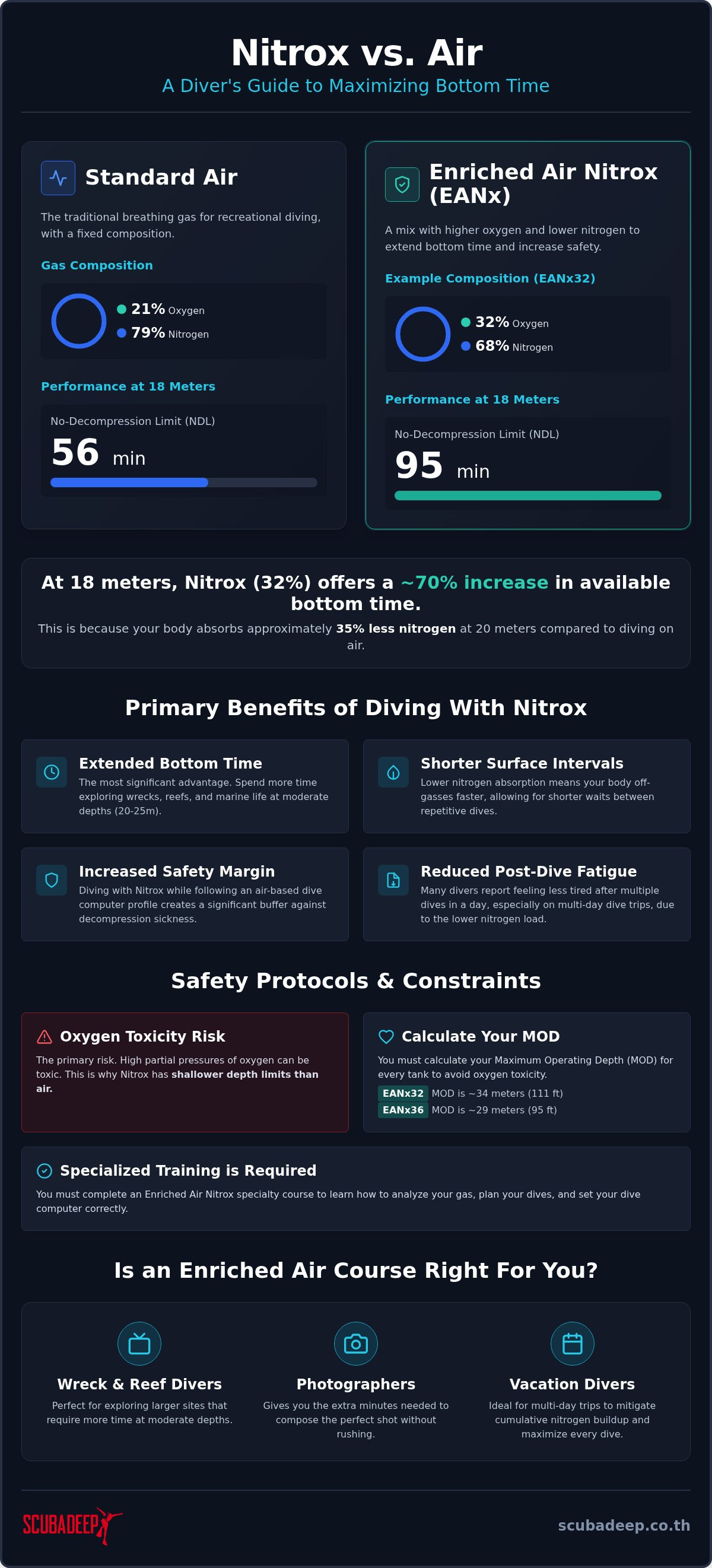
The most compelling reason to choose nitrox is the dramatic extension of your No-Decompression Limit (NDL). When evaluating nitrox vs air for recreational diving, the difference in bottom time is stark. At a depth of 18 meters, a diver on standard air has an NDL of about 56 minutes. Switching to EANx32 extends that limit to approximately 95 minutes. This 70% increase allows you to focus on the marine life and intricate coral formations rather than constantly monitoring a ticking clock on your wrist. Some divers choose to stay within air limits while breathing nitrox, which creates a massive safety buffer by absorbing far less nitrogen than their computer assumes.
Repetitive diving becomes much more efficient when you use Enriched Air. Because your body absorbs less nitrogen during the dive, you have less gas to eliminate once you surface. This often results in shorter required surface intervals between dives. Many professionals also report feeling less exhausted after a three-dive day in Phuket. While the scientific community continues to debate the "nitrox fatigue" phenomenon, the physiological reality is that your body manages a lower nitrogen load. This makes it a preferred choice for older divers or those with a higher BMI, as these factors can influence your susceptibility to decompression sickness.
Maximizing Bottom Time at Moderate Depths
Moderate depths between 20 and 25 meters are where nitrox truly shines. On a site like the King Cruiser Wreck, a diver on air might only have 20 minutes of bottom time before reaching their limit. Using EANx36 can nearly double that window, providing the time needed to explore the hull or photograph the massive schools of trevally. If you want to refine these technical skills and explore deeper sites safely, enrolling in an advanced diving course Thailand is the logical next step in your professional progression.
Why Nitrox is Essential for Diving Holidays
During a multi-day trip, nitrogen builds up in your tissues over several days of repetitive diving. By the third day, your NDLs on air will be significantly shorter than they were on day one. Using nitrox mitigates this cumulative effect, keeping your limits wider and your safety margins higher. There are many benefits of diving with nitrox, but the ability to enjoy the final dive of your holiday with the same confidence as the first is perhaps the most practical. If you are ready to upgrade your experience, you can join our Enriched Air Nitrox Course to start diving smarter and staying down longer.
Constraints and Safety Protocols of Nitrox Diving
While the advantages of enriched air are significant, this gas requires a higher level of discipline than standard air. In the early days of technical diving, some referred to nitrox as "Voodoo Gas" because they feared the invisible risks of oxygen. Today, we know that these risks are entirely manageable through professional training and strict adherence to safety protocols. When comparing nitrox vs air for recreational diving, the most critical trade-off is the depth penalty. Because oxygen becomes toxic under high pressure, every nitrox blend has a hard depth limit that you must never exceed.
Calculating and Respecting Your MOD
The Maximum Operating Depth (MOD) is determined by the partial pressure of oxygen (PO2). For recreational diving, the industry standard limit is 1.4 ata. If you're using EANx32, your MOD is approximately 34 meters. Exceeding this limit puts you at risk of central nervous system (CNS) oxygen toxicity, which can cause underwater seizures. This is why precise gas management is a cornerstone of our scuba diving safety tips. You must always program your dive computer to the specific mix in your tank to ensure your depth alarms are accurate for the specific blend you're breathing.
Busting the Gas Consumption Myth
A common misconception among newer divers is that nitrox helps you use less gas. This is false. Your gas consumption rate is dictated by your lung capacity, depth, and physical exertion, not the ratio of nitrogen to oxygen. The 'Nitrox consumption myth' is a confusion between extended NDL and actual gas supply. You might have the "time" to stay down longer, but you still need enough physical gas in the cylinder to finish the dive safely. Don't expect your tank to last longer just because it's green and yellow.
Equipment and Gas Analysis Procedures
The "Golden Rule" of enriched air diving is simple: never breathe from a tank you haven't personally analyzed. You must use an oxygen analyzer to verify the percentage and then record the results in a dedicated nitrox logbook. Cylinders must be clearly labeled with green and yellow markings to prevent accidental use by air divers. Most modern regulators are compatible with mixes up to 40% oxygen, but you should always verify your equipment's specifications. If you're ready to master these professional protocols, you can sign up for our Enriched Air Nitrox Course and gain the certification needed to dive with confidence.
Is the Enriched Air Specialty Right for You?
Deciding between nitrox vs air for recreational diving usually comes down to one simple question: are you tired of leaving the reef before your tank is empty? If you frequently return to the boat with plenty of gas but a "zero" on your no-decompression limit, you're the ideal candidate for an Enriched Air Nitrox Course. This specialty is the most popular upgrade in the industry for a reason. It bridges the gap between basic exploration and professional-level proficiency by giving you the one thing every diver wants: more time.
Who Benefits Most from Switching to Nitrox?
Underwater photographers benefit immensely from this transition. They often spend long durations at depths of 15 to 22 meters to capture the perfect shot, which is exactly where air limits are most restrictive. Divers planning multi-day excursions to premier sites also find it essential. It keeps your cumulative nitrogen levels lower over consecutive days, ensuring you don't have to sit out the final, most exciting dive of the trip. For those who've recently completed their open water course Phuket, this is the most logical next step to enhance your safety and underwater confidence.
Next Steps: Obtaining Your Certification
The beauty of this specialty is its efficiency. It focuses on the physics and physiology of oxygen rather than requiring complex new motor skills. In fact, it's one of the few certifications that can be completed through theory and practical application without mandatory training dives, though we always encourage testing your new limits in the water. The path to certification follows a logical, professional progression:
- Step 1: Master the theory regarding oxygen exposure, partial pressures, and gas laws through flexible eLearning.
- Step 2: Practice hands-on gas analysis using a digital analyzer to verify your tank's contents.
- Step 3: Learn to program your dive computer for different enriched air blends to ensure your alarms are accurate.
- Step 4: Apply your knowledge on guided dives at sites like the Racha Islands to see the difference in your NDL firsthand.
Combining this certification with a Wreck Diving Course or Deep Dive Course creates a powerful skillset for any serious explorer. Elevate your diving with our Enriched Air specialty today and stop letting the nitrogen clock dictate when your adventure ends.
Master the Art of Extended Exploration
Choosing the right gas mixture is more than a technical preference; it's a commitment to safer, more immersive underwater experiences. We've explored how the debate of nitrox vs air for recreational diving centers on the balance between extended bottom time and respecting specific depth constraints. By increasing your oxygen percentage, you effectively reduce your nitrogen load. This allows for longer, more relaxed explorations of Thailand's premier sites like the King Cruiser Wreck.
Professional diving requires discipline. Analyzing your own gas and respecting the Maximum Operating Depth are non-negotiable safety standards that define an elite diver. Whether you're a photographer seeking the perfect shot or a recreational explorer wanting to feel fresher after repetitive dives, enriched air is the essential tool for your progression. Our elite mentors are ready to guide you through this transition with a safety-first approach to advanced gas management.
Start your Enriched Air Nitrox journey with Scubadeep today and unlock the full potential of your time beneath the surface. We look forward to seeing you in the crystal-clear waters of Phuket.
Frequently Asked Questions
Is Nitrox safer than air for recreational diving?
Yes, Nitrox is generally considered safer because it reduces the amount of nitrogen your body absorbs during a dive. Many divers choose to breathe enriched air while following a standard air dive profile to create a significant safety buffer. This conservative approach greatly reduces the risk of decompression sickness, which is especially beneficial during repetitive diving days in Phuket.
Can I dive deeper with Nitrox than I can with air?
No, you cannot dive deeper with Nitrox; your maximum depth is actually more restricted. Higher concentrations of oxygen become toxic at depth, which creates a hard limit called the Maximum Operating Depth (MOD). While air allows you to reach 40 meters, a common 36% Nitrox blend limits you to just 28 meters to ensure your safety against oxygen toxicity.
How much longer can I stay underwater with Nitrox?
You can stay underwater significantly longer because Nitrox extends your no-decompression limits. At a depth of 18 meters, switching from air to EANx32 can increase your allowable bottom time from 56 minutes to approximately 95 minutes. When comparing nitrox vs air for recreational diving, this 70% increase in time is the primary reason most enthusiasts choose to upgrade their certification.
Do I need special scuba gear to dive with Nitrox?
Most modern regulators and dive computers are compatible with Nitrox blends containing up to 40% oxygen. However, you must use a dedicated Nitrox cylinder that has been oxygen-cleaned and clearly labeled with green and yellow decals. It's also essential to use a dive computer that allows you to manually set the oxygen percentage to ensure your decompression data remains accurate.
Why do I need a separate certification for Nitrox?
A separate certification is essential because diving with enriched air introduces risks that aren't covered in basic courses, such as oxygen exposure management. The training teaches you how to use an oxygen analyzer, calculate your MOD, and set your computer correctly. Mastering the nuances of nitrox vs air for recreational diving ensures you can enjoy the benefits of extended time without compromising your safety.
Does Nitrox help prevent nitrogen narcosis?
Nitrox does not reliably prevent nitrogen narcosis because oxygen may have narcotic properties similar to nitrogen when breathed under pressure. While you are technically inhaling less nitrogen, most training agencies treat the narcotic potential of both gases as equal for safety reasons. To manage narcosis effectively, you should rely on proper depth management and experience rather than simply changing your gas mixture.