

Most travelers view a single descent as a vacation checkbox, but they miss a fundamental truth: true underwater mastery is a structured journey that transforms how you perceive 70% of our planet. It's common to feel a sense of hesitation when faced with technical equipment or the pressure of choosing the right scuba certification agency. You want to explore the vibrant reefs of Thailand, yet the uncertainty regarding safety protocols and the time required for courses often creates a barrier to entry.
This 2026 guide provides the professional precision you need to move past that confusion and embrace the underwater world with confidence. You'll discover the essential path from your first Open Water breath to advanced specialties like Wreck or Deep Diving. We'll outline exactly how to evaluate a professional dive center and what to expect from your training progression. By the end of this article, you'll have a clear roadmap for experiencing Thailand's marine ecosystems with the skill and safety of a seasoned explorer.
Key Takeaways
- Understand why Thailand’s dual access to the Andaman Sea and the Gulf of Thailand provides an unparalleled gateway to the world's most diverse marine ecosystems.
- Learn the structured progression of certification levels, focusing on competency-based mastery to advance from introductory sessions to specialized training.
- Master professional scuba safety standards and risk mitigation techniques that ensure a secure and confident underwater experience.
- Discover how to distinguish premier dive operators from budget services while navigating Thailand’s national diving seasons for optimal visibility.
The Allure of Scuba: Why Thailand Leads Global Underwater Tourism
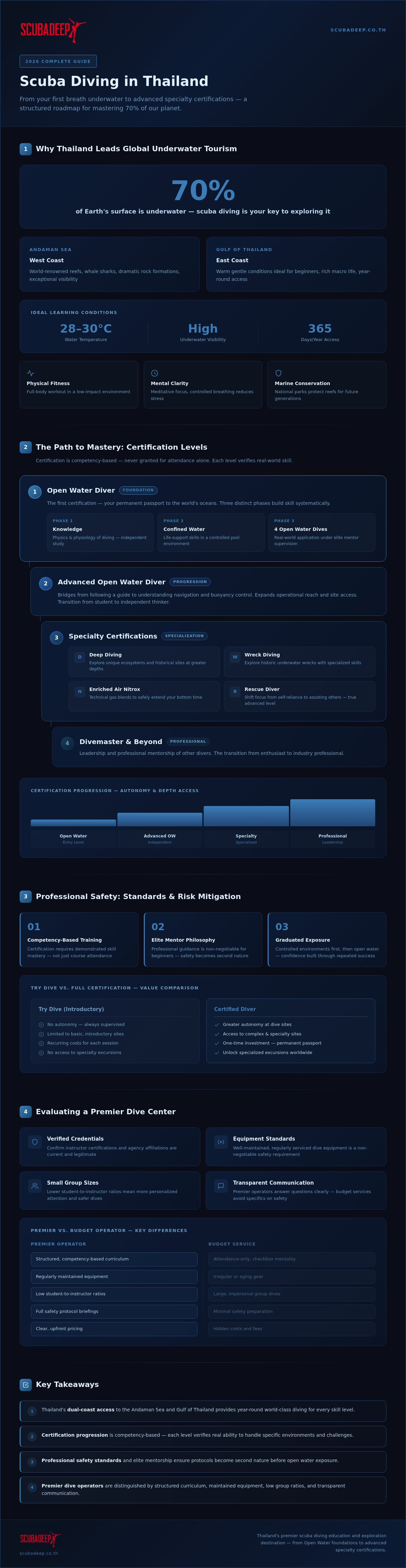
Scuba diving serves as the ultimate gateway to exploring the 70% of our planet that remains hidden beneath the ocean's surface. Thailand occupies a unique geographical position. With direct access to both the Andaman Sea and the Gulf of Thailand, the country offers diverse underwater topographies that cater to every skill level. This dual-coast advantage ensures that world-class diving is available year-round, regardless of seasonal weather shifts on either side of the peninsula.
Beyond the thrill of discovery, the benefits of scuba diving include significant improvements to physical fitness and mental clarity. It's a meditative experience that requires focus and controlled breathing, which helps reduce stress. We operate with an "Elite Mentor" philosophy. We believe that professional guidance is a non-negotiable requirement for beginners. This approach ensures that safety protocols become second nature, allowing you to focus on the environment rather than your equipment.
The Biological Diversity of Thai Waters
Thai waters are a sanctuary for biological diversity. You'll encounter everything from intricate macro life to pelagic giants like whale sharks. National maritime parks play a critical role in coral reef conservation, ensuring these ecosystems thrive for future generations. The conditions are consistently favorable for students. High underwater visibility and warm temperatures ranging between 28 and 30 degrees Celsius create a comfortable environment for mastering new skills.
The Economic and Personal Value of Certification
While a "Try Dive" offers a brief glimpse into the deep, obtaining a full certification is a long-term investment. It acts as a permanent passport to the world's oceans. Certified divers enjoy greater autonomy and access to more complex sites. From an economic perspective, being certified is far more cost-effective. You avoid the recurring costs of introductory sessions and gain the ability to join specialized excursions that are closed to uncertified tourists.
The Path to Mastery: Navigating Scuba Certification Levels
Becoming a proficient diver is a structured evolution rather than a simple checklist. In Thailand, the progression from a novice to an advanced explorer follows a logical hierarchy designed to build confidence through repeated success. It's essential to understand that certification is never granted based on attendance alone. Instead, it's a rigorous assessment of competency and safety mastery. Every level you achieve represents a verified ability to handle specific scuba environments and technical challenges.
This journey isn't just about depth; it's about expanding your operational reach. As you move beyond basic skills, the advanced diving course Thailand provides the necessary framework for refining your technique. This specialized training acts as a bridge, allowing you to transition from a student who follows a guide to a diver who understands the nuances of navigation and buoyancy control. If you're ready to begin your journey, consulting with a professional team at scubadeep.co.th ensures you receive the highest standard of mentorship.
Starting the Journey: The Open Water Foundation
The foundation of your education begins with the Open Water Course, which is divided into three critical phases. First, you engage in knowledge development through independent study to understand the physics and physiology of diving. Second, you move to confined water training. This is where you master essential life-support skills in a controlled environment. Finally, you complete four open water dives. These sessions allow you to apply your training in a real-world setting under the direct supervision of an elite mentor who prioritizes your comfort and safety.
Specializing Your Skills: Beyond the Basics
Once you've secured your foundation, specialized training allows you to tailor your experiences to your interests. Deep Diving and Wreck Diving are popular choices for those wishing to explore historical sites and unique ecosystems found at greater depths. For those looking to maximize their time underwater, Enriched Air Nitrox training teaches you how to use technical gas blends to extend your bottom time safely. The most significant shift in mindset occurs during Rescue Diver training. At this level, the focus moves from self-reliance to the sober responsibility of assisting others in need, marking your transition into a truly advanced practitioner.
Professional Scuba Safety: Standards and Risk Mitigation
The most common question from prospective divers is: what happens if something goes wrong underwater? Professional scuba diving isn't based on luck; it's built on a foundation of redundant systems and standardized protocols that eliminate guesswork. Every elite dive center in Thailand adheres to a rigorous set of scuba diving safety tips designed to manage risk before you ever leave the boat. This includes the "Buddy System," which acts as a critical safety layer where two divers remain in constant visual contact to monitor each other's air supply and physical status.
Maintenance of life-support equipment is another non-negotiable pillar of safety. High-end regulators, buoyancy control devices (BCDs), and tanks undergo strict, documented service cycles. These schedules ensure that the gear performs flawlessly at depth, providing you with a reliable source of air throughout your journey. To ensure your next underwater excursion meets these premier standards, you can consult with the expert team at scubadeep.co.th for personalized guidance.
The Role of the Professional Instructor
Safety is directly tied to instructor-to-student ratios. Low ratios allow for personalized attention, ensuring that every student masters a skill before moving to the next. In a global hub like Thailand, multi-lingual instruction is vital. It's not just about convenience; it's about ensuring that complex safety concepts are perfectly understood in your native language. An elite mentor builds your confidence through patience and incremental skill building, never rushing the learning process.
Health and Fitness for Underwater Exploration
You don't need to be an Olympic swimmer to enjoy the ocean. While basic comfort in the water is necessary, diving is more about relaxation than athletic prowess. Every participant must complete a medical questionnaire to ensure they're fit for the physiological changes that occur under pressure. If you've been out of the water for more than six months, a Scuba Refresher Review is essential. This short session re-establishes your muscle memory and ensures your safety skills are current before you head to deeper sites.
Executing the Perfect Scuba Trip: Timing and Selection Criteria
Selecting a dive operator is the most critical decision in your underwater journey. A premier center distinguishes itself by treating you as a student and a fellow explorer rather than just a passenger on a boat. While budget operators often cut corners on equipment maintenance or group sizes, a high-end service prioritizes your safety and skill development. You should look for an institution that demonstrates professional authority through its certifications and a clear commitment to national maritime standards.
A successful scuba excursion requires more than just a booking; it requires a strategic understanding of environmental conditions. Visibility, current strength, and marine life encounters change significantly based on the time of year. By aligning your trip with the correct seasonal window, you ensure that your investment in training translates into the best possible underwater experience.
Understanding Thailand's Diving Seasons
The peak diving season generally runs from November through April. This period offers the most consistent calm seas and exceptional visibility, making it the optimal time for those seeking crystal-clear water. Alternatively, the "Green Season" provides a quieter, more exclusive atmosphere for experienced divers who don't mind occasional tropical rain in exchange for less crowded sites. It's vital to plan around national park closures. Many protected maritime areas close from mid-May to mid-October to allow ecosystems to recover, so always verify the 2026 maritime regulations before finalizing your dates.
Choosing Your Dive Center: A Professional Checklist
Use this checklist to evaluate whether a center meets the "Elite Mentor" standard:
- Full Course Spectrum: Ensure the center offers everything from introductory sessions to advanced specialties like Wreck or Deep Diving.
- Safety Focus: Prioritize operators who mandate a Scuba Refresher Review for divers who haven't been active in the last six months.
- Technical Infrastructure: Verify that the equipment is modern, well-maintained, and suited for the specific conditions of national dive sites.
- Educational Value: Look for staff who provide detailed briefings that include site topography and marine biology insights rather than just basic directions.
Prioritizing these criteria ensures you receive a high-tier service that values your personal progression and safety as a diver.
Secure Your Future as an Elite Explorer
Your journey into the depths of Thailand's oceans is more than a simple vacation activity; it's a commitment to personal growth and world-class safety. By understanding the structured progression of certification and the necessity of rigorous gear maintenance, you move from a curious observer to a confident diver. We have established that strategic timing and professional mentorship ensure your underwater encounters are both awe-inspiring and secure. Mastering scuba skills allows you to navigate the world's most vibrant ecosystems with precision.
Transitioning from foundational training to advanced specialties requires a partner that values technical expertise as much as hospitality. Our team provides professional certification from beginner to Rescue level, alongside expert-led specialty courses in Wreck and Deep diving. Every session is anchored by a hospitality-driven service with a safety-first mentality. We act as your elite mentor, guiding you through every milestone of your underwater education.
Begin your underwater journey with Thailands premier dive experts at Scubadeep. The ocean's most exclusive secrets are waiting for those with the training and curiosity to find them.
Frequently Asked Questions
Do I need to be a strong swimmer to start scuba diving?
You don't need to be a competitive athlete or an Olympic swimmer to begin your journey. Basic water comfort is required for safety. Most certification standards require you to swim 200 meters without aids or 300 meters with mask, fins, and snorkel. You'll also need to demonstrate you can float or tread water for 10 minutes. These requirements ensure you have the stamina to handle surface conditions.
How long does a standard scuba certification course take in Thailand?
A standard Open Water Course typically spans three to four days of intensive training. The first day often focuses on knowledge development and confined water sessions in a pool. The following days involve four open water dives where you apply your skills in the ocean. This timeframe allows for a logical progression from theory to practice. It ensures every student achieves competency without feeling rushed through essential safety protocols.
What is the minimum age for children to begin diving?
Children can begin their underwater education as early as 10 years old for a Junior Open Water certification. Younger children, starting at age eight, can participate in specialized pool-based programs to build early confidence. These junior courses follow the same rigorous safety standards as adult training but include depth restrictions tailored to their physical development. It's a fantastic way to introduce the next generation to marine conservation and the thrill of discovery.
Can I dive if I wear glasses or contact lenses?
You can absolutely enjoy the underwater world if you have vision impairment. Many divers wear soft contact lenses without any issues during their scuba sessions. If you prefer not to wear lenses, prescription masks are a common and effective solution. These specialized masks are fitted with lenses that match your specific corrective needs. This ensures you don't miss the intricate details of the coral reefs or the diverse marine life during your descent.
Is it safe to fly immediately after a scuba diving session?
Flying immediately after a dive is not safe due to the risk of decompression sickness. You must wait a minimum of 12 hours after a single dive or 18 to 24 hours after multiple dives or days of diving. This surface interval allows your body to off-gas residual nitrogen safely before you experience the lower pressure of an aircraft cabin. Professional dive centers always prioritize this safety window when helping you plan your itinerary.
What is the difference between a Try Dive and an Open Water course?
A Try Dive is a single-day introductory experience designed for those who want to glimpse the underwater world without a long-term commitment. It doesn't result in a license. In contrast, the Open Water Course is a comprehensive certification program that provides you with a lifetime "passport" to dive anywhere in the world. While a Try Dive is a supervised tour, the full course focuses on building independent scuba skills and safety mastery for long-term exploration.