

A successful sea turtle encounter is more than just a lucky moment; it's a skill that separates the observant diver from the casual tourist. Most people visiting the Andaman Sea feel a deep sense of FOMO when they hear stories of others gliding alongside these ancient creatures. You likely want that same serene experience but might be unsure which sites offer the highest probability of a sighting. If you're planning on diving with turtles Phuket offers some of the most reliable opportunities in Thailand, provided you know exactly where to look and how to behave once you find them.
We agree that witnessing a turtle in its natural habitat is a transformative part of any underwater journey. This guide promises to equip you with the professional knowledge needed to identify the best sites for your experience level, from the Racha Islands to the vibrant reefs of Phi Phi. You'll learn to distinguish between species like the Green and Hawksbill turtle while mastering the art of the respectful approach. We will examine the top-tier locations and the specific techniques used by experts to ensure these encounters remain safe for both the diver and the marine life.
Key Takeaways
- Learn to distinguish between the Hawksbill and Green sea turtles to better understand their unique roles in the Andaman Sea ecosystem.
- Identify the specific sites within the "Turtle Triangle" where cleaning stations and feeding grounds provide the highest probability for sightings.
- Master the art of diving with turtles Phuket by refining your buoyancy; this allows for longer, more intimate encounters without causing stress to the animal.
- Discover the optimal seasonal windows and selection criteria for professional dive centers to ensure a safe, high-quality underwater experience.
- Adopt the "Elite Mentor" philosophy of leaving no trace while exploring the hidden beauty of Phuket's most exclusive reef systems.
Understanding the Sea Turtles of the Andaman Sea
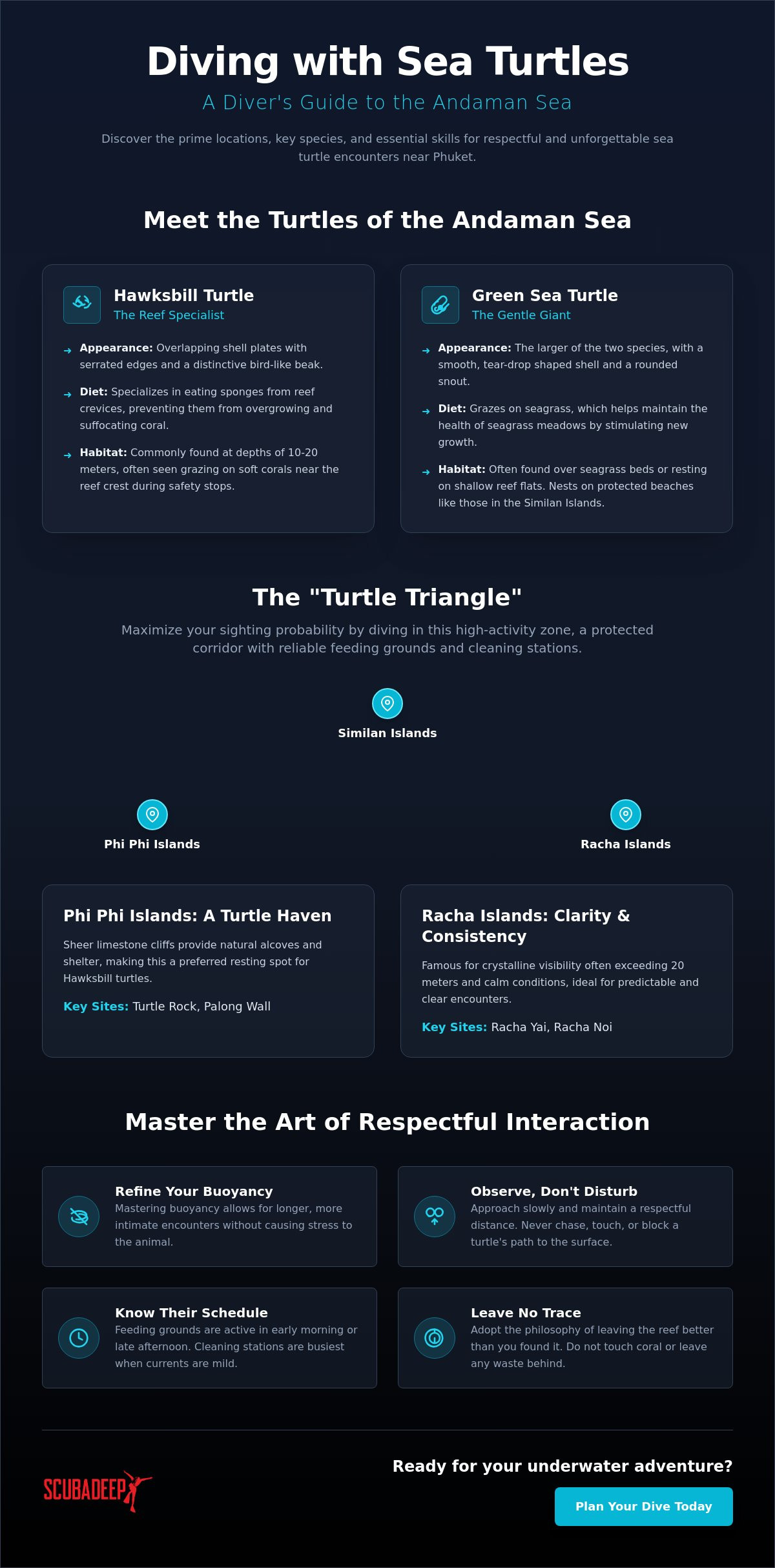
The waters surrounding Phuket serve as a vital sanctuary for marine reptiles that have traversed the oceans for millions of years. While four species frequent the Andaman_Sea, divers in this region primarily encounter the Hawksbill and the Green Sea Turtle. These species are strictly protected under Thai law, particularly within the boundaries of marine national parks where fishing and coral collection are prohibited. This protection is vital because these ancient travelers face global threats; Thailand's commitment to reef recovery and habitat preservation makes diving with turtles Phuket a world-class experience. We view every encounter as an opportunity to witness a success story in marine conservation.
The presence of these reptiles indicates a balanced ecosystem. When you see a turtle, you're seeing a reef that is functioning correctly. Their grazing habits prevent competitive exclusion among marine plants and invertebrates, which maintains the high biodiversity that Phuket is famous for. Protecting these habitats isn't just about the turtles; it's about the entire underwater architecture they support. For those who wish to extend this philosophy of environmental care to their own homes, Your Growing Companion offers a way to cultivate sustainable, organic gardens that mirror the balance found in nature.
The Hawksbill Turtle: The Reef Specialist
Easily identified by their overlapping shell plates and serrated edges, Hawksbills are the architects of a healthy reef. The Hawksbill turtle's unique, bird-like beak allows it to forage for sponges within narrow reef crevices, a specialized diet that prevents sponges from overgrowing and suffocating coral colonies. You'll often find them at depths between 10 and 20 meters, though they frequently ascend to the shallows. It isn't uncommon to spot a Hawksbill during your five-meter safety stop, where they graze on soft corals and anemones near the reef crest.
The Green Sea Turtle: The Gentle Giant
Green Sea Turtles are the larger of the two common species, characterized by a smooth, tear-drop shaped carapace and a rounded snout. Unlike the reef-dwelling Hawksbill, these gentle giants are often found hovering over seagrass beds or resting on shallow reef flats. They play a crucial role in maintaining the health of seagrass meadows by grazing on the blades, which stimulates new growth. While they spend most of their lives at sea, many return to the protected beaches of the Similan and Surin Islands to nest, continuing a life cycle that has remained unchanged for eons.
Prime Locations for Encountering Turtles Near Phuket
To maximize your chances of a sighting, you must understand the "Turtle Triangle," a high-activity zone formed by the Phi Phi Islands, the Racha Islands, and the Similan Islands. For those interested in diving with turtles Phuket, this region remains a stronghold for sea turtle conservation in the Andaman Sea. These parks act as protected corridors where resident turtles find reliable feeding grounds and essential cleaning stations. At these stations, small reef fish remove parasites from the turtles' shells, creating a stationary window for divers to observe natural behaviors without causing distress. The protection offered by the National Marine Parks ensures that these habitats remain undisturbed by commercial fishing, which directly correlates to the high sighting probabilities we see today.
Sighting a turtle is often a matter of knowing their schedule. Feeding grounds are typically active during the early morning or late afternoon, while cleaning stations are most frequented when currents are mild. By selecting sites that cater to these biological needs, we move beyond luck and into the realm of professional wildlife observation.
The Phi Phi Islands: A Turtle Haven
The Phi Phi Islands are widely regarded as a turtle haven. Sites like Turtle Rock and Palong Wall offer unique underwater topography where sheer limestone cliffs extend below the surface into the depths. These vertical walls provide natural alcoves and shelter from currents, making them preferred resting spots for Hawksbill turtles. When a turtle is tucked into a limestone crevice, it feels secure, allowing divers to observe them at a respectful distance. Because these sites feature varying depths and manageable currents, they are accessible to many experience levels. For a detailed breakdown of these locations and their specific underwater features, consult our Phuket dive sites guide.
The Racha Islands: Clarity and Consistency
If you prioritize water clarity and calm conditions, the Racha Islands are the premier choice for diving with turtles Phuket. Racha Yai and Racha Noi are famous for their crystalline visibility, which often exceeds 20 meters during the peak season. This high visibility is a significant advantage, as it allows you to spot these animals from a distance before you enter their personal space. It's a much more controlled environment for those who are still mastering their underwater skills. These islands are particularly beginner-friendly, providing a stable environment for those participating in a try scuba diving Phuket experience. The sandy bottoms and shallow reef patches make it easy to maintain neutral buoyancy while watching a Green turtle graze on the seabed. If you're ready to explore these sites with a professional team, our Fun Dive Phuket packages provide the expertise needed for a successful trip.
Essential Skills for Respectful Marine Life Interactions
As an Elite Mentor, your primary objective is to remain a silent, non-intrusive observer. When diving with turtles Phuket, your technical proficiency directly dictates the quality and duration of the encounter. If you are struggling with depth or flailing your fins, a turtle will perceive you as a chaotic threat and quickly leave the area. Professional interactions are built on the philosophy of leaving no trace and causing zero stress. This requires a heightened awareness of your trim and a deep understanding of marine life behavioral cues to ensure the animal feels secure in your presence.
Watch for subtle signs of stress before they escalate. If a turtle begins to swim away rapidly, makes a "yawning" motion, or tucks its flippers tightly against its body, you have entered its personal space. Increasing your distance immediately is the only professional response. Streamlining your equipment is also vital. Ensure your gauges and octopus are properly secured; dangling gear can snag on coral or startle an animal during a close pass. We believe that a disciplined diver is a more successful wildlife observer.
Mastering Neutral Buoyancy
Perfecting your buoyancy is the most critical skill for any wildlife enthusiast. By mastering the ability to hover motionless, you become a non-threatening part of the underwater landscape. This stillness often encourages curious turtles to approach you on their own terms. Instead of using aggressive fin kicks that create noise and silt, use subtle lung volume adjustments to control your vertical position. For those looking to refine these technical fundamentals, reviewing our scuba diving safety tips provides a professional framework for underwater stability.
The No-Touch Protocol and Approach Angles
Maintaining a strict no-touch policy is a matter of biological safety. Turtles possess a delicate protective mucus layer on their shells and skin that shields them from harmful bacteria. Human contact can strip this layer, leaving the animal vulnerable to life-threatening infections. When you approach, always maintain a 45-degree angle from the side. Never swim directly above a turtle or block its path to the surface. They are air-breathing reptiles and require a clear "chimney" to ascend when they need to breathe. If you want to reach this level of underwater composure, consider enrolling in our Advanced Open Water Course to master advanced buoyancy and environmental awareness.
How to Plan Your Turtle Diving Adventure in Thailand
A successful expedition is built on a foundation of logistics and local knowledge. While the Andaman Sea is home to these ancient reptiles year-round, your experience will vary significantly based on the month you choose to visit. Planning for diving with turtles Phuket requires a strategic approach to both the calendar and your choice of professional support. We recommend looking for dive centers that prioritize small group ratios and provide detailed eco-conscious briefings. These briefings should cover more than just the dive plan; they should educate you on the specific behaviors of the resident Hawksbill and Green turtles you're likely to encounter.
Preparation also involves mental composure. Wildlife encounters are never guaranteed, but they are highly probable when you align your trip with the right environmental factors. Arriving with a patient mindset and refined technical skills ensures that when the moment happens, you're ready to engage respectfully. Every detail, from the streamlining of your equipment to your understanding of local currents, contributes to the quality of the interaction.
The Best Time to Dive with Turtles
The peak season for diving with turtles Phuket runs from November through April. During this window, the Andaman Sea offers glassy surface conditions and crystalline visibility that often exceeds 25 meters. This is also the period when all National Marine Parks, including the Similan Islands, are fully accessible to the public. If you prefer a quieter experience, the shoulder months of May and October can be rewarding. While visibility may fluctuate due to plankton blooms, these nutrient-rich waters are exactly what attract foraging turtles to the reef. It's also worth noting that the nesting season for several species peaks between December and March, making these months particularly active for sightings near protected island shores.
Choosing Your Experience Level
Your certification level dictates the range of sites you can explore. For certified divers, a fun dive Phuket provides the most direct route to established turtle hotspots like Phi Phi or Racha Yai. A professional guide is indispensable here; they possess the "trained eye" needed to spot a camouflaged Hawksbill resting among soft corals. If you want to expand your horizons to more remote pinnacles or deeper cleaning stations where larger Green turtles often congregate, an advanced diving course Thailand is the ideal progression. This training refines your buoyancy and air management, allowing for longer and more stable observations in the water.
Elevate Your Underwater Encounters in the Andaman Sea
A successful turtle encounter is the result of technical preparation and a deep respect for the marine environment. You now understand that identifying the right species and selecting the optimal seasonal window are only the first steps. By mastering neutral buoyancy and adopting the "Elite Mentor" philosophy, you transform from a passive observer into a responsible steward of the reef. Whether you're navigating the vertical walls of Phi Phi or the clear shallows of Racha Yai, your commitment to these professional standards ensures that these ancient creatures remain undisturbed. It's a journey that requires patience and precision.
When you're ready for your next session of diving with turtles Phuket, our team provides the expertise and local knowledge required for a premier experience. We prioritize small group sizes to ensure better wildlife encounters while maintaining a strict focus on marine conservation. Our professional multi-lingual guides act as your consultants, helping you navigate the best-kept secrets of the Andaman Sea with high-tier safety standards. Book your guided turtle encounter with Scubadeep today and begin your next adventure. We're eager to share the hidden beauty of Thailand's reefs with you.
Frequently Asked Questions
Where is the best place to see turtles while diving in Phuket?
The Phi Phi Islands represent the premier choice for reliable encounters, particularly at the site known as Turtle Rock. This location features unique limestone alcoves that provide essential shelter for resident populations. For those who prioritize water clarity and calm conditions, the Racha Islands offer a high probability of sightings in a more controlled environment that is perfect for all experience levels.
Is it guaranteed that I will see a turtle during my dive trip?
No professional operator can guarantee a wildlife sighting; however, your probability is exceptionally high when visiting established feeding grounds. Sightings are influenced by tidal movements, water temperature, and the presence of cleaning stations. By diving with turtles Phuket experts who understand these ecological patterns, you align yourself with the highest statistical chances of a successful and serene encounter.
What should I do if a sea turtle approaches me underwater?
Maintain your position and remain perfectly still to demonstrate that you are not a threat. Neutral buoyancy is your most important tool in this scenario; use slow, controlled breathing to stay level without aggressive finning or sudden movements. You should never reach out or attempt to touch the animal, as this will likely startle it and immediately terminate the interaction.
Can beginners go diving with turtles in Thailand?
Beginners can certainly enjoy these encounters through introductory programs like a Try Dive or by enrolling in an Open Water Course. Many of the most popular sites, such as those at Racha Yai, feature shallow reef patches and sandy bottoms that are ideal for those still building their confidence. These environments allow new divers to observe marine life without the complications of deep water.
What species of turtles are most common in the Andaman Sea?
The Hawksbill and the Green Sea Turtle are the two species most frequently encountered by divers in this region. While Leatherback and Olive Ridley turtles also inhabit the Andaman Sea, they are much rarer to spot during a recreational dive. Hawksbills are easily identified by their bird-like beaks and serrated shell edges, while Green turtles are known for their larger size and smooth carapaces.
Are there any specific rules for photographing sea turtles in Thailand?
Photography must always be secondary to the welfare of the animal and the health of the reef. Avoid using high-intensity strobes or flashes in close proximity, as this can disorient the turtle and cause unnecessary stress. Professional etiquette dictates that you should never block a turtle's path to the surface or surround it with cameras, as they require a clear ascent path to breathe. Once you have captured your ideal shots, you can turn them into professional-grade keepsakes with Photobook Press.