

What if the postcard-perfect limestone cliffs of Phi Phi actually offer a more challenging underwater environment than the deep, open waters of Racha Noi? When weighing Phi Phi vs Racha Islands diving, most travelers struggle to balance the desire for high-intensity biodiversity with the need for manageable conditions. You want the sharks and turtles, but you also want the 30-meter visibility that makes for a seamless experience. It's natural to worry about missing out on bucket-list sightings or finding yourself in currents that don't match your current experience level.
We understand that every descent is an investment in your personal progression. This guide provides a definitive comparison to help you select the adventure that matches your certification and expectations for the 2026 season. We'll examine the technical differences in topography, the latest environmental regulations regarding underwater photography, and exactly where to find species like Blacktip reef sharks or Manta Rays. You'll gain the confidence to book a trip that aligns perfectly with your skill level and underwater goals.
Key Takeaways
- Contrast the high-intensity biodiversity of Phi Phi’s limestone reefs with the crystal-clear stability and deep-water potential found at the Racha Islands.
- Evaluate Phi Phi vs Racha Islands diving based on your technical skills to ensure your buoyancy control matches the specific needs of each ecosystem.
- Gain professional insights into the 2026 maritime regulations, including mandatory photography restrictions for divers below the Advanced Open Water level.
- Pinpoint the most effective locations for specialized training, such as utilizing Racha Noi for the Deep Dive Course or exploring the King Cruiser Wreck.
- Prepare for essential logistical requirements, including national park fees and mandatory reef-safe sunscreen, to ensure a seamless and compliant expedition.
Comparing Phi Phi and Racha Islands: The Ultimate Diving Comparison
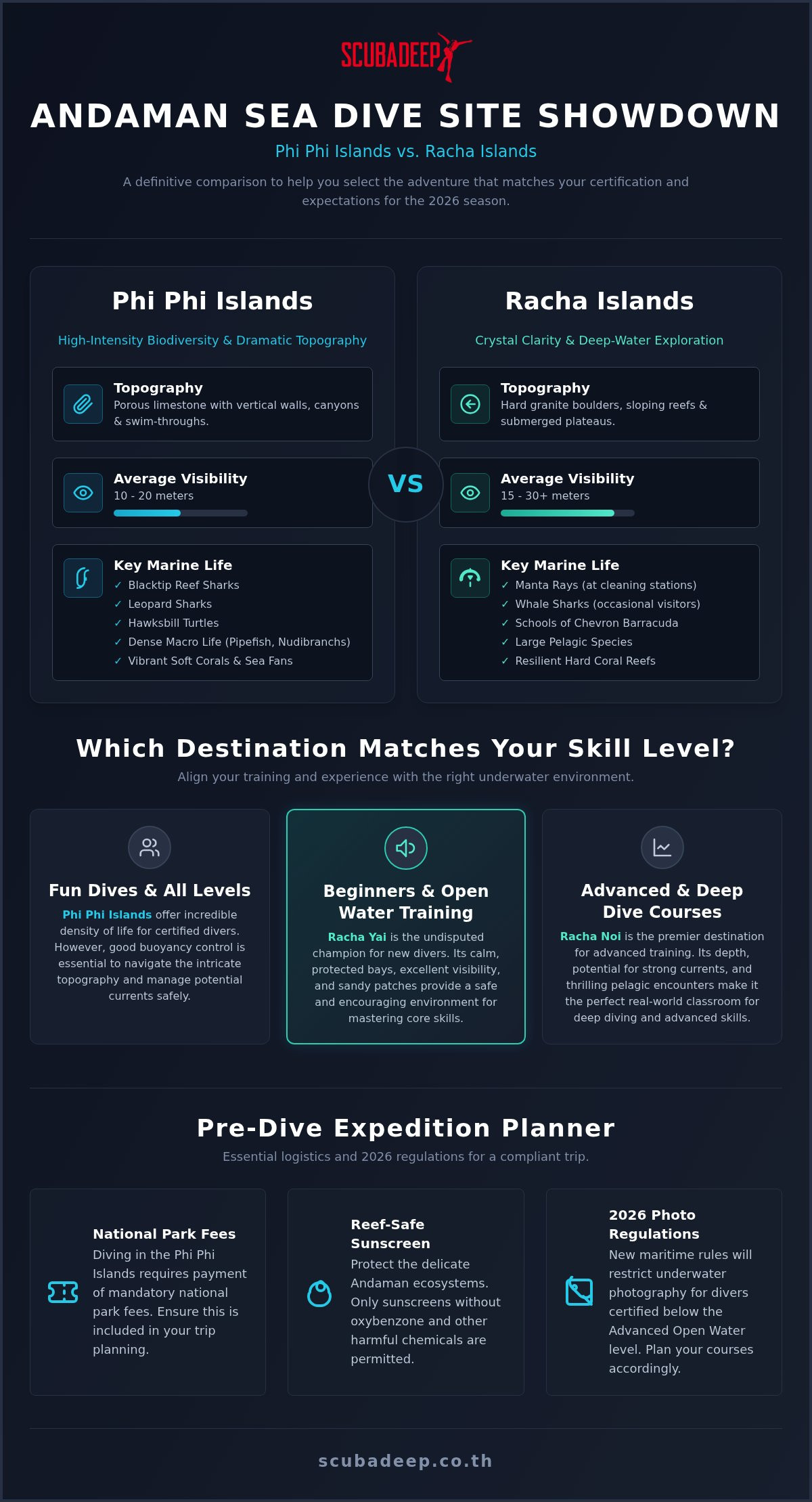
Choosing between these two destinations often defines your entire Thai holiday. Both serve as premier hubs in the Andaman Sea, yet they offer fundamentally different underwater experiences. Your decision on Phi Phi vs Racha Islands diving hinges on whether you prioritize dramatic topography and high biodiversity or exceptional water clarity and deep-sea exploration. While the optimal season for both runs from November to early May, their geological foundations create distinct playgrounds for every level of diver.
The primary differences are summarized by these environmental factors:
- Topography: Phi Phi features porous limestone with intricate crevices; Racha consists of hard granite boulders and sloping reefs.
- Clarity: Racha Islands average 15 to 30+ meters of visibility; Phi Phi typically ranges between 10 to 20 meters due to nutrient-rich currents.
- Marine Focus: Phi Phi is the global standard for reef sharks and turtles; Racha Noi offers a higher probability of seeing manta rays or whale sharks.
The Limestone Majesty of the Phi Phi Islands
The Phi Phi Islands are world-renowned for their dramatic vertical walls that plunge into nutrient-dense waters. These nutrients are the lifeblood of the reef, supporting an incredible density of soft corals and sea fans. Diving here feels like navigating a submerged mountain range. You'll find hidden swim-throughs and narrow canyons carved into the rock. This high-intensity environment makes it the ultimate location for a Fun Dive Phuket experience, where every corner reveals a new species of macro life or a resting leopard shark.
The Crystal Clarity of the Racha Islands
If your goal is endless blue water, Racha Yai and Racha Noi are the undisputed visibility champions. The granite boulder formations provide a stable, clean environment with significantly less suspended sediment than limestone sites. Racha Noi, the more remote of the two, offers a true deep-sea atmosphere. Its southern tip features massive submerged plateaus where strong currents attract pelagic giants. This stability and depth make Racha Noi the premier spot for an Advanced Open Water or a Deep Dive Course, where clear sightlines are essential for safety and skill progression.
Marine Life and Underwater Landscapes: Biodiversity vs. Visibility
The debate over Phi Phi vs Racha Islands diving often centers on what you want to see versus how clearly you want to see it. Phi Phi acts as a massive nursery of life, fueled by nutrient-dense currents that support vibrant soft coral gardens and sea fans. In contrast, the Racha Islands are characterized by resilient hard coral reefs and massive granite structures. While Phi Phi offers a consistent abundance of resident species, the Racha Islands rely on deep-water thermoclines and oceanic currents to bring in pelagic visitors. These cold water upwellings are the primary reason large rays and sharks frequent the Racha sites during the peak season.
Macro Wonders and Sharks at Phi Phi
Diving within the Hat Noppharat Thara–Mu Ko Phi Phi National Park provides unmatched access to iconic reef residents. You'll frequently encounter Blacktip Reef Sharks patrolling the shallow limestone edges and Leopard Sharks resting on the sandy bottoms. Hawksbill turtles are almost a guaranteed sighting at sites like Bida Ngao, often found grazing on sponges. For those with a keen eye for detail, the soft corals hide ornate ghost pipefish, seahorses, and nudibranchs. This dense biodiversity makes the area a favorite for photographers focusing on macro life, though the 10 to 20 meter visibility requires closer proximity to the subject.
Manta Rays and Big Fish Potential at Racha Noi
Racha Noi is the premier destination for divers seeking "big fish" encounters. Its southern tip is famous for the "washing machine" current, a powerful water movement that draws in Manta Rays to cleaning stations. Whale sharks are also occasional visitors here, emerging from the deep blue to cruise along the granite walls. Schools of Chevron Barracuda often hang in the water column, visible from great distances due to the superior 30-meter clarity. Unlike the resident-heavy reefs of Phi Phi, Racha Noi offers the thrill of the unexpected. It's a high-reward environment where deep-water visitors are the main attraction. To maximize your chances of these encounters, consider joining a Fun Dive Phuket trip led by experts who understand these complex current patterns.
Choosing the Right Site for Your Certification and Skill Level
Your certification level acts as a roadmap for your Andaman adventure. When evaluating Phi Phi vs Racha Islands diving, it's essential to consider how each environment tests your technical abilities. While Phi Phi offers breathtaking biodiversity, its fragile ecosystem demands high-level buoyancy control. Under the 2025 environmental regulations, divers must maintain a minimum distance of 2 meters from all coral. Along with this requirement, only those with an Advanced Open Water certification or at least 40 logged dives are permitted to use underwater cameras. These rules ensure the protection of the reef while challenging you to refine your trim and air consumption.
Beginner Friendly: Try Dives and Open Water Training
Racha Yai stands as the premier training ground for the region. Its shallow, sandy bays provide the perfect conditions for a try dive or initial Open Water sessions. The water is calm. The visibility is consistently high. This helps new divers manage anxiety by providing a clear, predictable environment. You can focus on your breathing and basic skills without worrying about the surge or depth found at more exposed sites. Racha's granite slopes offer a steady progression, allowing you to build confidence before moving toward more complex topography.
Ideal Locations for Advanced Specialty Training
Experienced divers looking to push their limits should look toward Racha Noi. It is the definitive location for a Deep Dive Course, offering stable granite walls that drop well beyond 30 meters. These sites prepare you for the technical demands of the King Cruiser Wreck, where visibility can drop and currents can shift rapidly. Mastering your navigation at Phi Phi and your depth at Racha Noi ensures you are a well-rounded diver ready for any challenge. Each site acts as a classroom, moving you closer to professional-level expertise.
Professional guidance is the key to a safe and rewarding progression. If you are ready to move beyond the basics, book your next Advanced Open Water Course with our elite mentors to gain the skills needed for Thailand's most iconic depths.
Planning Your Andaman Dive Expedition: Logistics and Expert Guidance
Executing a successful expedition requires more than just picking a destination. When finalizing your choice between Phi Phi vs Racha Islands diving, logistical preparation becomes the priority. A standard day trip begins with an early morning pickup, typically between 7:00 AM and 8:00 AM. You'll spend the transit time receiving thorough briefings on site conditions and reviewing scuba diving safety tips with your guide. Professional preparation also includes verifying your insurance and ensuring your equipment is configured for the specific depths of the day.
Essential items for your gear bag include:
- Your physical or digital certification card and logbook.
- Mandatory reef-safe sunscreen, which must be free of oxybenzone and octinoxate to comply with Thai law.
- A refillable water bottle to respect the single-use plastic ban on Phi Phi Leh.
- Cash for the Phi Phi National Park fees, which total 600 THB for divers as of August 2026.
Daily Trip Schedules and Boat Comfort
The journey to the Phi Phi Islands takes approximately 2 to 3 hours from the mainland pier. This longer crossing offers ample time for a full breakfast and detailed dive planning. In contrast, the Racha Islands are accessible in about 1.5 hours, making for a shorter day on the water. If you're prone to motion sickness, the Racha route is often the more comfortable choice. Regardless of the destination, you must account for a 18 to 24 hour "no-fly" window after your final ascent. Plan your departure flight accordingly to ensure a safe recovery period.
Why Professional Mentorship Matters
A premier dive experience relies on more than just the location. It depends on the expertise of an elite mentor who understands the subtle shifts in Andaman currents. Small group ratios are vital. They allow for a tailored pace and direct supervision, which significantly enhances both safety and the quality of marine life sightings. At Scubadeep, we prioritize these professional protocols to ensure every guest receives a sophisticated, guided journey through the region's best-kept secrets. Whether you're conducting a Fun Dive Phuket or a specialty course, our commitment to excellence ensures you go further with total confidence.
Secure Your Ultimate Underwater Adventure for 2026
Your choice between Phi Phi vs Racha Islands diving ultimately comes down to your personal objectives for the season. If you prioritize navigating dramatic limestone topography and encountering a high density of reef sharks, Phi Phi is your definitive destination. Conversely, if you seek the crystal-clear visibility of granite plateaus or need a stable environment for advanced training, the Racha Islands offer the premier blue-water experience. Both locations demand a deep respect for the 2026 environmental protocols to ensure these ecosystems remain pristine for future explorers.
Professional mentorship transforms a standard boat trip into a sophisticated journey of discovery. By choosing a partner that prioritizes safety and elite skill progression, you ensure every descent is both rewarding and responsible. Our team provides the expertise needed to navigate complex currents and find the region's most exclusive marine life sightings. It's time to elevate your underwater perspective and push your limits in the Andaman Sea.
Book Your Premier Andaman Dive Adventure with Scubadeep Today. We offer elite professional mentors, small group ratios for maximum safety, and comprehensive certification programs tailored to your goals. We look forward to guiding you through Thailand's most iconic depths.
Frequently Asked Questions
Is Phi Phi or Racha better for absolute beginners?
Racha Islands are generally superior for absolute beginners due to their shallow, sheltered bays and exceptional visibility. Sites like Racha Yai provide sandy bottoms and calm conditions that allow new divers to practice skills without the distraction of strong surges. While Phi Phi offers stunning reefs, the vertical walls and nutrient-rich waters often present more complex buoyancy challenges for those on their first descent.
Can I see Manta Rays at the Phi Phi Islands?
Manta Ray sightings are extremely rare at the Phi Phi Islands; you should head to Racha Noi for the best chance of an encounter. The deep-water cleaning stations at Racha Noi’s southern tip attract these pelagic giants during the peak season. When deciding on Phi Phi vs Racha Islands diving for big fish, Racha Noi is the clear winner for rays, while Phi Phi remains the choice for reef sharks.
How long is the boat ride from the mainland to these dive sites?
The boat journey from the Phuket mainland takes approximately 1.5 hours to reach the Racha Islands and between 2 to 3 hours for the Phi Phi Islands. These times vary based on the type of vessel and sea conditions on the day of your trip. The longer crossing to Phi Phi provides a great opportunity for a full breakfast and a comprehensive safety briefing before reaching the national park.
Do I need an advanced certification to dive at Racha Noi?
You don't strictly need an advanced certification for all areas of Racha Noi, but it is highly recommended for the more challenging sites like the South Tip. These deeper plateaus often experience strong currents and require precise buoyancy control. Divers holding an Open Water certification can still enjoy the shallower northern reefs, but an Advanced Open Water level unlocks the full potential of these granite formations.
What is the best time of year to dive in the Andaman Sea?
The optimal window for diving in the Andaman Sea is from November to early May. This period offers the calmest seas, minimal rainfall, and the most consistent underwater visibility. While diving is possible year-round, many of the more remote sites are best visited during these months when the weather patterns are stable and the marine life is most active across the region.
Are there sharks at the Phi Phi Islands dive sites?
Yes, sharks are a primary attraction at the Phi Phi Islands, particularly Blacktip Reef Sharks and Leopard Sharks. You'll often find Blacktips patrolling the shallow reef flats at sites like Palong Wall, while Leopard Sharks are frequently seen resting on the sandy patches at Bida Nok. These residents are a key factor in the Phi Phi vs Racha Islands diving comparison for those seeking consistent shark sightings.